In the IELTS Speaking test, especially in Part 2, candidates are often asked to describe a place. Whether it’s a flat you would like to own, a favorite spot in your city, or a historic landmark, the key to a strong answer is detailed and vivid description. This guide will walk you through a step-by-step framework you can use to effectively describe a place, whether it’s an outdoor or indoor location. Go here for Describe a Time or Event: The Ultimate Guide, and here for Describe a Person: The Ultimate Guide. Check out the latest IELTS Speaking Questions if you have your test soon.
Home > IELTS > Speaking > Part 2
Table of Contents
| Heading | Subheading |
| 1. Introduction to Describing a Place | |
| 2. Understanding the Question | – Common types of questions in IELTS Speaking Part 2 |
| 3. Essential Vocabulary for Describing Places | – Words and phrases for places |
| 4. Setting the Scene: Location and Description | – Prepositions of location |
| – Using expressions of size and shape | |
| 5. Describing the Appearance and Character | – Adjectives for character and appearance |
| – Describing the materials and structure | |
| 6. Explaining the Purpose or Significance | – Using the passive voice to express purpose |
| – Describing past habits related to the place | |
| 7. Expressing Popularity and Fame | – How to talk about why a place is famous or popular |
| 8. Discussing Why the Place is Special and Your Feelings | – Using conditionals to talk about preferences |
| – Using expressions for feelings | |
| 9. Concluding Your Monologue | – How to wrap up your description |
| 10. Grammar Focus: Tenses for Describing Places | – Past simple, present simple, and future simple |
| 11. Tips for Fluency and Coherence | – Linking phrases and cohesive devices |
| 12. Practicing for the Test | – Importance of regular practice |
| 13. Common Mistakes to Avoid | – Grammar and vocabulary pitfalls |
| 14. Sample Answer: Describing a Place You Visited | – Example structure and vocabulary |
| 15. FAQs for Describing Places in IELTS Speaking | |
| 16. Vocabulary & Grammar in More Detail | – More detailed examples from previous sections |
IELTS Speaking Part 2 Quiz: It Doesn’t Need to be Hell!


1. Introduction to Describing a Place
Describing a place in the IELTS Speaking test requires more than just listing facts. You need to create a vivid mental image for the examiner by focusing on key aspects: what the place is, where it is located, what it looks like, its purpose, and why it is significant to you. This guide will help you structure your response, enrich your vocabulary, and use appropriate grammar.
2. Understanding the Question
IELTS Speaking Part 2 includes a variety of questions about places, such as:
- Talk about a flat or house you would like to own one day.
- Describe a historic place in your country.
- Talk about a shopping center or mall you have visited.
The key is to focus on a specific place and describe it in detail. Make sure to address every part of the question: What is the place? Where is it located? What makes it special?
3. Essential Vocabulary for Describing Places
Choosing the right vocabulary is crucial for a clear and vivid description. Here’s a list of common words and phrases for describing places:
Types of Places
- Urban Areas: City, downtown, neighborhood, park, shopping mall
- Rural Locations: Village, countryside, mountain, forest
- Tourist Attractions: Historic site, museum, landmark, temple
Common Phrases
- In the heart of the city…
- Located on the outskirts of town…
- Nestled in the mountains…
These phrases help set the context for your description.

4. Setting the Scene: Location and Description
To help the examiner visualize the place, you need to clearly describe where it is located and what it looks like.
Prepositions of Location
Use prepositions to describe the exact location:
- In: In the city center…
- At: At the top of the hill…
- On: On the corner of Main Street…
- More
These prepositions guide the listener to understand where the place is situated.
Using Expressions of Size and Shape
Describe the physical characteristics of the place by mentioning its size and shape:
- A vast open space…
- A tiny, cozy cafe…
- A long, narrow street…
- More
These expressions help create a clearer picture of the place.
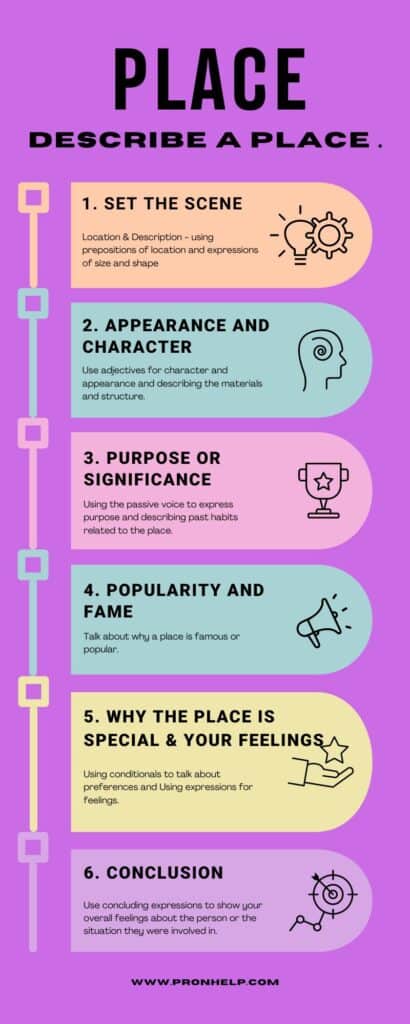
5. Describing the Appearance and Character
The appearance and character of a place can make it memorable. Use adjectives to bring your description to life.
Adjectives for Character and Appearance
- Positive: Majestic, vibrant, peaceful, charming
- Negative: Run-down, gloomy, dilapidated
- More
For example:
- The park is a peaceful oasis in the middle of the bustling city.
Describing the Materials and Structure
If the place is a building or structure, describe the materials it is made of:
- The building is constructed of red brick and has large glass windows.
- The old church is made of stone and covered with ivy.
These details add depth to your description.
6. Explaining the Purpose or Significance
Describing why the place is important or what it is used for can add context to your response.
Using the Passive Voice to Express Purpose
The passive voice can help explain the purpose or significance of a place:
- The museum was built to preserve local history.
- The park is used for community events and outdoor concerts.
This structure is useful for talking about well-known places or landmarks.
Describing Past Habits Related to the Place
You can also mention how the place was used in the past:
- I used to visit this park every weekend as a child.
- The library was once a gathering place for students.
- More
These expressions personalize your description and show your connection to the place.
7. Expressing Popularity and Fame
If the place you are describing is famous or popular, mention why:
How to Talk About Why a Place is Famous or Popular
- The city is famous for its historic architecture.
- This beach is popular with tourists because of its clear water and soft sand.
- More
These expressions highlight what makes the place stand out.
8. Discussing Why the Place is Special and Your Feelings
To make your description more engaging, explain why the place is special to you and how it makes you feel.
Using Conditionals to Talk About Preferences
Conditionals help you express your preferences and hypothetical situations:
- If I want to relax, I go to this park.
- If I had the chance, I would visit this museum again.
- More
These sentences show how the place fits into your life.
Using Expressions for Feelings
Describe your emotional connection to the place:
- I love this beach because it reminds me of my childhood.
- This park makes me feel calm and peaceful.
- More
These expressions add a personal touch to your description.
9. Concluding Your Monologue
It’s important to wrap up your description with a strong conclusion that summarizes why the place is significant to you.
How to Wrap Up Your Description
- Overall, this place holds a special place in my heart.
- In the future, I hope to visit this place again.
A clear conclusion helps reinforce your main points and leaves a lasting impression.
10. Grammar Focus: Tenses for Describing Places
Using the correct tenses is crucial when describing a place. Here’s a quick refresher:
- Past Simple: I visited the museum last year.
- Present Simple: The park is located near my house.
- Future Simple: I will visit this place again next summer.
These tenses help you convey when and how you interacted with the place.
11. Tips for Fluency and Coherence
To sound fluent and natural, use linking phrases and cohesive devices to connect your ideas.
Linking Phrases
- As a result…
- For instance…
- On the other hand…
- More
12. Practicing for the Test
Regular practice is essential to improving your ability to describe events. Try recording yourself, timing your responses, and practicing with a partner to get feedback.
Practice Techniques
- Mock Exams: Simulate real test conditions by timing your responses.
- Peer Feedback: Practice with a friend and provide constructive feedback to each other.
13. Common Mistakes to Avoid
When describing a place, avoid these common mistakes:
Grammar Mistakes
- Confusing tenses (e.g., using present tense when talking about the past)
- Incorrect use of prepositions (e.g., in versus at)
Vocabulary Pitfalls
- Overusing simple adjectives (e.g., good, bad) instead of more descriptive ones.
14. Sample Answer: Describe a Place You Would Like to Visit
Let’s look at a sample answer using the structure and vocabulary discussed:
Question: Describe a place you would like to visit.
Answer:
I’d like to talk about Kyoto, a historic city in Japan. Kyoto is famous for its beautiful temples and traditional wooden houses. It’s located in the central part of the country and is surrounded by lush mountains.
The city itself is quite large, but what really attracts me are the smaller, serene temples scattered throughout. I’ve seen pictures of Kyoto’s autumn scenery, with vibrant red and orange leaves covering the grounds, and I think it looks absolutely stunning.
Kyoto is not only a place of great historical significance but also a cultural hub. I would love to visit during the cherry blossom season, as I’ve heard the parks and riversides are breathtaking during that time. I imagine walking through the peaceful gardens and feeling a deep sense of tranquility.
Overall, Kyoto is a place I’ve always dreamed of visiting, and I hope to experience its unique blend of history and nature someday.
15. FAQs for Describing Places in IELTS Speaking
1. What should I focus on when describing a place?
Focus on the key details: what the place is, where it’s located, what it looks like, and how you feel about it.
2. How can I make my description more interesting?
Use vivid and varied vocabulary, talk about the significance of the place, and express your personal feelings to make your description more engaging.
3. Should I use past, present, or future tenses?
Use the present tense for describing the place in general, the past tense for any past experiences related to it, and the future tense if you’re talking about future visits or aspirations.
4. How long should my answer be?
Aim to speak for the full 1-2 minutes in Part 2, ensuring your answer is detailed but concise.
5. How do I conclude my answer?
End with a summary of why the place is important to you or how it makes you feel, using a concluding expression like “Overall, this is one of my favorite places…”
6. What if I run out of things to say?
Use linking phrases to expand on your points, and add related details if necessary, such as what you would do if you visited the place again.
Conclusion
Describing a place in the IELTS Speaking test is all about preparation and practice. By using the vocabulary, grammar structures, and techniques outlined in this guide, you can confidently describe any place with clarity and detail. Remember to practice regularly and focus on structuring your answers effectively to achieve success in your IELTS Speaking exam.
Prepositions of Location
Essential prepositions of location:
in + an enclosed or larger place
…in New York City…
…in the countryside…
…in the middle of nowhere…
at + a certain place or location
…at the top of the mountain…
…at the end of the street…
on + a surface or road
…on the fifth floor…
…on a main road…
…on the outskirts of the city…
over/ above + a certain place or location
…above a Japanese restaurant…
Every day the Chinese flag flies over Tiananmen Square.
next to/ beside/ by + a certain place or location
…by the seaside…
…next to the Bell Tower…
…beside South Lake…
opposite/across from + a certain place or location
I work opposite my favourite restaurant.
The Fruit Market is just across from Riddle Square.
between + two places or locations
Hue, which is between Saigon and Ha Noi,…
My house is between the mountains and the sea.
in front of + a certain place or location
The Bund in Shanghai is just in front of the main historic buildings.
The Virgin Mary Statue stands in front of Saigon Notre-Dame Basilica.
outside of (a town/ city)
Ben Duoc Temple is just outside of Vientiane.
There’s a fascinating market outside of the city centre.
near (to)
Nghe An, which is very near to Laos,…
New York City is near the sea.
far from
It would be far from the city centre.
The UK is extremely far from Japan.
Vocabulary for Size and Shape
It’s important to remember these adjective+ noun collocations:
a vast mountain range/landscape/lake/desert
a massive/gigantic/huge/enormous/immense building/ house/shopping complex/room
a cramped room/house/dormitory
a broad avenue/ street
a squat house/building
a tall/high building/mountain
a winding path/country road/mountain pass
a tiny/minuscule/incredibly small object/doorway/window
You can also use the following phrases to talk about the dimensions of the place: (number) metres/ kilometres by (number) metres/ kilometres
George Square is 320 metres by 100 metres.
(number) metres/ kilometres square
The size of West Lake in Hangzhou is about 6.5 kilometres square.
Vocabulary for Character and Appearance
Here are a few common adjective + noun collocations:
a(n) airy/well-lit/light/ dingy/horrible room/house/flat/dormitory
a dark/gloomy/dank cave/woodland
a murky river/lake/pool/stream
an awe-inspiring work of art/scene/panorama/building
a majestic building/statue
a thrilling scene
a significant area of town/spot/historic site/symbol of our city
Here are a few more common adjective + noun collocations:
a crumbling old building/wall
a tatty curtain/clothes/fabric/wooden structure
a run-down/shabby old building
a dusty room/building/yard
a(n) luxurious/opulent/sumptuous/upmarket/expensive palace/mansion/five-star hotel/ restaurant
If the place you are talking about is a building, you can also describe its appearance by saying what material the building is made of.
be made of + material
The Great Wall is made of thousands and thousands of bricks.
The ‘Gherkin’ building in London is made completely of glass.
material+ building
The Great Wall is an enormous brick wall.
The Pantheon in Rome is actually a concrete temple.
be covered in/with+ objects/designs
A city in southern China is completely covered in graffiti.
The roofs of the Forbidden City are covered with yellow tiles.
be decorated with + objects/designs
The mosque is decorated with dragons and flowers.
Lots of ancient tombs in Egypt are decorated with paintings of ancient Egyptian life.
be painted + colour
My dream house would be painted pink.
The building is painted white, just like the White House in Washington.
Linking Phrases
When you describe a place, you should say what things can be found there, or talk about the qualities the place has. To do this you should use linking phrases such as the following:
as well as…also…/as well as+ verb-Ing…also…
As well as being a place of great natural beauty, it is also a place of great historical significance.
besides…also…/ besides+ verb-ing…also…
Besides being one of the most popular music venues in the city, the bar also has great food.
in addition to…also…/ in addition to + verb-ing ..also…
In addition to having hosted the Olympic swimming contests, the Water Cube is also a fascinating piece of architecture.
along with, ..also…
Along with great shops and designer outlets, Parkson Paragon also has a number of handy restaurants.
not only.. but also…
Loch Lomond in Scotland is not only beautiful and tranquil, but it’s also a great place to do activities such as fishing and hiking.
both…and…
This gym is both conveniently located and reasonably priced.
Expressions to Talk about Past Habits
The place that you describe will often be somewhere you have a personal history with, or somewhere you have been many times. To describe this, the past simple, “used to” and other habit phrases are extremely useful.
the past simple
I visited the river at weekends and went swimming.
My girlfriend and I exercised at the gym.
Note: You can use adverbs of frequency with the past simple.
I always visited the river at weekends and went swimming.
My girlfriend and I regularly exercised at the gym.
used to
I used to spend many hours painting by the river.
My family used to spend every summer camping at Juniper Steep Waterfall.
habit phrases
If I felt stressed, I would go to the bar to relax.
When I needed some more designer clothes, my mother would go to the shopping mall near my home.
Popularity and Fame Expressions
Popularity and fame expressions will help you explain why the place you are describing is famous or popular.
be famous for + noun/verb-ing
be famous because + clause
be renowned for + noun/verb-ing
be noted for + noun/verb-ing
be popular with + types of people
be great for/excellent for/particularly good for + noun/verb-ing
Examples:
Chengdu is famous for the local cuisine.
The Grand Canyon is famous because it is so beautiful.
The Victory Hotel is renowned for the live music it has on the weekend.
The Cu Chi Tunnel is noted for its size and historical importance.
The new shopping mall is only really popular with wealthy people because the prices are so high.
The new sports centre is great for meeting like-minded sports enthusiasts.
The Zero & First Conditionals to Talk about Habits & Preferences
Let’s have a look at how Bertha, James and Catherine use the zero and first conditionals to talk about habits and preferences.
Use the zero and first conditionals to talk about what you like to do at the places you are talking about. You will sound much more natural if you can use these to talk about your habits and preferences.
Zero conditional
This is used to talk about things that are always true.
if/ when+ present verb, present verb
If l am hungry, I go to a restaurant.
When I am hungry, I go to a restaurant,
present verb+ if I when+ present verb
I go to a restaurant if l am hungry,
I go to a restaurant when I am hungry
First conditional
This is used to talk about things that might happen in the future if something else happens.
if+ present verb, will+ verb
If l have enough time, I will go shopping.
will+ verb+ if+ present verb
I will go shopping if I have enough time.
More information on Conditional Sentences
Expressions for How You Feel
Usually to describe a place, the one you decide to talk about will be one that is special to you. So, you should use some expressions to explain how you feel about the place and why it is special to you.
Look at the following useful expressions:
I like/love (the place) because…
I value (the place) because…
(The place) is important to me because…
(The place) makes me feel…
(The place) reminds me of…
(The place) provides me with..,
(The place) gives me…
(The place) lets me…
Examples:
I love the Greasy Spoon café near my house because the food is so great and such good value!
The British Museum always makes me feel inspired to learn more about other countries and cultures.
The Legion Field provides me and my friends with a pleasant, green space in which to play sports or just hang around.