
Improve Your Skills! Boost B2 First Speaking Part 2 by learning effective strategies for comparing and contrasting photos, time management, and techniques to improve your fluency! A reliable route to a confident Part 2, is to use dedicated practice, so you know exactly what to do regardless of the photos you are given. Here are some practice pictures and sample answers for B2 First Speaking Part 2.
Home > B2 First > Speaking > Part 2
Understanding B2 Speaking Part 2
You have very little time, so it is essential that you have a simple method to follow. As opposed to C1 Advanced, the main method in B2 First (apart from comparing, contrasting, speculating and using people vocabulary) is to fit the pictures you are given into your answer template. This does not mean you need to memorise answers, it means you know how you want to answer and put the information in the pictures you are given in your test into your method. This makes it much easier to practice too because you do not need to think of every question as completely new.
B2 First Speaking Part 2 Quiz: Only 1 Minute!


Use a Structured Answer Template
Why It Matters: Having a structured method to follow can save you valuable time and reduce stress during the exam. Instead of memorizing answers, focus on developing a flexible template that you can adapt to different prompts.
How to Implement It:
- Identify Key Elements: Quickly assess the photos by noting down key elements such as people, actions, locations, and emotions.
- Use the Ping-Pong Method: Rather than describing one photo fully before moving to the other, alternate between the two images. This method helps in maintaining a dynamic comparison and ensures you cover both images effectively.
Effective Comparison Techniques for B2 Speaking Part 2
1. Dynamic Comparison (Ping-Pong Method)
- Example:
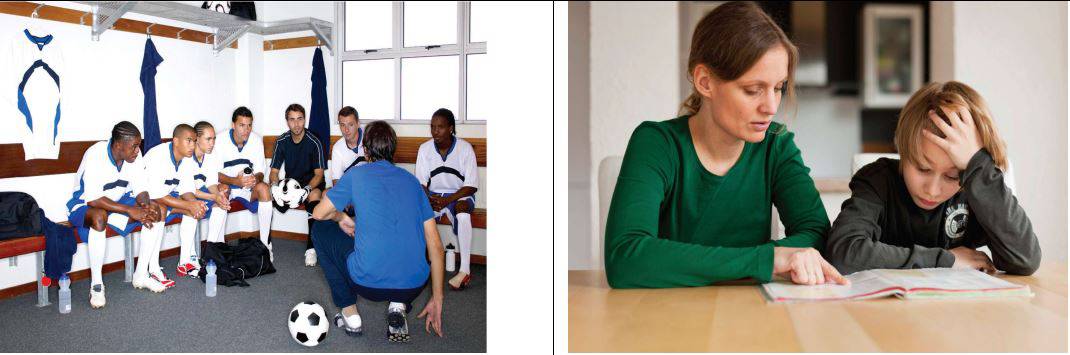
- Photo 1: A mother helping her son with homework.
- Photo 2: A football coach instructing his team.
- Approach:
- Start by describing one element from each photo, then switch to another element. For instance, describe the setting of Photo 1, then immediately compare it with the setting of Photo 2.
The question is
Why might it be important to give advice in these situations?
In the first picture, it looks as if there is a mother helping her son with his homework, while in the second picture, it looks as if there is a football coach telling his team how to win a game. In his mother’s eyes, it is important for the boy to study hard, so he passes his exams in my opinion. Saying that the coach may be giving advice on how to win a game in a competition, so the team will progress. Although the mother and the coach are both giving advice, there are only two people in the first photo, whereas, in the second, there are many more. A similarity is that both the son and the football team appear to be under pressure to succeed, but the mother and the coach are calmly working through the problems for the best results. On the other hand, there are still differences such as the team are all wearing football gear, while the mum and the boy are dressed casually. I guess they are at home, but the team seem to be in a changing room at some kind of sports facility.
2. Sequential Description
- Example:
- Photo 1: Mother and son at home.
- Photo 2: Football team in a sports facility.
- Approach:
- Describe Photo 1 first, covering all aspects, then move on to Photo 2. This method can be less effective if you struggle to maintain a clear comparison or if you run out of time.
In the first picture, it looks like there is a mother helping her son with his homework. In the mother’s eyes, it is important for the boy to study hard, so he passes his exams, in my opinion. There are only the two of them in the first picture and they look like they are at home. The boy looks like he is under pressure, but the mother is calmly working through the problem. It looks like they are at home, and they are dressed casually. In the second picture, it looks as if there is a football coach telling his team how to win a game. The coach may be giving advice on how to win a game in a competition, so the team will progress. He is also calm, while the players will be under more pressure to succeed in my opinion. The football team are wearing football gear and seem to be in a changing room at some kind of sports facility.

Differences
In the first example, if you hesitate (and you will because you are under pressure in an exam) you can still compare and contrast, and you can still answer the questions using your speculative language.
Problems
The problem with the second example isn’t the English, but it gives you fewer chances to use your comparing and contrasting language and it also doesn’t help if you pause to think. You could still be talking about the first picture when your time is over!!!!!
Tips for Effective Preparation
1. Practice with Sample Photos:
- Use practice photos and sample answers to familiarize yourself with different scenarios. This practice will help you refine your template and improve your response time.
2. Focus on Key Vocabulary:
- Incorporate relevant vocabulary related to comparing, contrasting, and speculating. This will enhance the quality of your response and demonstrate your language skills.
3. Time Management:
- Prepare how to use your one-minute wisely. Learn your template, so you can focus on the main points you want to cover.
4. Avoid Memorization:
- While it’s essential to practice, avoid memorizing responses. Instead, focus on understanding how to structure your answers effectively.
Practice Tips for Different Scenarios
For Digital Tests:
- Get accustomed to typing your responses quickly and accurately.
For Paper-Based Tests:
- Write clearly and practice making corrections that are easy to read.
Conclusion
By implementing these strategies, you’ll be well-prepared to tackle B2 First Speaking Part 2 confidently. Remember, effective planning and consistent practice are key to mastering this part of the exam. Keep honing your skills, and you’ll find yourself more fluent and ready to succeed. Good luck!