
Get the Facts! CAE writing assessment criteria for you to master your C1 Advanced writing tasks. Improve by using the C1 writing rubric to your advantage. Discover exactly how to improve each part of your C1 writing score NOW!
Home > C1 Advanced > Writing > General
C1 Advanced Writing Part 1 Quiz: Give It Your Best!


Learning how your writing assignments are scored is arguably one of the most challenging aspects of the C1 Advanced test. My students frequently ask me about this, but it’s tough to explain everything in a minute or two in a writing lesson. So, I decided to write everything down for you. This way, you’ll have all the knowledge you need, and you’ll be able to come back to this site anytime you want to learn more about how to make your CAE texts achieve higher grades.
There are four key factors that examiners use to grade your writing:
1/ Content – answering the question completely and relevantly
3/ Organisation – using logical paragraphing, cohesion, coherence and referencing
4/ Language – vocabulary and grammar
The full C1 Advanced writing assessment scales can be downloaded here.
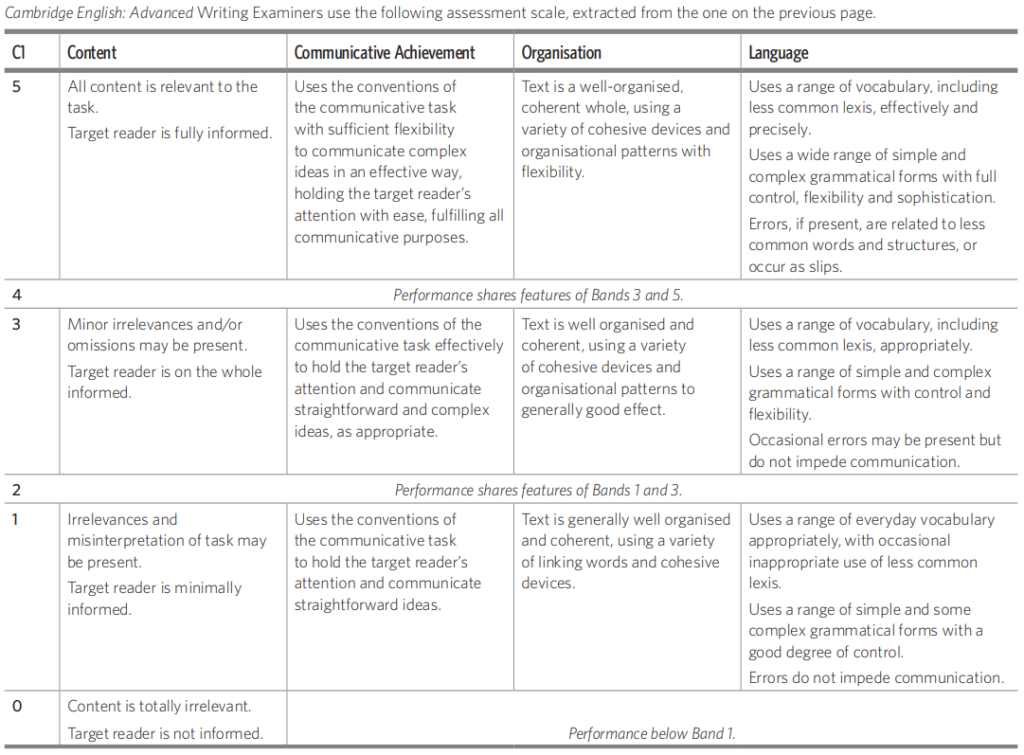
The scales are all marked out of 5, so when you practice you will get a score between 0 and 20 for each text. There are two texts, so the total mark will be from 0 to 40.
But how does that relate to the scores you see of 180 to 200 that you see on the certificates? Examiners have their own marking system, while we need to use this marking rubric which is available to the public. Fortunately, there Cambridge have provided conversion charts so you can compare your practice scores to the real results you need to pass.
Now, we need to go into greater detail since the four assessment scales in C1 Advanced examine varied and particular areas of your writing ability. You will only receive good grades if you can demonstrate a high level in all four, so let’s look at each scale in detail.
Content
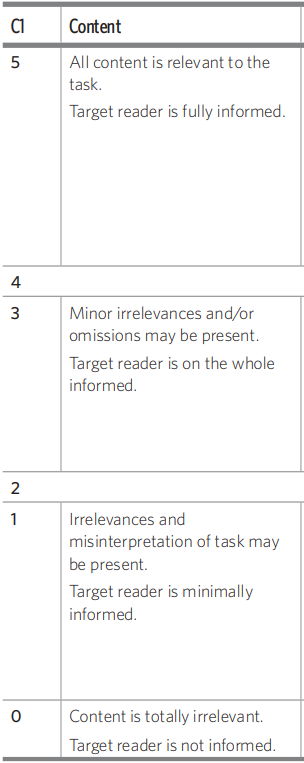
It is essential that you review the Content scale in order to fully understand how it works. For this category, the examiner sees if you completed the assignment, answered it thoroughly and fully informed your reader.
Here is an example.
Your class has had a discussion on the value of competitive sport for young people. You have made the notes below.
What is the greatest value of competitive sport for young people?
– positive attitude
– healthy lifestyle
– use of time
Some opinions expressed in the discussion
‘It can make young people overly competitive, then they don’t learn to help each other or learn to co-operate.’
‘It’s good to exercise because a healthy body means a healthy mind – winning irrelevant’
It takes up too much time and takes away from important things like studying.’
Write an essay discussing two of the points in your notes. You should explain which is the greater value of competitive sport for young people, giving reasons in support of your answer.
You may, if you wish, make use of the opinions expressed in the discussion, but you should use your own words as far as possible.
This is a typical CAE Writing Task 1 essay question. As with essay questions in most English tests, the question actually tells you what to do. All you need to do is to know how to look for the clues.
The main question is in the box on the the left hand side.
As you are told under the two boxes, you only need to talk about two of the three options: a positive attitude, a healthy lifestyle or use of time. There is no correct choice, it is up to you.
You must also explain which facility is most important. Again, this is a matter of choice.
It is essential that you support that choice with reasons and examples in your answer.
Forgetting about one of these points will reduce your score for your writing test, so practice and get an experienced teacher to mark your papers and give you detailed feedback on what you are doing right and wrong.
To sum up, most C1 Advanced Task 1 essays have the same format, so if you practice following the instructions the task gives you, you should have no problems here. Again, corrections and feedback from an experienced teacher will not only improve your writing, it will improve your confidence and therefore your score.
Communicative Achievement
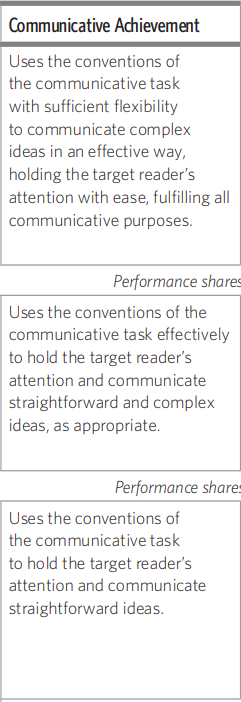
Although it isn’t always obvious, all of the elements required to effectively convey your thoughts are included in this scale. Have you decided on the most appropriate register (formal, neutral, or informal)? Have you been able to clearly explain your thoughts? Is your writing hard to follow or have you managed to keep the reader’s attention?
It is essential that you know who is going to read what you have written. In task 1, it is usually a teacher of some kind, while in Task 2, it can be anybody from your best friend to a local government official or sports fan to a TV producer as you can see from the following examples.
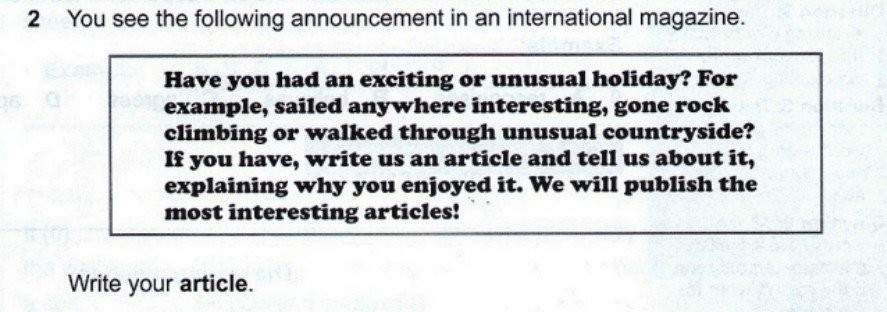
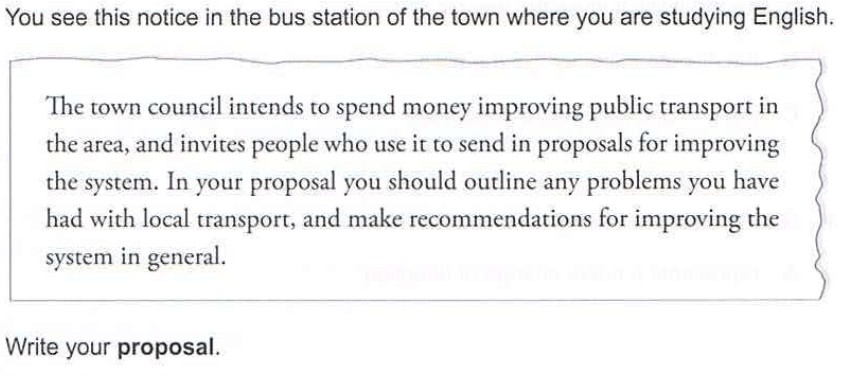
In the first example about writing an article for an international magazine, you should write in semi-formal conversational English so you speak directly to your readers, while in the second, it should be formal because you are writing to talk about the serious issue of improving the local public transport system. Imagine if you swapped the two! It would be really boring to read a website article in formal English, and any proposal that wasn’t formal would probably be instantly rejected!
Another thing to think about before you start writing is the difference between each type of writing task. A proposal, a review, a letter or email or an article. Which are you in need of a title? Which need subheadings, an introduction/conclusion, a greeting, and/or a salutation? What are the differences in how you would greet a friend or an official? These are all important questions to ask yourself, and the answers will only come to you quickly and easily if you practice.
Your ability to clearly explain your thoughts and keep the reader’s attention is assessed in Communicative Achievement. When you proofread, you should get the impression that your ideas are clear and easy to follow even for someone who is unfamiliar with the subject.
In conclusion, Communicative Achievement assess if you use the correct layout for the task, the correct tone as well as how successfully you express your ideas.
Organisation
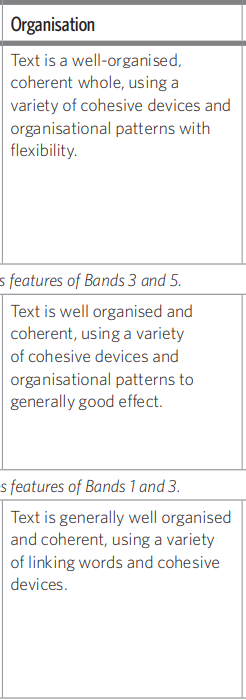
Organisation is more constant across the question types. This marks how you paragraph your answer, how well you use coherence and cohesion as well as referencing. Let’s talk more about each one.
Paragraphing – In an essay for C1 Advanced, there should be an introduction, two body paragraphs and a conclusion. This is more or less the same for each format, but there are slight differences. I plan to write another more detailed post about paragraphing so I don’t want to go into too much detail here, except to say this. If you don’t write a conclusion to an essay, it is considered unfinished. Even if you leave the second body paragraph incomplete and write a rough conclusion, it will get you a higher score than finishing the body paragraph.
Coherence – This is the flow of your ideas, which is best done in the planning stage. If the reader is told about two choices A and B in the introduction, then the first body paragraph should be about a and the second about B. If they are then compared at some point A is compared to B, not B to A. Paragraph topic sentences also create coherence because they show the reader what is coming in this paragraph.
| Good Coherence | Poor Coherence |
| Many people believe that social media is essential for modern communication; however, it also has drawbacks, such as reducing face-to-face interactions. For instance, studies show that excessive screen time can negatively affect mental health, leading to issues like anxiety and depression. Therefore, it is important to balance online activities with real-world interactions to maintain overall well-being. Why It’s Good Clear logical flow: each sentence builds on the previous one. Appropriate linking words (however, for instance, therefore) connect ideas smoothly. Ideas develop logically from problem (social media drawbacks) to example (negative effects) to solution (balance). | Social media is popular. Many people use it. Screens are bad. Health is important. Talking to people is good. For example, it is sunny outside. This is why social media matters. People feel sad sometimes. Exercise is fun. Why It’s Poor No logical flow: the sentences are unrelated or jump between unrelated ideas. Lack of linking words: no connections between ideas, making the text disjointed. Ideas are vague and do not develop or support a central point. |
Cohesion – This is the flow of your English rather than your ideas and can be done by using cohesive devices such as Furthermore, firstly, secondly, finally, however, in reality, in conclusion, and so on. These should be used when linking ideas in sentences or paragraphs to create a flow so the text is one part rather than a collection of smaller parts.
| Good Cohesion | Poor Cohesion |
| Example: “Learning a foreign language is a challenging yet rewarding experience. For instance, mastering new vocabulary can significantly enhance your ability to communicate effectively. Moreover, understanding the culture associated with the language often deepens your appreciation of its nuances.” Why cohesive? The sentences use linking words (“For instance,” “Moreover”) and maintain a clear topic focus on learning a language. Example: “The government has implemented several policies to address climate change. As a result, renewable energy usage has increased, and carbon emissions have decreased. These improvements highlight the importance of continued investment in green technology.” Why cohesive? Pronouns (“these improvements”) and connectors (“As a result”) create logical flow and reference earlier ideas. | Example: “Learning a foreign language is hard. Words are important. Some people learn fast. Grammar is also important.” Why not cohesive? The ideas are disjointed, with no linking words or logical progression. Example: “The government has policies. Green technology is important. Investments should be made. Emissions are lower now.” Why not cohesive? There is no clear connection between sentences, and the topic shifts abruptly without explanation. |
Referencing – This means using words such as they, their, these, that, and so on to keep referring back to people or things in previous sentences. This acts as glue to bind sentences and paragraphs together. Be careful not to refer to something to far back, or it will create confusion rather than cohesion.
| Good Referencing | Poor Referencing |
| The first text argues that online learning is more accessible for students. This claim is supported by data showing a 30% increase in student participation since 2020. Although some people believe that electric vehicles are expensive, the second passage contradicts this view, highlighting subsidies and falling battery prices. As mentioned in the first paragraph, climate change is a global issue. This idea is reinforced by the author’s use of statistics from the United Nations. | Online learning is more accessible for students, and many people participate in it. It is said somewhere that participation increased in recent years. The second passage says electric vehicles aren’t too expensive, but some people disagree. This is unclear, and it doesn’t explain much. Climate change is important, as stated in the first text. This is obvious, and the second passage doesn’t explain anything new. |
As far as the different question types are concerned, you should practice so you know both what is expected of you and how to achieve it.
When everything is said and done, Organisation assesses your ability to write your task in a logical manner, with paragraphs separating important ideas and linking devices connecting them.
Language
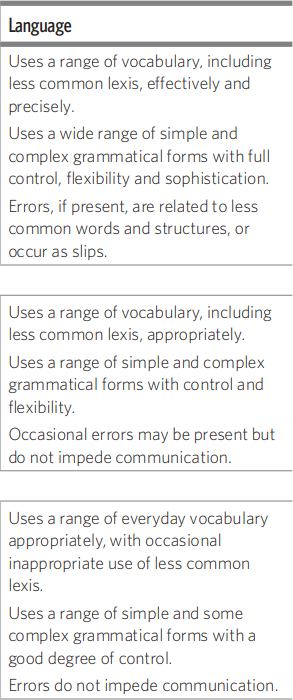
Arguably the easiest of the four marking scales, Language evaluates how well you utilize grammar, your vocabulary range and if your errors impede communication.
As can be seen from the rubric above, less common lexis is needed for higher scores in this scale. This means that you should use collocations and phrases that are natural as well as phrasal verbs and idioms in less formal question types. Using more difficult vocabulary is also good, but NOT words that no one ever uses these days. That is the road to confusion and a low score. Using phrases that go together naturally such as family gathering, absolutely fantastic or distinguished scholars will help you to higher score.
As far as grammar is concerned, control, flexibility and range are they keys. Control means that you should say what you want to say without error. Flexibility is being able to say similar things in different ways, while range means that you should try and show what you can do rather than just completing the task if you are looking for a higher score. If not, then being safe is maybe better advice.
In conclusion, if you just answer the question using simple grammar and vocabulary, then you will get a simple score. Preparation is essential to score well here, because then you can learn which grammar and vocabulary fit well into different parts of your writing task. Once you reach that stage, a higher score is ensured.
Examiners assess several different areas of your abilities while marking C1 Advanced writing. You must demonstrate that you are competent in all areas, but with the correct information and tools, you can succeed. Improve your weaknesses, build on your strengths and begin practicing now.
There is vocabulary for C1 Advanced writing here.
FAQ: Cambridge C1 Advanced Writing Rubric
1. What are the main criteria used to assess my writing?
Your writing is assessed using four main criteria:
- Content: Have you addressed the task appropriately and fully?
- Communicative Achievement: Is your writing appropriate for the genre, audience, and purpose?
- Organization: Are your ideas logically structured and well-connected?
- Language: Do you use a range of vocabulary and grammar accurately and appropriately?
2. What does “Content” mean in the rubric?
Content assesses whether:
- You have followed the instructions.
- You have included all necessary points and avoided irrelevant details.
- Your ideas are clear and sufficiently developed.
Tip: Always reread the task to ensure you’ve included all required points.
3. What is “Communicative Achievement,” and why is it important?
This criterion evaluates:
- Whether the tone and style suit the task (e.g., formal for a report, informal for an email to a friend).
- How well you engage the reader.
- Whether your writing achieves its purpose (e.g., to persuade, inform, or describe).
Tip: Pay attention to who your audience is and adapt your language accordingly.
4. How does “Organization” affect my score?
Organization looks at how well you structure your writing:
- Are paragraphs clear and logically connected?
- Do you use linking words (e.g., however, in addition, therefore) appropriately?
- Is your text cohesive, with ideas flowing naturally?
Tip: Use planning time to organize your ideas before writing.
5. What does “Language” cover?
Language assesses:
- Your range of vocabulary: Is it varied and appropriate for the task?
- Your grammatical range: Do you use complex structures accurately?
- Your accuracy: Are there frequent errors, or is your writing mostly error-free?
Tip: Use a mix of sentence structures and avoid repeating the same words or phrases.
6. Will I lose marks for spelling mistakes?
Minor spelling errors won’t severely impact your score, but consistent errors can lower your Language score. Focus on accuracy and proofreading.
7. Is it better to write more than the word limit?
Writing more is not necessarily better. Stay within the word limit (220–260 words for most tasks).
- Writing too much may lead to irrelevant content and organizational issues.
- Writing too little might mean you haven’t developed your ideas enough.
8. How can I improve my coherence and cohesion?
- Use linking words to connect ideas logically.
- Avoid overusing the same connectors (e.g., don’t start every sentence with “and” or “but”).
- Group related ideas into clear paragraphs.
Tip: Practice writing outlines before completing tasks.
9. What happens if I don’t follow the task type?
If you write in the wrong format (e.g., writing a letter instead of a report), your Communicative Achievement score will drop significantly. Always ensure you know what type of text is required.
10. Can I use informal language in the exam?
It depends on the task:
- Informal language is acceptable for letters/emails to friends.
- Formal or neutral language is required for essays, reports, and proposals.
Tip: Identify the level of formality required before you start writing.
11. How can I expand my vocabulary for the exam?
- Read widely (newspapers, academic articles, blogs) to learn new words.
- Practice using synonyms to avoid repetition.
- Create topic-specific word lists (e.g., education, environment).
12. What’s the best way to prepare for the Writing test?
- Practice writing each text type: essays, reports, proposals, letters, and reviews.
- Get feedback on your work from a teacher or peer.
- Time yourself during practice to simulate exam conditions.