There is a lot of confusion about the pronunciation of words that end in the letter S, especially plurals, which is why it is one of the most common pronunciation errors. There are three final sounds to these words, /s/ and /z/ are two of the sounds that occur, while the third possibility is /iz/. Watch the video and learn the pronunciation final s rules and examples. Record, listen and assess your pronunciation for instant improvement!
Pronunciation Difficulties and Practice
Many think that the /z/ sound is an easy sound to make, but when they hear another student, they think they are wrong. It is the voiced sound of /s/ which is so common in many languages. But to get that voiced sound with the sound in the throat and the tongue behind the teeth, it can be quite difficult for some. If you would like to practice ‘s’ endings by yourself, try speaking the words into Google translate, or another translation app.
* Please remember that English pronunciation is important, but in different ways to many languages. In some languages, such as Chinese, different pronunciations of the same characters change the meaning. Because of this pronunciation in such languages is crucial.
Although there are difficult sounds in English, most pronunciation difficulties are associated with word stress rather than tone.
So, do you need to learn which plural nouns end with which sounds or are there rules? Well, you are in luck. There are some rules.
Pronunciation of Voiced and Unvoiced Sounds
First, let’s talk about the difference between voiced and unvoiced sounds.
Voiced Sounds
Voiced sounds are sounds that come from your throat. If you put two fingers to your throat, when you say sounds like /b/, /v/, /m/, you can feel your throat vibrate. This is the ‘voice’ of the voiced.
The voiced phonemes are: /b/, /d/, /ʤ/, /g/, /v/, /ð/, /z/, /ʒ/
Unvoiced Sounds
Unvoiced sounds are sounds that don’t make your throat vibrate. For example, /f/, /s/ and /p/.
Unvoiced phonemes (not including vowel sounds) are: /p/, /t/, /ʧ/, /k/, /f/, /θ/, /s/, and /ʃ/
Sibilant Sounds
There is another sound that is important. The sibilant sound can be unvoiced or voiced but is similar to an /s/ sound, or a sound that hisses or buzzes. For example, /s/, /z/ etc
Sibilant letters are: c, s, x, z, ss, ch, sh, ge
| Voiced | Unvoiced | Sibilant |
| /b/ | /p/ | c |
| /d/ | /t/ | s |
| /ʤ/ | /ʧ/ | x |
| /g/ | /k/ | ss |
| /v/ | /f/ | ch |
| /ð/ | /θ/ | sh |
| /z/ | /s/ | ge |
| /ʒ/ | /ʃ/ |
Rules for the Pronunciation of final ‘s’
Final s Rule 1/
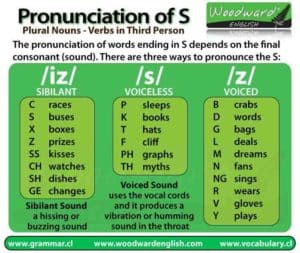
If the original final sound before the s is voiced, then the pronunciation of the plural s is /z/ for example, words, deals, fans etc.
Final s Rule 2/
If the pronunciation of the plural s is /s/ then the final sound before that s must be unvoiced. For example, books, hats, myths etc
Final s Rule 3/
But if the final sound before the s is sibilant, then the ending is /iz/ which also adds another syllable to the word. So go from kiss to kisses, race to races and bus to buses.
Match the words with the correct plural ‘s’ sound


Below is an excellent infographic from Woodward English that explains all this very clearly.
Common Errors with Final ‘S’
Pronouncing the final -s in English can be challenging for learners, especially because its pronunciation varies depending on the word. Here are some common errors students make:
1. Using the Wrong Sound
The final -s has three possible pronunciations:
- /s/ (e.g., cats)
- /z/ (e.g., dogs)
- /ɪz/ or /əz/ (e.g., dishes)
Errors:
- Pronouncing all final -s as /s/ regardless of the preceding sound:
- Saying /dɒgs/ for dogs instead of /dɒgz/.
- Pronouncing /ɪz/ where it doesn’t belong:
- Saying /kæt-ɪz/ for cats instead of /kæts/.
2. Omitting the Final -s
Students often drop the -s entirely, especially when it marks:
- Plural nouns: three cats becomes three cat.
- Third-person singular verbs: She runs becomes She run.
- Possessives: John’s car becomes John car.
3. Adding the Final -s Where It’s Not Needed
Some learners overgeneralize and add an -s:
- Saying she reads books every days instead of every day.
- Overusing possessives: This is Johns’ car instead of John’s car.
4. Not Distinguishing Between Voiced and Voiceless Sounds
The pronunciation of -s depends on whether the preceding sound is voiced or voiceless:
- Voiceless sound → /s/ (e.g., cats).
- Voiced sound → /z/ (e.g., dogs).
Errors:
- Saying /dɒg-s/ for dogs instead of /dɒgz/.
- Saying /kæt-z/ for cats instead of /kæts/.
5. Overemphasizing the Final -s
Learners sometimes exaggerate the -s, especially when trying to be accurate:
- Saying dogsss or booksss.
FAQ: Pronunciation of Final -S in English
1. Why does the final -s sound different in different words?
The final -s is pronounced differently depending on the sound that comes before it. English uses three pronunciations:
- /s/ after voiceless sounds (e.g., cats).
- /z/ after voiced sounds (e.g., dogs).
- /ɪz/ after sibilant sounds (e.g., dishes).
2. How can I tell if a sound is voiced or voiceless?
A sound is voiced if your vocal cords vibrate when you pronounce it (e.g., b, d, g, z). It is voiceless if your vocal cords don’t vibrate (e.g., p, t, k, s).
Tip: Place your hand on your throat to feel the vibration.
3. What are sibilant sounds?
Sibilants are sounds made by hissing or buzzing, like s, z, ʃ, ʒ, tʃ, dʒ (e.g., the sounds in hisses, buzzes, or wishes). After these sounds, the final -s is pronounced /ɪz/ or /əz/.
4. Can you give examples of the three pronunciations of -s?
- /s/: cats, hats, kicks.
- /z/: dogs, beds, runs.
- /ɪz/: dishes, watches, boxes.
5. What are common mistakes when pronouncing the final -s?
- Pronouncing all -s as /s/.
- Omitting the -s, especially in plurals (three cat instead of three cats).
- Adding -s where it’s not needed (everydays instead of every day).
- Overemphasizing the -s, saying dogsss instead of dogs.
6. How can I practice the correct pronunciation of final -s?
- Listen and repeat: Use audio recordings to hear the correct pronunciation.
- Practice minimal pairs: Compare similar words (e.g., cats vs. dogs).
- Learn the rules: Focus on voiced, voiceless, and sibilant sounds.
- Record yourself: Play it back to identify any errors.
7. Does the pronunciation of -s change in connected speech?
Yes! In connected speech, native speakers may soften or blend the sound. For example, She runs every day might sound like She runsevery day. Practicing with natural sentences can help you understand these changes.
The rules apply to most cases, but proper nouns, irregular plurals, and regional accents may influence pronunciation. For example, the plural of children is pronounced with a /z/ sound: children’s.
Conclusion
So, there you have it, there are three endings /z/, /s/ and /iz/, and there are clear rules to use. But remember this is English, so somewhere there will be an exception.
Good luck, see you next time and thank you for reading.
If you have any comments post them below. If you like this post, please share it as much as you like.
beneficial and clear explanation.
Thanks
Thanks,this was really helpful for me
Useful but what about thé prononciation of final s in words liké countries babies parties is it z or iz
Thank you for the comment, Salam.
The originals of these words all end in an /i/ sound, such as baby, party and country.
When you change the letter ‘y’ to ‘ies’ for the plural, you keep the /i/ sound and add a /z/ making the whole word end in /iz/.
I hope that helps.
good
Very useful
Very well explained, clear, and useful. Thanks for your help.