
One of the most effective ways to prepare for your C1 Advanced Speaking test is to watch this official test video. Such videos provide a realistic view of the test, showcasing what happens during the exam and how candidates are assessed.
1. Watch Official C1 Advanced Speaking Videos
After watching, take the time to read the examiners’ comments. Go through the video again, step by step, while comparing your own thoughts with the official feedback. This approach allows you to recognize key areas for improvement and gives you a clear understanding of what examiners are looking for in each part of the test.
Also watch these videos
Click on the image for the video and click here for the examiners’ comments on how Pedro and Isabella performed in their C1 Advanced Speaking test.
Click on the image for the video and click here for the examiners’ comments on how Teresa and Antonio performed in their C1 Advanced Speaking test.
More tips and general advice on the C1 Advanced Speaking test

2. Understand the C1 Advanced Speaking Test Format
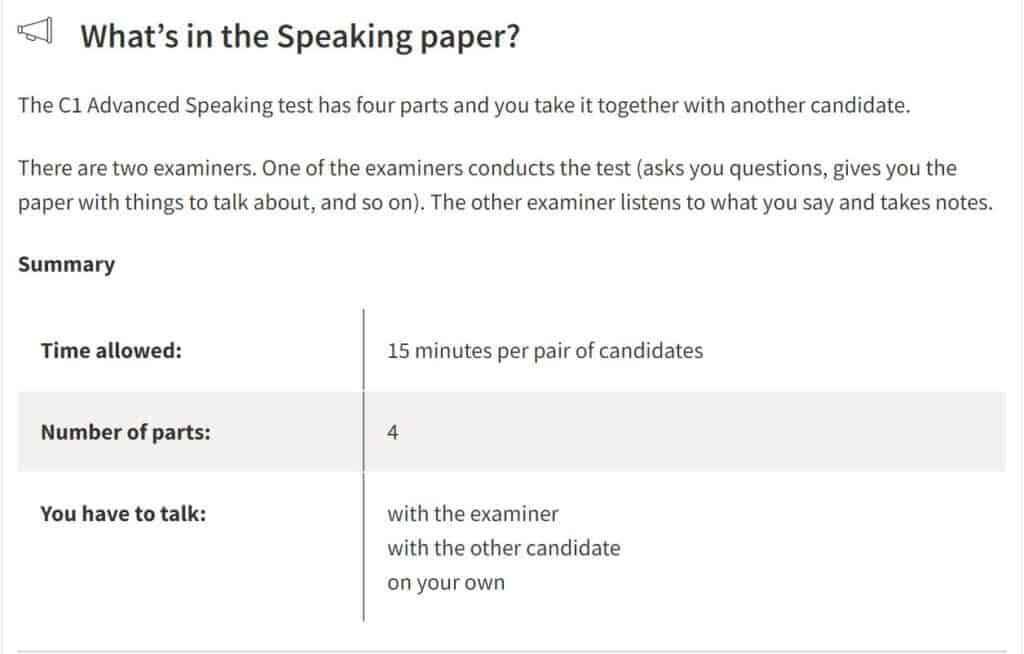
Memorizing the structure of the C1 Advanced Speaking test is crucial. Knowing the order of tasks helps reduce anxiety and ensures you are prepared for what comes next. You’ll need to navigate through various parts of the test, including answering personal questions, comparing pictures, and engaging in a discussion with another candidate.
To familiarize yourself with the test structure, check out the official Cambridge guidelines, which explain each section in detail. Alternatively, review the breakdown of each section in this article to get a better understanding of the types of questions and speaking tasks you’ll face.
3. Learn How Your Speaking Will Be Assessed
To achieve a high score in your C1 Advanced Speaking test, you need to understand how your performance will be assessed. The official Cambridge rubric (below) is your go-to resource for this. Focus on the key marking criteria: grammar, vocabulary, pronunciation, and fluency.
Use the rubric to identify your strengths and weaknesses. Listen to sample tests, like the Raphael and Maude video, and try assessing their performance. This practice will help you see how examiners apply the marking criteria and give you a clearer idea of where you need to focus your efforts.

C1 Advanced Speaking Part 1
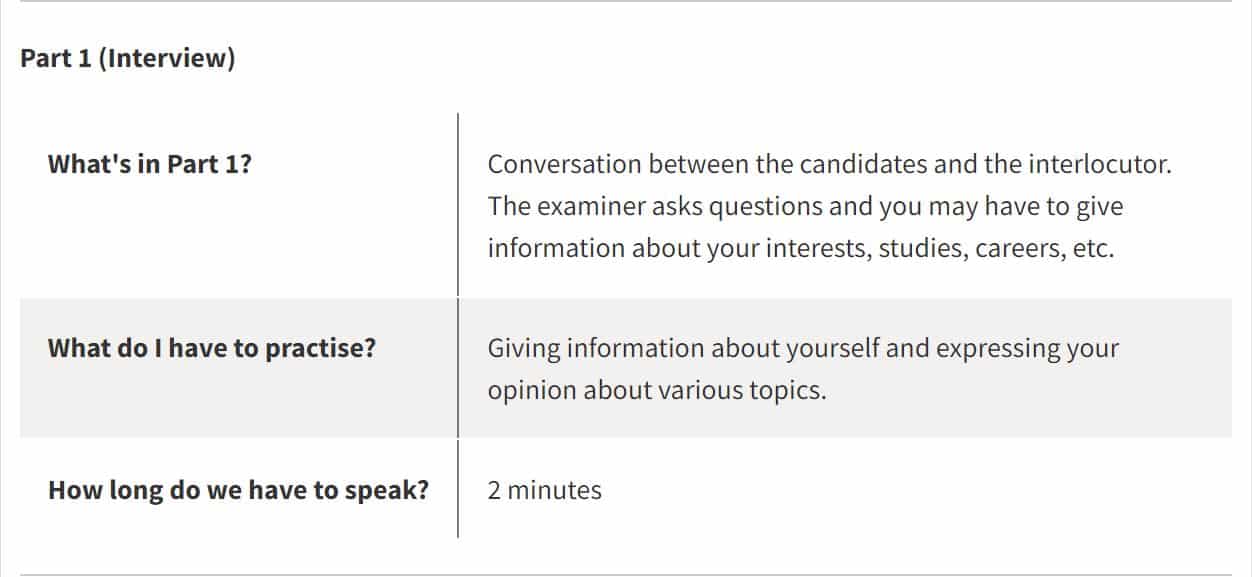
In Part 1, you will be asked questions about yourself, your life and your opinions. You know the answers to these questions, so it’s a good way for you to relax and get comfortable for the rest of the test. Or is it?
This is an ideal time for you to show what you can do with your English because you know the answers to these questions. However, before we get on to that, there’s another thing you need to think about. Who are you?
4. Be Prepared to Talk About Yourself (Part 1)
Know who you are, where you’re from, why you are learning English, and so on. You know the answers to these questions, so you shouldn’t need to hesitate, or repeat yourself. This part is to put you at ease, but also for the examiner to start assessing your level. You know the answers, you know your life, but you need to know how you are going to answer. For example, look at the question below.
Examiner – Where do you come from?
You – I come from eh eh , do you mean the town I live in now, or the town I was born in?
You have to decide what you are going to say BEFORE the exam. Do you come from X? Do you come from Y? Or do you want to say: Well, I was born in X, but I have lived in Y for the last 3 years, and I would prefer to say I am from Y. The last one is the better answer, but you do not want to hesitate.
You know the answer to the question, that’s why you’re asked it. If you have to bend the truth a little, that’s fine, it’s an English test, not a memory test.
Examiner – Where do you come from?
You – I come from a lovely little seaside town called Whitby on the east coast of England. It’s very picturesque but life there is too slow for anyone under 60 years old.
Examiner – What’s your favourite food?
You – Hamburger or pizza, hamburger or pizza……… eh…….eh
Decide what you are going to do. Choose the first thing that comes into your head? Choose the second of a choice of two?
A good way is to do it like this
Examiner – what’s your favourite food?
You – I used to absolutely love HB chocolate biscuits when I was younger, but these days I don’t seem to have such a sweet tooth, so my favourite food is oranges, especially the small ones.
5. Extend your answer
Answer the question and extend your answer, using better vocabulary and/or change the grammar. If you don’t answer the question, you can’t change the grammar tense.
Examiner – Where are you from?
You – Belgium
There is no tense in the answer ‘Belgium’, so you have nothing to change.
Try this
Examiner – Where are you from?
You – I’m from Belgium.
Now you have a tense, but you have no information: so, add something.
Examiner – Where are you from?
You – I’m from a little-known town in the south of Belgium called noname town, it’s a market town for the surrounding farming community, and is quite busy for such a small place.
Better, you have more detail, you’re putting a picture of the place in the examiner’s head, but the grammar is still in the same tense. Try this
Examiner – Where are you from?
You – I’m from a little-known town in the south of Belgium called noname town, I’ve been living there for the last 10 years since I moved there with my family from Antwerp.
So now you’ve changed have an extended answer, better vocabulary, and increased grammar range. All because you know the answer to the question.
More information, advice, and further ways to improve and vary your answers.

C1 Advanced Speaking Part 2
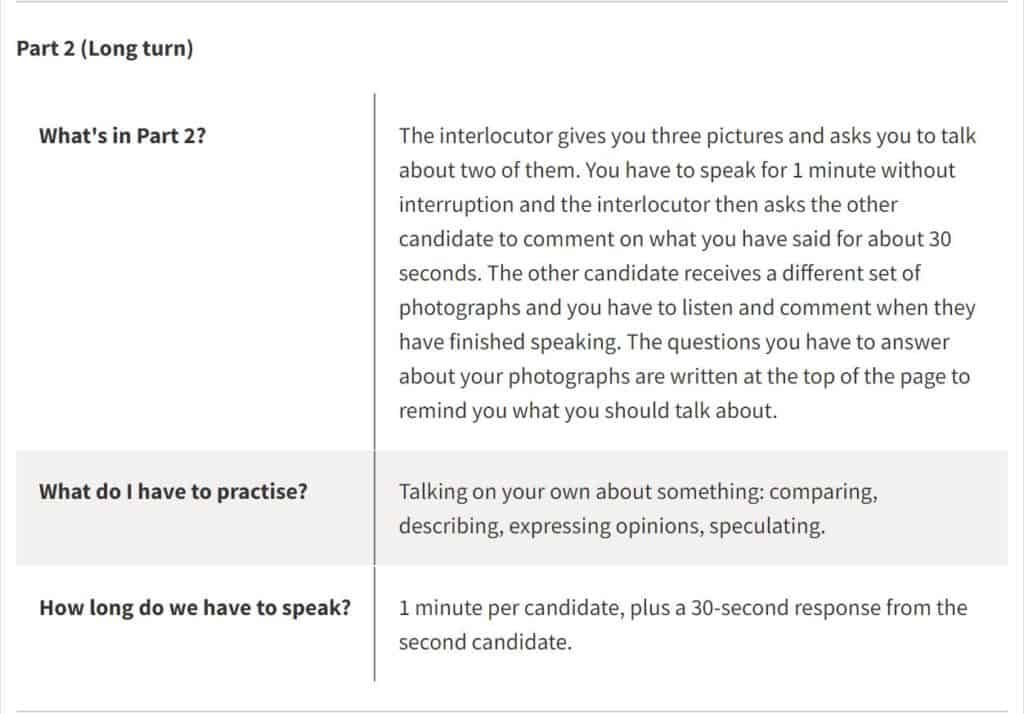
In Part 2, you need to choose two pictures from a set of three compare and contrast them while answering the questions. You need to do all this in one minute. It’s not a long time, so you need to practice, so it’s much better if you are prepared and have a plan how to answer.
6. Master Vocabulary for Describing People and Places (Part 2)
In Part 2 of the C1 Advanced Speaking test, you’ll be required to compare and contrast two pictures. Most of these pictures involve people, so it’s vital to expand your vocabulary related to describing people, actions, and settings.
Use resources like Quizlet to learn and practice relevant vocabulary. Focus on terms related to occupations, activities, emotions, and interactions. With a strong vocabulary base, you’ll be able to describe pictures in more detail and with greater precision, which is essential for a high score.
7. Develop a Strategy for Choosing Pictures (Part 2)
During Part 2, you’ll need to select two pictures from a set of three and compare them. Deciding which pictures to choose is important, as it can impact how comfortable you feel discussing them. Practice beforehand to determine whether you find it easier to talk about similar pictures or contrasting ones.
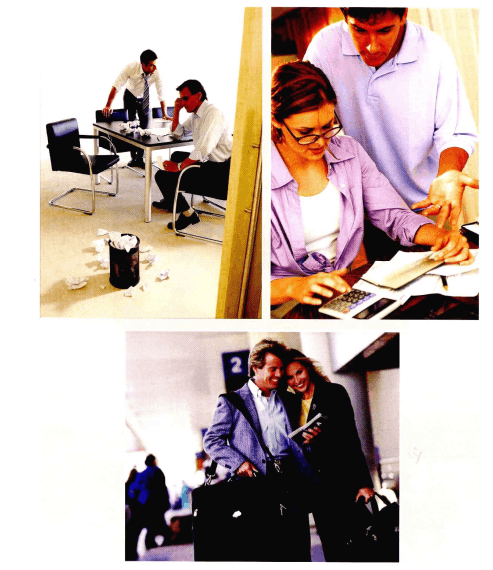
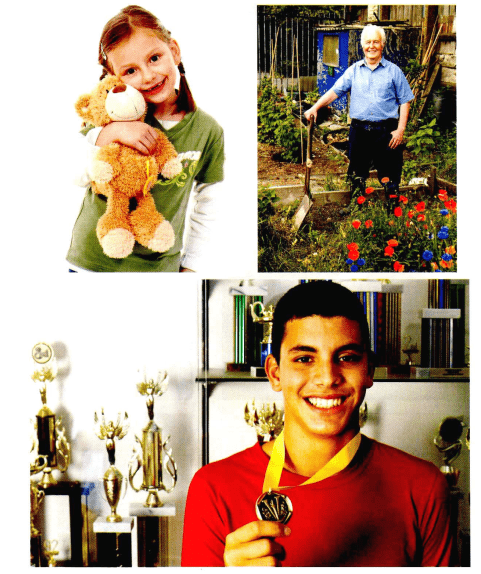
This is just a personal choice. What do you find it easier to do, talk about similar pictures or different pictures? In my opinion for example, in the pictures below, I would talk about the two men in an office and the man and the woman with their bags. In the next set of three pictures, I would talk about the girl with the teddy bear and the boy with the trophies. If you don’t know, why not practice and see which you think is easiest.
8/ Put the pictures into your answer template
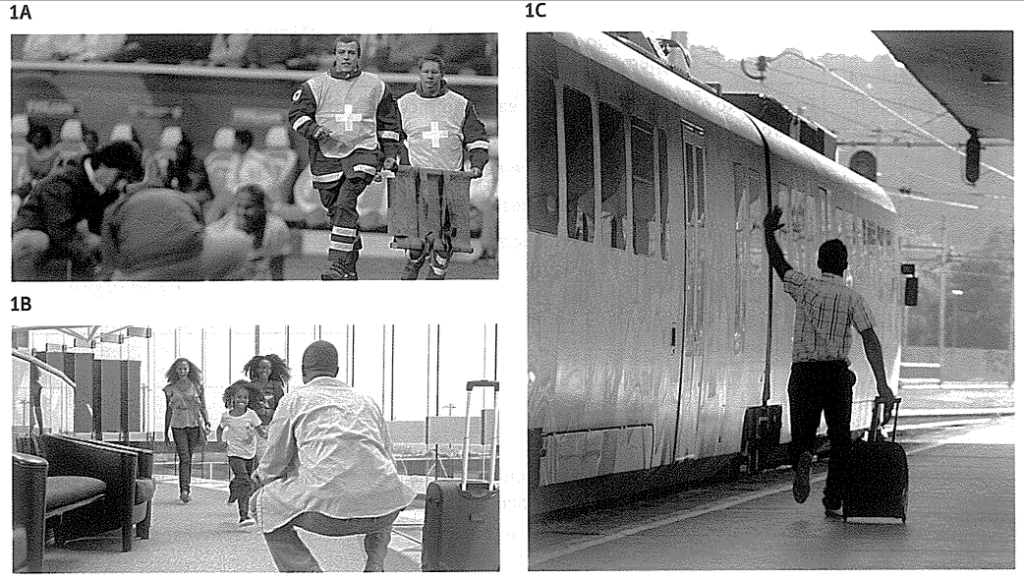
Use your preparation time to put the pictures into you what you have learned in class. What does this mean? Read on
Who what when where why and how many, how much, how long, ….?
You only have one minute to compare and contrast the pictures, and that isn’t long. It takes a lot of practice to be able to answer the questions and compare and contrast using speculative language in such a short time. I have discovered that a kind of ping-pong method, going quickly from one picture to the other and back is much more effective than talking about one picture, then the other.
The questions are
Why do you think the people are running?
What do you think the people’s lives are like?
I would choose the picture on the lower left-hand side, and the one on the right.
In the first example, I try and go from one picture to the other quite quickly. Like this:
It seems to me that the first picture is at an airport, whereas the second one may be at a train station. The man at the station seems to have missed his train and is running after it possibly to get home, whereas the girls who are running in the airport picture seem happy to see who I presume to be their dad. I think this dad has just come home from yet another business trip, and his family has missed him very much, while the man running after the train could also have a very busy life and be trying to go home to see his family.
In the second example below, I talk about one picture, then the other
It seems to me that the first picture is at an airport, and there are girls running towards a man who I presume to be their dad. I think this dad could be away from home a lot and has a very busy life and has just come home from yet another business trip, and his family spend much of their time missing him very much. The second picture is of a train station as far as I can tell, and there is a man running after a train waving his hand. He may have missed the last train home at the weekend and so could have missed his only opportunity to see his family. I’m afraid that this could be a breaking point for him because his whole world could revolve around his time at home.
In the first example, if you hesitate (and you will because you are under pressure in an exam) you can still compare and contrast, and you can still answer the questions using your speculative language.
The problem with the second example isn’t the English, but it gives you fewer chances to use your speculative language and it also doesn’t help if you pause to think. You could still be talking about the first picture when your time is over!!!!!
9. Learn Phrases for Comparing and Contrasting
Having a set of ready-to-use phrases for comparing and contrasting pictures will make it easier to articulate your thoughts. Here are some useful phrases for comparisons:
- For similarities: “Likewise,” “Similarly,” “In the same way.”
- For contrasts: “However,” “Whereas,” “On the other hand.”
Learning and practicing these phrases will help you sound more fluent and confident during the test, which can positively impact your score.
10. Prepare Speculative Phrases
Speculative language is an important part of the C1 Advanced Speaking test, especially when discussing pictures. Prepare phrases that allow you to hypothesize about what’s happening in the images, such as:
- “They might be…”
- “It looks like they could be…”
- “I’d guess that they are…”
- “I’m pretty sure that they’re feeling…”
- “It’s quite hard to tell, but I think they may be ……….”
- “Perhaps he’s a ………”
- “He doesn’t look like a ……. but”
- “They look like they’re a ……. family”
- “It looks like she’s teaching him what to do”
- “It’s possible that he’s just missed the train”
- “I’m pretty sure they’re happy because they’re smiling”
- “Maybe they’re going on a trip”
Using speculative language effectively will show the examiner that you can think critically and express uncertainty or possibilities, both of which are important skills at the C1 level.

C1 Advanced Speaking Part 3
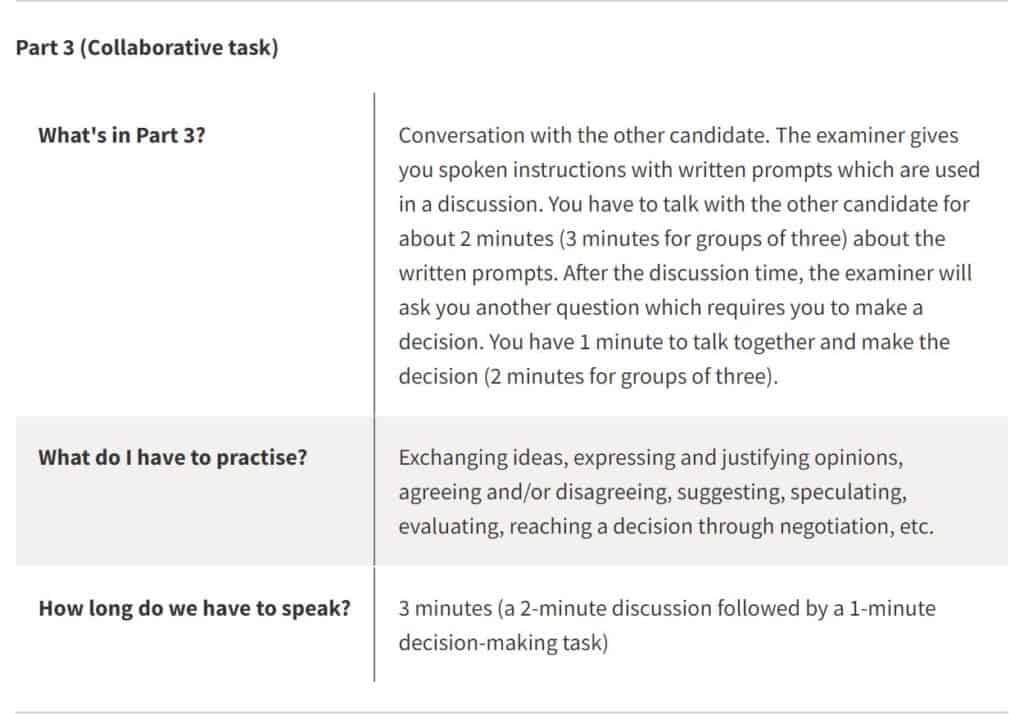
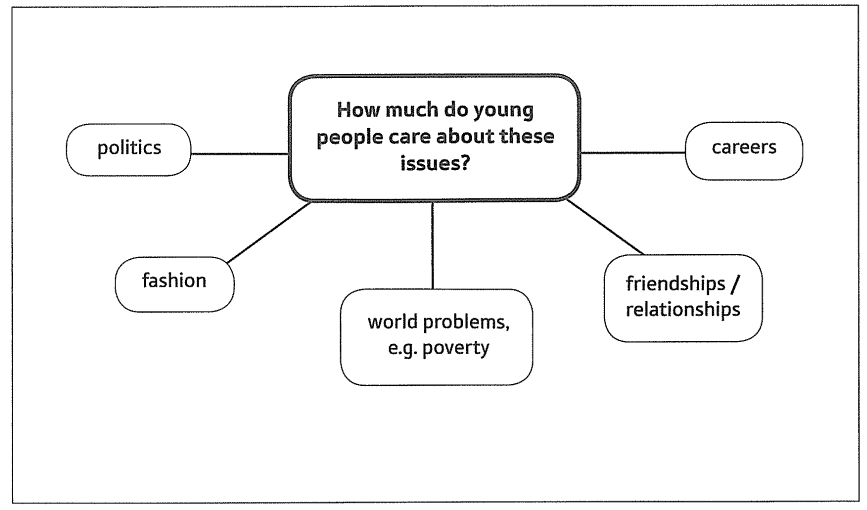
In Part 3, you and the other student need to discuss the different options of the central theme, described in the mind map or picture. You need to do this for two minutes and show you can pass the discussion back and forth between the two of you giving your opinions and agreeing and disagreeing. After this, you and your partner have one minute to decide which option is best.
11. Be Proactive in Part 3 Discussions
In Part 3, you’ll need to engage in a discussion with your partner. Being proactive in this part of the test shows leadership and confidence. Take the initiative by using phrases like:
- “Do you mind if I start?”
- “Shall I begin?”
This approach allows you to control the flow of the conversation and focus on topics you’re more comfortable discussing. Practicing this skill will help you manage the conversation more effectively during the exam.
12. Learn phrases for agreeing and disagreeing
During the discussion in Part 3, you’ll need to agree or disagree with your partner’s opinions. Using appropriate phrases for this is essential to sounding polite and engaged. Here are some useful expressions:
- Agreeing:
- “I think we see eye to eye on that,”
- “You’re absolutely right,”
- “I couldn’t agree more.”
- “Yeah, I’d go along with that.”
- “That’s so true.”
- “Absolutely!
- “You took the words right out of my mouth.”
- “You have a point there.”
- “I’m with you 100% on this one.”
- Disagreeing:
- “I take your point, but…,”
- “I beg to differ,”
- “I’m not sure I agree with that.”
- “We don’t see eye to eye on that I’m afraid”
- “I tend to disagree with you there.”
- “That’s not always the case”
- “Isn’t it more a case of…?”
- “I don’t think so.”
Practicing these phrases will help you express your thoughts clearly and contribute effectively to the discussion.
Agreeing is a more positive experience during the exam, so don’t waste your test arguing about some small point, unless you use great language to do it. Another thing you can do is to use concessions like although, even though, despite, in spite of ……
For example
Although I thought …… when I saw the question, I see your point and now agree with you on that
Even though I believed ………. I now think you’re right
Although I’m not 100% convinced, I’ll go along with you for now
Despite wanting to believe ……. I see your point
In spite of some personal experience in the matter, I agree with what you are saying
After you have talked about the mind map for 2 minutes, you then have to decide with your partner, the best option.
13. Use Phrases for Choosing the best
Phrases for choosing
I think we’ve pretty much covered all the bases, so which option do you think would be the best…..
I think we agree that …….. and ……. aren’t the best, don’t we?
Well, xxxxx isn’t really an option is it, and as for ……,
I’m not too keen on that. What do you think?
Ok I see your point, let’s go for that one as the best
And then why
In my opinion
The way I see it is ………
As far as I’m concerned ………
If you ask me, ……….
Then ask the other person their opinion
Why do think that?
What makes you say that?
What do you think?
Do you agree?
What are your thoughts on that?
Would you agree with that?

C1 Advanced Speaking Part 4
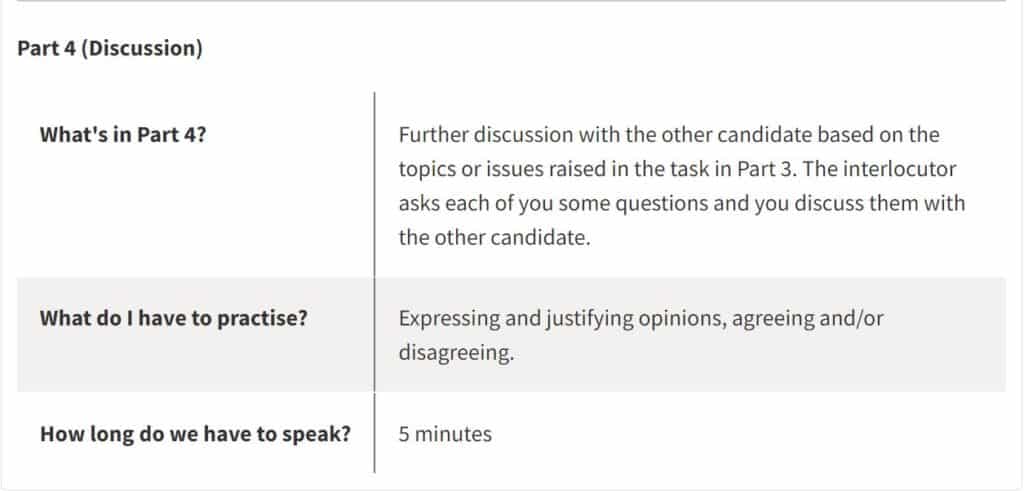
In Part 4, the two examinees and the examiner have a discussion, asking and giving opinions using questions related to Part 3’s topic. Here are some example questions.
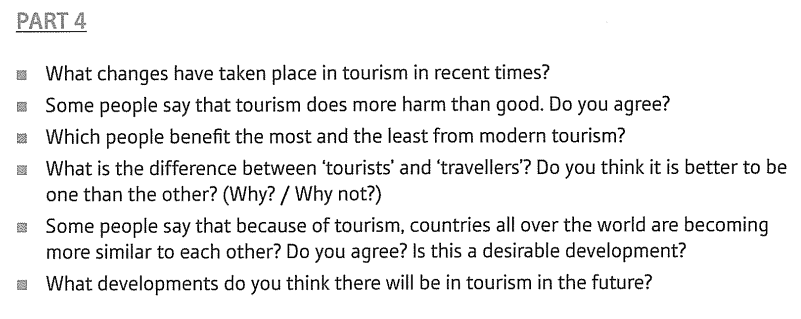
14. Practice Giving and Asking for Opinions (Part 4)
In Part 4, the examiner will join the discussion and ask for your opinions on various topics. This is your chance to demonstrate your ability to express yourself clearly and engage in a debate. Use phrases like:
- “In my opinion…”
- “As far as I’m concerned…”
- “What are your thoughts on that?”
Engaging the examiner and your partner with thoughtful questions and responses will show your ability to participate in an advanced-level discussion.
Check how well you know these phrases with this quick quiz.
[h5p id=”193″]
15. Use Discourse Markers to Signpost Your Answers
Discourse markers help structure your answers and make them easier to follow. For example:
- Sequencing: “First,… then,… finally…”
- Emphasizing: “Above all,… especially,… notably…”
Using discourse markers will improve the flow of your speech and make your arguments more coherent, which can boost your score in the fluency and coherence category.
Also, use your speculative phrases, and especially modal verbs to soften any statements that are too strong. Using might, may, could,….. to soften opinion n examples with meaning.
16. Master Clarification Phrases
Sometimes you just don’t hear the question properly or don’t understand it. Instead of guessing, use your English to ask the examiner to repeat the question. These phrases are the best ones to use, choose one or two to use if you need to.
I’m sorry, but could you repeat that please?
I’m afraid I didn’t hear what you said.
Could you repeat that?
Could you say that again, please?
What did you say?
I beg your pardon.
17. Body language tips
It’s always good to give a good impression in the test, so dress comfortably but smartly, and keep eye contact with the examiner or the other student when you are talking to each other.
Listen actively, so nod your head in agreement, or shake your head in disagreement, and so on. It helps the others and it also helps to keep you engaged in the test.
Use open body language, so don’t sit and fold your arms or cross your legs to make you look defensive.
Also, speak up, this is a speaking test, so the examiner and the other student need to be able to hear what you say. If you don’t speak up, you’ll lose points, and taking the exam will be a waste of time.
18. Get Help
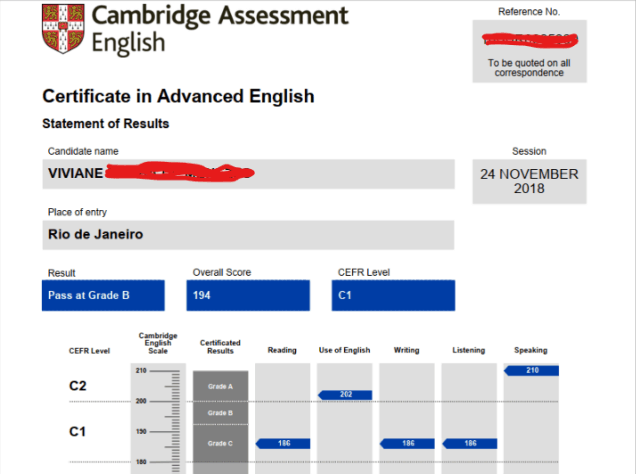
Taking lessons to improve your performance and improve your score is also very useful, especially if you are studying alone, or are lost in a big class. Here are the results of one student Viviane from Rio in Brazil, who actually got 100% in her speaking test. She said she owed it all to her teacher.
Thank you very much for reading this long post, I hope you find it useful. If you have any comments, please post them below.
Thank you so much for all those tips, I found them very useful!
Thank you very much Fabienne, it’s nice to know someone appreciates them 🙂