
These are high-scoring sample answers for the following Cambridge B2 First Speaking Parts 3 and 4. Read them and the analysis to understand what you need to talk about and the kind of answers you need to give for a good B2 First speaking score.
Home > B2 First > Speaking > Part 3 / Part 4
B2 First Speaking Part 3 Quiz: Pass or Fail?


B2 First Part 3
Question
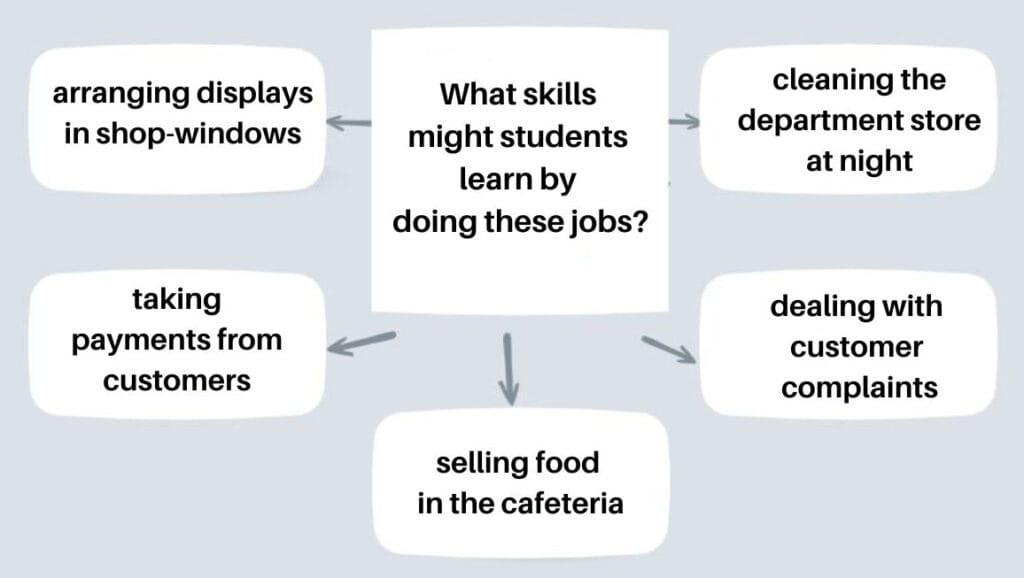
Sample Answer – Discussion
There is two minutes to discuss how each part influences the central question.
Candidate A:
Maybe we could start with arranging displays in shop-windows? That job would help them develop creativity and an eye for detail. They’d probably learn how to make things look attractive to customers. Do you agree?
Candidate A:
Yes, and they might also learn teamwork if they have to work with others to design the layout. What do you think about taking payments from customers?
Candidate B:
That would definitely improve their numeracy and confidence with handling money. Also, in my opinion, they’d need to be accurate and polite, which helps with customer service skills.
Candidate A:
I couldn’t agree more. I also think selling food in the cafeteria would teach similar things — dealing with people, working under pressure during busy times, and being organised.
Candidate B:
Good point. And cleaning the department store at night might seem simple, but it could teach students to be responsible, especially if they have to work independently. Do we see eye to eye on that?
Candidate A:
Absolutely, and they’d learn the importance of reliability and working quietly and efficiently. Now, dealing with customer complaints sounds really challenging. What’s your view?
Candidate B:
I agree. But it would teach them patience, problem-solving, and how to stay calm in stressful situations.
Sample Answer – Reaching a Decision
There is one minute for the candidates to reach a decision about which activity teaches the most useful skills.
Candidate B:
I’d probably say dealing with customer complaints teaches the most useful life skills. Staying calm and solving problems is something they’ll need in any job.
Candidate A:
I agree. It’s really difficult but prepares them for real-world challenges. Although selling food in the cafeteria also teaches a lot of useful everyday skills.
Candidate B:
Yes, but I think handling complaints is more advanced. So we’ll say dealing with customer complaints is the most valuable job in terms of learning skills.
🎯 Targeted Tips
🔗 1. Use Linking Phrases to Compare and Build Ideas
- Comparing: “That’s similar to…”, “Compared to that…”
- Adding: “Also…”, “Another thing is…”
- Emphasising: “What’s really important is…”
👂 2. Ask Questions to Involve Your Partner
- “What do you think about…?”
- “Would you agree that…?”
- “Which one do you think is more useful?”
💡 3. Expand Your Answers with Explanations
Go beyond “It’s helpful” — say why and how.
Example:
Instead of: “It’s good for teamwork.”
Say: “It teaches teamwork because they might have to work with others to solve problems or serve customers quickly.”
🗣️ 4. Paraphrase Key Phrases
Avoid repeating the question.
- “Learn skills” → “develop abilities”, “gain experience”, “improve confidence”
- “Doing these jobs” → “by working in these roles”, “while doing this kind of work”
⏱️ 5. Keep Track of Time and Cover Enough Options
- Discuss at least 4–5 jobs before deciding
- Use prompts like:
“Let’s move on to…”, “Now, how about…” to stay on track
B2 First Speaking Part 4 Quiz: Try Now!

B2 First Speaking Part 4
One candidate is asked a Part 4 question, then the other one is asked to give a shorter opinion on it too.
Questions
- How difficult do you think it is to work and study at the same time?
- Do you think it is a good idea for teenagers to do work experience?
- How easy do you think it is for young people to find a job nowadays?
- Is it better to try different jobs or to stay in the same job for a long time?
- How enjoyable is it to shop in large department stores?
- Some people say TV ads make us buy things we don’t need. What do you think?
Sample Answers
1. How difficult do you think it is to work and study at the same time?
I think it can be quite difficult, especially if the job takes up a lot of time or energy. It’s not easy to concentrate on your studies after a long day at work. However, some people manage it well by being organised and setting a clear schedule. It depends a lot on the type of job and the person’s motivation. In some cases, working can even help you become more responsible and independent.
2. Do you think it is a good idea for teenagers to do work experience?
Yes, definitely. Work experience gives teenagers a chance to understand what it’s like in the real world. It helps them learn practical skills and discover what kind of jobs they might enjoy in the future. Even if the work is simple, it can build confidence and teach important values like punctuality and teamwork. I think it’s a great way to prepare for adult life.
3. How easy do you think it is for young people to find a job nowadays?
I think it really depends on where you live and what kind of job you’re looking for. In some areas, there are many opportunities, especially in retail or online work. But in other places, it can be difficult because of high competition or lack of experience. Many young people also struggle with temporary or low-paid jobs. So I would say it’s not always easy, but it is possible with effort and flexibility.
4. Is it better to try different jobs or to stay in the same job for a long time?
Both options have benefits. If you try different jobs, you gain a wide range of experiences and learn new skills, which can help you find what you really enjoy. On the other hand, staying in the same job for a long time can give you stability and the chance to get promoted. I think it depends on the person—some people like change, while others prefer security.
5. How enjoyable is it to shop in large department stores?
Personally, I think it can be enjoyable if you like having lots of options in one place. Department stores often have a wide variety of products, and everything is organised, which makes shopping easier. However, they can also be crowded and a bit stressful, especially during sales. So it really depends on your mood and what you’re shopping for.
6. Some people say TV ads make us buy things we don’t need. What do you think?
I agree with that to some extent. TV ads are designed to catch our attention and make products look exciting or necessary, even if we didn’t think about buying them before. Sometimes we make quick decisions just because something looks good in an ad. Of course, not everyone is influenced in the same way, but I do think ads can affect our choices more than we realise.
Less Common Vocabulary
- displays – collections of objects arranged for public viewing
- layout – the way in which the parts of something are arranged
- numeracy – the ability to understand and work with numbers
- punctuality – the fact or quality of being on time
- retail – the sale of goods to the public in relatively small quantities for use or consumption rather than for resale
- struggle – strive to achieve or attain something in the face of difficulty or resistance
- flexibility – willingness to change or compromise.
- stability – the state of being stable
- promoted – raise (someone) to a higher position or rank
- crowded – (of a space) full of people, leaving little or no room for movement
- sales – a period during which a shop or dealer sells goods at reduced prices
- to some extent – something is true or holds true to a certain degree, but not completely or entirely
- ad – short for advertisement
Related Content
How to Avoid Making Sweeping Statements

Sweeping statements are statements which cover a broad topic in a concise or even terse manner. They make it seem as if everybody does something. This is really common in…
Cambridge B2 First Speaking: 17 of the Best Ways to Improve

Improve Your Skills! Discover 17 effective strategies to ace the Cambridge B2 First Speaking test, from understanding the test format to mastering vocabulary and body language. Some readers have been…
B2 First Speaking: Your Guide to Success
The B2 First Speaking test is designed to assess your ability to communicate effectively in English across a variety of situations. You’ll be tested on everything from interacting with a…
B2 First Speaking Rubric: How To Score Well

Get the Facts! Discover what the B2 First Speaking rubric really means and how to prepare for each part of the test to maximize your score. Try it Now! How…
B2 First Speaking Parts 3 & 4 Sample Answers: Easy Learning!
Sample Answers: High scoring B2 First Speaking Part 3 and Par 4 sample answers to guide to a better score. Practice your skills. All have answer transcripts. Home > B2…
B2 First Speaking Part 4: Powerful Quantities and Types of People

Improve Your Skills! Accurately talk about people in B2 First Speaking Part 4 using these expressions for quantities and types of people and types of people. In B2 First Speaking…
B2 First Speaking Part 4: How to Talk About Unfamiliar Topics

Improve Your Skills! B2 First Speaking Part 4 is an English test, not a general knowledge one. Even if you don’t know the answer, you still have to speak. Taking…
B2 First Speaking Part 4: 2 Simple Ways to Improve

Improve Your Skills! Don’t make the two most common B2 First Speaking Part 4 errors. Follow this guide for a solid foundation to any part 4 question. Some seem to…
B2 First Speaking Part 4 Quiz: Try Now!

Quiz: How much do you know about what makes a good answer in B2 First Speaking Part 4? If you think you know everything, give this quiz a try and…
B2 First Speaking Part 4 Information and Advice

Get the Facts! Master B2 First Speaking Part 4 by learning the format, preparation, essential advice and sample questions. Know what to do, to have a calm exam. There is…