For most IELTS Speaking test-takers, knowing what they need to do to get a higher band score is extremely vague. It is almost impossible for them to predict what score they will get, so often, they can only use their last IELTS Speaking test score as a guide.
Home > IELTS > Speaking > Sample Answers
Chat GPT has created these sample answers so such students can discover the changes they need to make to their speaking responses to improve their results and reach their target IELTS Speaking score.
This page is for the IELTS Speaking Part 2 question below and its associated Part 3 questions:
Describe a cultural place that you would like to learn the culture there (e.g. a library, museum, theatre)
You should say:
Where it is
How you knew this place
What it is like
And explain how the place is related to culture
Pros and Cons of This Method
Pros:
- Grammar: You can easily see the differences in the grammar used in each question.
- Vocabulary: You can easily see how the words and phrases are to a higher standard as the scores improve.
- Fluency and Coherence: As the score improves, you can see the increased use of sequence or discourse markers to assure the listener knows what is happening and when.
- Pronunciation: This is worth 20% of your score, so you should pay attention to the differences here. A simple way to improve
Cons:
- Grammar: Although there are differences between the answers, there are no mistakes, which is uncommon for these band scores.
- Vocabulary: While it is easy to see what is needed, to use better vocabulary, you need to practice seriously so you can include it fluently in your answers.
- Fluency and Coherence: There are very few pauses or hesitations which usually mark an IELTS Speaking test-takers Part 2 response.
- Pronunciation: Obviously, without audio or video, it’s impossible to get an example of the differences between the scores.
Author’s Thoughts:
- Video. Although it seems to be standard to put a video on YouTube with a teacher’s own answer to these questions, I don’t have the time or the patience to do that.
- Why Chat GPT?: I can make more sample answers with Chat GPT in a short time. Anyone could do that, but many don’t want to or are too lazy.
- Different scores: The idea is to show the differences between the answers, rather than having perfect answers. Some of these answers are too short, or they repeat the question in the first sentence. They are not perfect, but they inform students what they need to do to improve!
- Me: I used to make videos of speaking answers, but it’s not about me or how good my course is, or how many likes I get on Instagram or YouTube. It’s about trying to help you pass your speaking test and changing your life.
- You: If you have any ideas on how this could be improved, any other pros and cons, or would just like to comment, please use the comment box at the bottom of the page. If you like the content, please share it.
IELTS Speaking Part 2 Quiz: It Doesn’t Need to be Hell!


IELTS Speaking Part 2 AI Answers
Describe a cultural place that you would like to learn the culture there (e.g. a library, museum, theatre)
You should say:
Where it is
How you knew this place
What it is like
And explain how the place is related to culture
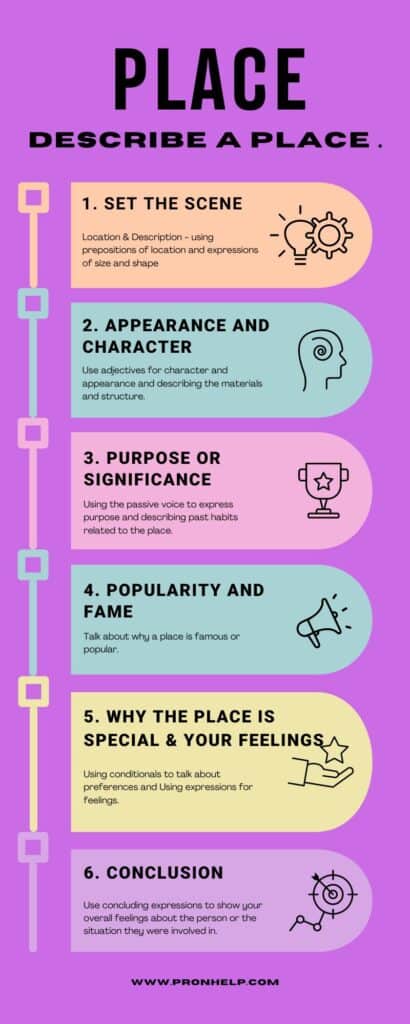
Compare the different band scores to check what you can do to improve your score!
IELTS Band 6 Answer:
Setting the Scene: There’s a museum in the city centre, near the old town square. It’s quite a big building, with two floors, and I saw it while walking around the area with my family. The outside is made of stone, and it looks like an old historical place.
Describing the Appearance and Character: The museum is very old and traditional. Inside, there are big rooms with high ceilings and wooden floors. The walls are white, and there are many pictures and old objects. It feels calm and quiet inside.
Explaining the Purpose or Significance: The museum was built to show the history and culture of the city. It is used to teach people about how the city developed. In the past, people used to visit it more, but now it’s mostly tourists who go there.
Expressing Popularity and Fame: It’s not the most famous place in the city, but it’s known by people who are interested in history and culture. Many school trips are organised there.
Discussing Why the Place is Special and Your Feelings: If I had more time, I would like to visit this museum again because I think I could learn more about the history. I feel like I didn’t see everything the first time.
Concluding Your Monologue: To conclude, it’s a place I think everyone should visit if they want to know more about the culture of our city.
Explanation:
- Grammar: Simple past tense is used effectively, but the passive voice is basic.
- Vocabulary: Basic adjectives like “big,” “old,” and “quiet” are used.
- Fluency: Some hesitation, but the message is clear.
- Coherence: The answer is clear, but the details and descriptions are quite simple.
IELTS Band 7 Answer:
Setting the Scene: There’s a well-known museum located right in the heart of the city, close to the river. It’s a large rectangular building with tall columns in the front, and I first heard about it from one of my history teachers when I was still in school. She recommended it as a great place to learn about our local culture.
Describing the Appearance and Character: The museum is quite grand and traditional in appearance. Inside, you’ll find spacious galleries with high ceilings and beautifully polished wooden floors. The artefacts and paintings are carefully displayed in glass cases, and each room has a different theme, such as ancient history or modern art.
Explaining the Purpose or Significance: This museum was specifically designed to preserve and showcase the cultural history of our city. It’s used to educate people about how our culture has evolved over time. In the past, it was a central meeting point for historians and artists, and even today it plays a significant role in cultural education.
Expressing Popularity and Fame: It’s not as famous as some larger national museums, but it’s still quite popular with both locals and tourists. Many people visit to learn more about the unique aspects of our culture, and it’s especially busy during school holidays.
Discussing Why the Place is Special and Your Feelings: If I could, I’d visit the museum with my parents again because I feel like there’s so much to learn. It always gives me a deep appreciation for our city’s heritage. I feel inspired every time I go there.
Concluding Your Monologue: Overall, it’s a place that holds a special place in my heart, and I believe it’s essential for anyone interested in learning about our culture.
Explanation:
- Grammar: A good range of past tenses and passive voice is used. Conditionals are introduced.
- Vocabulary: More descriptive adjectives like “grand,” “spacious,” and “inspired.”
- Fluency: Fewer hesitations, and the answer flows more naturally.
- Coherence: The structure is well-organised, with more depth and detail.
IELTS Band 8 Answer:
Setting the Scene: The place I’d like to talk about is a museum located in the very centre of our city, just a short walk from the main square. It’s an iconic building, with a classical architectural style featuring large stone columns and a domed roof. I first learned about it years ago from a documentary I watched, which focused on the cultural landmarks in our city.
Describing the Appearance and Character: The museum is truly impressive, both in size and design. The exterior is made of grey stone and has intricate carvings on the walls. Inside, the space is vast, with elegant marble floors and towering walls adorned with priceless artwork and artefacts from different eras. Each exhibit is carefully curated to provide an immersive experience, and the atmosphere is both awe-inspiring and educational.
Explaining the Purpose or Significance: The museum was established with the specific purpose of preserving and showcasing the cultural heritage of our region. It has played a vital role in educating the public about the city’s historical significance. In the past, it served as a centre for research and hosted numerous cultural events. Today, it continues to be a focal point for learning and reflection.
Expressing Popularity and Fame: While it may not be as internationally renowned as some larger museums, it is extremely well-known within the region. It attracts thousands of visitors annually, especially those with a keen interest in history and the arts. The museum has also been featured in several cultural programs and documentaries.
Discussing Why the Place is Special and Your Feelings: If I had the chance, I would definitely visit the museum again with my parents. It’s a place where I feel deeply connected to my cultural roots, and I always leave feeling both enlightened and proud of my heritage. The museum is unique in the way it makes history come alive.
Concluding Your Monologue: In conclusion, this museum is not only a treasure trove of knowledge but also a place that fosters a deep emotional connection to the past. It’s a cultural gem that I believe everyone should experience at least once.
Explanation:
- Grammar: A wide range of complex structures is used, including passive voice, conditionals, and various tenses.
- Vocabulary: Rich and precise language, with expressions like “iconic,” “immersive experience,” and “fosters a deep emotional connection.”
- Fluency: The answer is highly fluent, with minimal hesitation.
- Coherence: The response is well-organised, with detailed and thoughtful descriptions.
Key Differences:
- Band 6: Basic grammar and vocabulary are used. The description is clear but lacks detail and complexity.
- Band 7: There’s a better range of grammar, including conditionals and passive voice. The vocabulary is more descriptive, and the answer is more structured.
- Band 8: The answer uses complex grammar accurately and a rich variety of vocabulary. The descriptions are detailed and the story is well-organised, with a deep exploration of feelings and significance.
IELTS Speaking Part 3 Quiz: Do You Know it All?

IELTS Speaking Part 3 AI Answers
Compare the different band scores to check what you can do to improve your score!
IELTS Speaking Part 3 Answers and Band Score Explanations
1. How does the internet affect culture?
Band 6 Answer: “I think the internet affects culture a lot because people can see other cultures online. For example, people can watch videos from different countries and learn about their traditions. It helps people understand each other better, but it can also make cultures more similar because everyone uses the same websites and apps.”
- Explanation: The Band 6 answer is basic but clear. It demonstrates understanding of the topic but lacks depth and complexity in both ideas and vocabulary. The speaker repeats simple words like “culture” and “people,” with limited variety in sentence structures.
Band 7 Answer: “The internet has a big impact on culture because it allows people from all over the world to connect and share information. Through social media, streaming platforms, and news websites, people are exposed to different customs and traditions, which helps increase understanding. However, it also means that cultures are becoming more globalized, and sometimes, local traditions can be overshadowed by popular global trends.”
- Explanation: The Band 7 answer provides more developed ideas and examples. The vocabulary is more varied with words like “customs,” “traditions,” and “globalized.” The sentence structures are also more complex, showing better fluency and organization.
Band 8 Answer: “The internet has profoundly transformed the way cultures evolve and interact. It acts as a double-edged sword; on one hand, it fosters cross-cultural understanding by allowing instant access to diverse perspectives, traditions, and values. On the other hand, it accelerates the globalization of culture, leading to the homogenization of unique cultural identities as global trends, brands, and entertainment dominate. This phenomenon, while creating a shared global culture, may lead to the erosion of local cultural nuances over time.”
- Explanation: The Band 8 answer demonstrates a higher level of sophistication in both vocabulary (“homogenization,” “cultural nuances,” “erosion”) and ideas. The response is more analytical, with complex sentence structures and a clear argument. The ideas are well-connected, and the speaker addresses both positive and negative aspects in depth.
2. How is a culture formed?
Band 6 Answer: “Culture is formed by many things like traditions, language, and the way people live. For example, people in different countries have different holidays, food, and clothes. It also depends on history, like how people used to live in the past. All these things together make a culture.”
- Explanation: The Band 6 answer is simple and factual. The vocabulary is basic, and the response does not explore the topic in much depth. There’s a reliance on simple sentence structures without much variety.
Band 7 Answer: “Culture is shaped by a variety of factors such as traditions, religion, history, and the environment. It reflects the way people live, what they believe in, and how they celebrate important events. For instance, the language people speak, their holidays, and their social customs all contribute to forming a culture. Over time, these aspects become deeply ingrained in society, passed down from one generation to the next.”
- Explanation: The Band 7 answer gives a more detailed and organized response, with a wider range of vocabulary and ideas. The speaker explains the factors that influence culture and provides specific examples, using more complex sentences.
Band 8 Answer: “A culture is the product of an intricate interplay between historical, geographical, religious, and social factors. It evolves organically over time, shaped by the collective values, beliefs, and behaviors of a society. Key influences include language, traditions, art, religion, and the environment. Additionally, external factors, such as migration, colonization, and globalization, can profoundly impact the development of a culture, either enriching it or causing aspects of it to change or fade. Ultimately, culture is a dynamic, evolving entity that reflects the identity and shared experience of a community.”
- Explanation: The Band 8 answer provides a sophisticated analysis, using advanced vocabulary (“intricate interplay,” “organically,” “migration, colonization”) and complex sentence structures. The speaker offers a more in-depth exploration of the topic, discussing both internal and external factors that shape culture.
3. What kind of culture is popular among young people?
Band 6 Answer: “Young people like pop culture, like music, movies, and fashion. They follow what is popular on social media and like to copy celebrities. Also, young people are interested in technology and video games. They spend a lot of time online, so they are influenced by what they see there.”
- Explanation: The Band 6 answer is clear but basic, with simple vocabulary and ideas. The speaker uses straightforward sentence structures and provides limited explanation or examples. There’s no deeper exploration of the topic.
Band 7 Answer: “The culture that appeals to young people is often centered around trends in music, fashion, and entertainment. They tend to follow influencers on social media platforms and are interested in the latest technology, such as smartphones and gaming. Additionally, youth culture often embraces new ideas and movements, such as environmentalism and social justice, which shape their values and lifestyle choices.”
- Explanation: The Band 7 answer is more developed, with specific examples like “influencers” and “social justice.” The speaker uses more complex sentences and varied vocabulary, offering a better-organized response that explores both entertainment and values in youth culture.
Band 8 Answer: “Contemporary youth culture is heavily influenced by digital media and global trends. Social media platforms like Instagram, TikTok, and YouTube play a significant role in shaping young people’s interests, from music and fashion to political and social movements. While entertainment, such as films, music, and video games, continues to dominate, younger generations are increasingly drawn to causes like environmental sustainability, equality, and mental health awareness. This fusion of entertainment and activism reflects a shift in youth culture towards a more socially conscious and globally connected perspective.”
Explanation: The Band 8 answer demonstrates advanced vocabulary (“contemporary youth culture,” “socially conscious,” “activism”) and a well-developed, complex response. The speaker analyzes the deeper influences of digital media and social causes, showing a nuanced understanding of how culture is shaped among young people.
4. How do young people learn different cultures?
Band 6 Answer: “Young people learn about different cultures through the internet and social media. They can watch videos, read articles, and see pictures of how people live in other countries. Sometimes, they also learn about cultures in school or when they travel. It’s easy to learn because everything is online now.”
- Explanation: The Band 6 answer is simple, with basic vocabulary like “watch videos” and “read articles.” The ideas are clear but not very detailed. The sentence structure is mainly simple, with little variety, and the response lacks depth in terms of analysis.
Band 7 Answer: “Young people today have many opportunities to learn about different cultures. Social media platforms, online videos, and even school programs provide access to a wide range of cultural experiences. They can follow influencers or blogs from other countries and learn about traditions, food, and customs. Travel is another way young people get exposed to new cultures, and many take advantage of study-abroad programs or international vacations to gain a firsthand understanding.”
- Explanation: The Band 7 answer is more developed, offering specific examples such as “influencers” and “study-abroad programs.” The vocabulary is more varied, and the sentence structures are more complex. The speaker connects ideas more effectively and provides more in-depth reasoning.
Band 8 Answer: “Young people today engage with diverse cultures through a combination of digital media, formal education, and travel. Social media platforms like TikTok, Instagram, and YouTube provide an immersive experience where they can explore cultural trends, traditions, and even languages from around the world. Additionally, many schools incorporate multicultural curriculums, encouraging students to appreciate the customs and histories of different societies. For those with the means, travel and study-abroad programs offer invaluable opportunities to experience other cultures firsthand, fostering a deeper, more nuanced understanding of global diversity.”
- Explanation: The Band 8 answer uses advanced vocabulary (“immersive experience,” “multicultural curriculums,” “nuanced understanding”) and offers a sophisticated analysis. The ideas are well-structured, with complex sentences and a broader perspective that includes both digital and traditional means of learning culture.
5. Which is more important in terms of culture, literature or music?
Band 6 Answer: “I think both literature and music are important for culture. Literature tells stories and helps people understand the past, while music is something everyone enjoys and brings people together. It’s hard to say which one is more important because they both play a big role in culture.”
- Explanation: The Band 6 answer is straightforward and provides a clear but basic opinion. The speaker doesn’t go into much detail, and the vocabulary is quite simple. The ideas are relevant but not fully developed.
Band 7 Answer: “Both literature and music are essential elements of culture, but I would say literature might be slightly more important because it provides a detailed record of a society’s values, history, and experiences. Through books and stories, people gain insight into the past and the evolution of a culture. However, music also plays a significant role as it is often tied to cultural identity and can transcend language barriers, making it accessible to everyone.”
- Explanation: The Band 7 answer is more analytical and provides a clear comparison between literature and music. The speaker offers reasons for their opinion and includes specific examples. The vocabulary is more varied, with terms like “record of society” and “cultural identity,” and the sentence structures are more complex.
Band 8 Answer: “While both literature and music are integral to the preservation and transmission of culture, I would argue that literature holds greater importance in shaping cultural identity. Literature offers an in-depth exploration of a society’s philosophies, ideologies, and historical narratives, providing context and continuity over time. That said, music has the unique ability to evoke emotions and foster collective experiences, often serving as a universal language that transcends borders. Ultimately, the importance of each depends on the specific context, but literature’s capacity for detailed documentation and analysis arguably gives it a more lasting cultural impact.”
- Explanation: The Band 8 answer presents a more nuanced argument with advanced vocabulary (“preservation and transmission,” “philosophies,” “continuity over time”) and sophisticated sentence structures. The response explores both literature and music in depth and provides a balanced view, highlighting the strengths of each while making a clear argument for literature’s greater importance.
6. Does the culture of the past have an impact on today’s culture?
Band 6 Answer: “Yes, I think the culture of the past still has an effect on today’s culture. For example, traditions from the past are still important today, like holidays or how people celebrate. Also, things like old buildings or art are still part of modern life. But I think some things have changed a lot because of technology.”
- Explanation: The Band 6 answer is simple but relevant. The speaker provides basic examples like “traditions” and “old buildings,” but the ideas lack depth, and the vocabulary is fairly limited. The response is clear but doesn’t offer much detail or analysis.
Band 7 Answer: “Yes, the culture of the past continues to influence modern culture in many ways. For example, traditional festivals, rituals, and even forms of art that were established centuries ago are still celebrated and appreciated today. Historical events and cultural movements also play a role in shaping today’s values and societal norms. However, with the rise of technology and globalization, new cultural trends are emerging, blending old traditions with modern influences.”
- Explanation: The Band 7 answer is more detailed and analytical, with a clear explanation of how past culture affects the present. The speaker provides specific examples like “traditional festivals” and “historical events” and introduces more complex ideas. The vocabulary is more varied, and the sentence structures are more advanced.
Band 8 Answer: “The culture of the past undoubtedly continues to shape contemporary society. From art, literature, and architecture to social norms, customs, and values, much of what we consider modern culture is built upon the foundation of historical legacies. Cultural movements such as the Renaissance, the Enlightenment, and even ancient philosophies still resonate in today’s world, influencing everything from politics to education. While technology and globalization are driving rapid cultural shifts, the deep-rooted influence of the past persists, often manifesting in more subtle ways, such as language, ethical frameworks, and even modern fashion trends.”
- Explanation: The Band 8 answer provides a sophisticated analysis of the influence of past culture, using advanced vocabulary like “historical legacies,” “cultural movements,” and “ethical frameworks.” The ideas are well-organized, with complex sentences and a deeper understanding of how culture evolves. The speaker discusses both overt and subtle influences of past culture on the present.
Key Differences Between the Band Scores:
- Vocabulary: Band 6 answers use basic, everyday vocabulary. Band 7 shows a wider range of words and phrases with some attempt to use more specific terms. Band 8 demonstrates advanced vocabulary and precise language.
- Grammar: Band 6 answers use simple grammar structures. Band 7 responses have a mix of simple and complex sentences, while Band 8 consistently uses complex and varied sentence structures.
- Fluency and Coherence: Band 6 responses are coherent but tend to be short and less developed. Band 7 answers are more organized with clear explanations, and Band 8 answers are highly coherent, with well-developed ideas and clear, logical progression.
- Idea Development: Band 6 provides basic ideas with limited examples. Band 7 offers more detailed explanations and examples, and Band 8 delves deeper into analysis and provides nuanced, sophisticated responses with multiple perspectives.
Related Content
21 Simple Steps to the IELTS Speaking Score You Want

Achieving a high score in the IELTS Speaking test requires both practice and strategy. While there are many methods to help you improve, these 21 tips will make a significant…
How to Answer If You Know Nothing in IELTS Speaking

Taking tests such as IELTS Speaking are extremely challenging for many reasons, with one of the main ones being that a certain amount of life experience is needed to be…
How to Avoid Making Sweeping Statements

Sweeping statements are statements which cover a broad topic in a concise or even terse manner. They make it seem as if everybody does something. This is really common in…
How to Best Use the Latest IELTS Speaking Questions

There are several pages on this site that are dedicated to the ‘latest’ IELTS speaking questions. These questions are released for three periods of four months each year. January to…
How to Describe A Person: The Ultimate Guide

In IELTS Speaking Part 2, it is really common to be asked to describe a person. Whether it they are an old person, someone who is patient, a relative you…
How to Describe a Place: The Ultimate Guide

In the IELTS Speaking test, especially in Part 2, candidates are often asked to describe a place. Whether it’s a flat you would like to own, a favorite spot in…
How to Describe a Time or Event: The Ultimate Guide

In the IELTS Speaking test, especially in IELTS Speaking Part 2, candidates are often asked to describe a time when they did something memorable or significant. This guide will walk…
How to Easily Boost Your IELTS Vocabulary Score

If your job or course involves technical language in English, integrating it into your IELTS vocabulary in your speaking responses can significantly enhance your performance. By steering your answers toward…
How to Eliminate Hesitation in IELTS Speaking Part 2

In IELTS Speaking Part 2, the examiner will give you a cue card. You have one minute to make some notes to help you speak on that topic/question for between…
How to Speak for Longer in IELTS Speaking Part 2

This is a great way to extend your answer for IELTS Speaking Part 2. You use a strategy to suit the question, you do well, but there is still too…
How to Use Chunking in IELTS Speaking Part 2

Don’t memorise your answers in IELTS Speaking Part 2, that’s one of the worst things you can do. It’s really easy for an examiner to know when IELTS Speaking test…
How to Use Natural English Expressions for Better Precision

Improve Your Skills! Master that feeling that you MUST answer correctly by using these natural expressions to show what you know or don’t know about a topic. There is no…
How to Zoom In: The Most Useful Technique for IELTS Speaking

Imagine you are just starting to watch your favourite TV series. The theme music is playing, you see a view of a city, then a neighbourhood, then a street, then a…
IELTS Speaking
Latest questions, sample answers as well as many resources that will boost your journey to IELTS speaking success, Strategies for each part of the test! IELTS Speaking General IELTS Speaking…
IELTS Speaking Format, Preparation and 8 Great Hacks for Success

It’s madness to go into any English-speaking test expecting to do well. The IELTS Speaking test is demanding, so you should use any knowledge you can glean to your advantage….
IELTS Speaking Part 1 Format and 6 Simple Little Tricks To Help You

Many students think IELTS Speaking Part 1 is easy. It is an ideal time to add more challenging English, but knowing little tricks helps too. Know the format, how to…
IELTS Speaking Part 1 Questions

Many students think that the IELTS Speaking Part 1 questions are the easiest and simplest of the three parts, but it is a great time to show off what you…
IELTS Speaking Part 1 Quiz: Is It as Easy as You Think?

Test your IELTS Speaking Part 1 knowledge by taking this quick quiz. How much do you really know about this part of the speaking test? Try it and find out!…
IELTS Speaking Part 1 Sample Answers
This is a list of sample answers for IELTS Speaking Part 1 questions. All have transcripts of the answers. Some of them have video, some audio. Home > IELTS >…
IELTS Speaking Part 1: 16 Great Ways Start Your Test!

Many students think that the IELTS Speaking Part 1 Questions are the easiest and simplest of the three parts, but it is a great time to show off what you…
IELTS Speaking Part 2 – Phrases and Vocabulary

Here are some sentences and phrases to help you with IELTS Speaking Part 2. These are particularly useful for students who are using one of my strategies. This is a…
IELTS Speaking Part 2 Quiz: It Doesn’t Need To Be Hell!

Most students fear Part 2 of the IELTS Speaking test, but using strategies common to every topic, it can really boost your speaking score. How much do you know about…
IELTS Speaking Part 2 Sample Answers
This is a list of sample answers for IELTS Speaking Part 2 questions. All have transcripts of the answers. Some have video, some audio. Home > IELTS > Speaking > Part 2
IELTS Speaking Part 2: Format, Tips, and 5 Powerful Hacks

Are you worried about your IELTS Speaking test? Many students feel overwhelmed, especially when it comes to Part 2 of the exam. But fear not! This guide will help you…
IELTS Speaking Part 3 – Quantities and Types of People

In IELTS Speaking Part 3, when many questions ask about ‘people’ or ‘children’ or ‘businesses’, it is much easier to answer if you use expressions for quantities of people and…