These are high-scoring sample answers for the following Cambridge B2 First Speaking Parts 3 and 4. Read them and the analysis to understand what you need to talk about and the kind of answers you need to give for a good B2 First speaking score.
Home > B2 First > Speaking > Part 3 / Part 4
B2 First Speaking Part 3 Quiz: Pass or Fail?


B2 First Part 3
Question
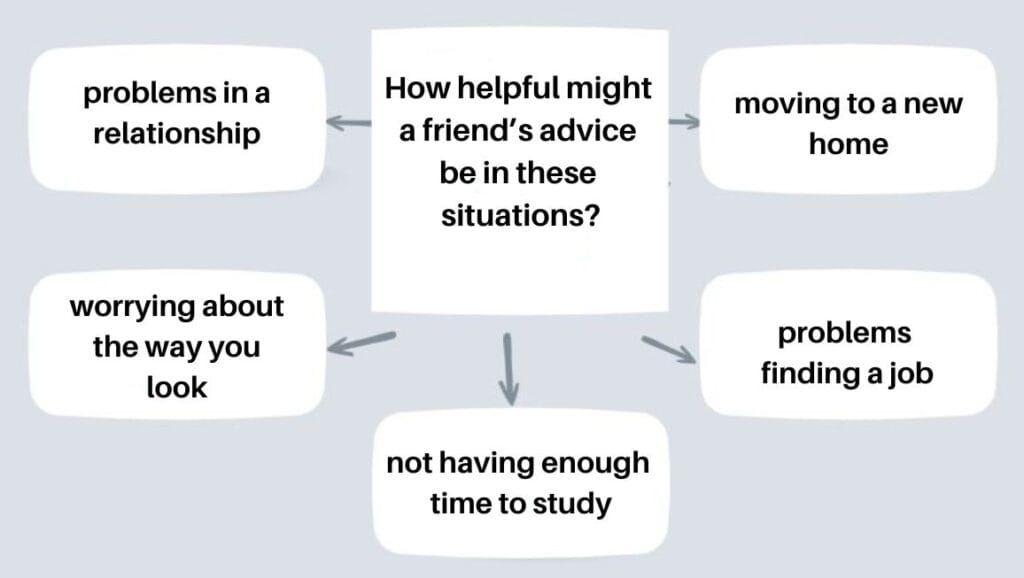
Sample Answer – Discussion
There is two minutes to discuss how each part influences the central question.
Discussion (2 minutes)
Question: How helpful might a friend’s advice be in these situations?
Student A:
Let’s start with problems in a relationship. I think a friend’s advice can be really helpful here because sometimes you just need someone to talk to. Don’t you think that friends often know you well and can give honest opinions?
Student B:
Yes, I agree. Especially if your friend has gone through something similar. They might not solve the problem, but they can help you see things more clearly. What about worrying about the way you look?
Student A:
Hmm, that’s a bit different. I think friends can help you feel more confident, like reminding you of your good points. But sometimes, people need more professional support if it’s a serious issue. What do you think?
Student B:
I agree. A friend’s support can help emotionally, but it might not be enough in the long term. Now, moving to a new home — I think advice is useful, but more practical. Wouldn’t tips on packing or settling in be more helpful?
Student A:
Yes, and it’s great if your friend has moved before. They can share their experience and make you feel less nervous. Shall we talk about not having enough time to study now?
Student B:
Sure. I think a friend could suggest time-management tips or study with you. But again, it depends on how serious the problem is.
Student A:
Exactly. If they’re also studying, their advice might be really practical. And what about problems finding a job?
Student B:
Friends might know of job openings or help with your CV. I think their support can be very helpful emotionally too — it keeps you motivated.
Sample Answer – Reaching a Decision
There is one minute for the candidates to reach a decision about which option needs a friend’s advice most?
Decision (1 minute)
Student A:
So, which one do you think a friend’s advice is most helpful for?
Student B:
I’d say problems in a relationship, because it’s personal and emotional, and friends are usually the first people we talk to.
Student A:
Yes, I agree. You can’t really go through that kind of thing alone. Their advice might not be perfect, but just listening helps a lot.
Student B:
Exactly — so we’ll go with problems in a relationship as the most helpful situation for a friend’s advice.
🎯 Targeted Tips for This Task
1. Group the Topics: Emotional vs Practical
This helps you compare more easily:
- Emotional advice situations:
→ Problems in a relationship
→ Worrying about the way you look
→ Problems finding a job - Practical advice situations:
→ Moving to a new home
→ Not having enough time to study
You can say things like:
“In emotional situations, I think a friend’s advice is more about support than solutions.”
“For more practical problems, a friend might have some useful tips or personal experience.”
2. Use Useful Phrases for Evaluating
- “It depends on…” (e.g., how close the friend is, how serious the problem is)
- “A friend can offer support, but they’re not an expert.”
- “Their advice might be helpful, especially if they’ve had a similar experience.”
- “They may not solve the issue, but they can help you feel less alone.”
3. Work Together During the Discussion
Ask your partner’s opinion to keep the conversation moving:
- “What do you think about that?”
- “Do you agree, or would you choose something else?”
- “Should we talk about another one?”
4. Decision Time: Justify Your Choice
After the discussion, show clear agreement and explain why that situation is the most suitable:
“I think advice is most helpful in a relationship because it’s hard to deal with alone, and a friend can offer emotional support.”
5. Watch Out For…
- Going off-topic: Stay focused on how helpful advice is — not solving the problem completely.
- Listing without developing: Don’t just name reasons — explain them with short examples.
- Monologues: Keep the exchange interactive. Ask and respond.
B2 First Speaking Part 4 Quiz: Try Now!

B2 First Speaking Part 4
One candidate is asked a Part 4 question, then the other one is asked to give a shorter opinion on it too.
Questions
- Who would you turn to for advice If you had a problem?
- How important is it to have good friends who can give advice?
- Do you think young people are better able to deal with problems than older people?
- How much do you think parents can do to help their children
- Do you think young people may worry too much about their appearance?
- Do you think it is possible to enjoy life and not worry about anything?
Sample Answers
1. Who would you turn to for advice if you had a problem?
If I had a problem, I would probably talk to a close friend or a family member, depending on the situation. For example, if it was something personal or emotional, I might speak to my best friend because they understand me well and are good at listening. But if it was something more serious, like a financial issue or something related to my future, I would turn to my parents, as they have more experience.
2. How important is it to have good friends who can give advice?
I think it’s very important. Good friends can see things from a different point of view, and they usually want what’s best for you. Sometimes, when you’re too close to a problem, it’s hard to see it clearly, and a friend can help you think more logically. Also, just knowing that someone is there to support you can make a big difference, even if they don’t have all the answers.
3. Do you think young people are better able to deal with problems than older people?
That’s an interesting question. I think young people can be very strong and creative when it comes to solving problems, especially in areas like technology or modern issues. However, older people often have more experience and are usually calmer when dealing with difficulties. So, in a way, both groups have their strengths, but maybe older people are better at staying calm under pressure.
4. How much do you think parents can do to help their children?
I think parents can do a lot, especially by being supportive and understanding. When children feel safe and listened to, they are more likely to open up and ask for help. Parents can also guide them by sharing their own experiences or helping them learn how to solve problems on their own. But it’s also important that parents don’t try to control everything, because children need to learn to be independent too.
5. Do you think young people may worry too much about their appearance?
Yes, I do. These days, there’s a lot of pressure on young people to look a certain way, especially because of social media. They often compare themselves to others and worry if they don’t look “perfect.” I think it’s important to be healthy and take care of yourself, but appearance shouldn’t be the most important thing. Confidence and personality matter much more in the long run.
6. Do you think it is possible to enjoy life and not worry about anything?
I think it’s very difficult to enjoy life without worrying about anything at all, because everyone has responsibilities and challenges. However, I believe it’s possible to enjoy life most of the time if you learn how to manage stress and not let small problems affect you too much. Some people are naturally more relaxed, but for others, it takes effort to focus on the positive and not overthink things.
Less Common Vocabulary
- confident – feeling or showing certainty about something
- professional – a person engaged in a specified activity, especially a sport, as a main paid occupation rather than as a pastime
- settling in – to start to feel comfortable in a new home, job, etc
- financial – relating to or involving money
- logically – in a way that shows clear, sound reasoning
- to overthink – to think about (something) too much or for too long
Related Content
How to Avoid Making Sweeping Statements

Sweeping statements are statements which cover a broad topic in a concise or even terse manner. They make it seem as if everybody does something. This is really common in…
Cambridge B2 First Speaking: 17 of the Best Ways to Improve

Improve Your Skills! Discover 17 effective strategies to ace the Cambridge B2 First Speaking test, from understanding the test format to mastering vocabulary and body language. Some readers have been…
B2 First Speaking: Your Guide to Success
The B2 First Speaking test is designed to assess your ability to communicate effectively in English across a variety of situations. You’ll be tested on everything from interacting with a…
B2 First Speaking Rubric: How To Score Well

Get the Facts! Discover what the B2 First Speaking rubric really means and how to prepare for each part of the test to maximize your score. Try it Now! How…
B2 First Speaking Parts 3 & 4 Sample Answers: Easy Learning!
Sample Answers: High scoring B2 First Speaking Part 3 and Par 4 sample answers to guide to a better score. Practice your skills. All have answer transcripts. Home > B2…
B2 First Speaking Part 4: Powerful Quantities and Types of People

Improve Your Skills! Accurately talk about people in B2 First Speaking Part 4 using these expressions for quantities and types of people and types of people. In B2 First Speaking…
B2 First Speaking Part 4: How to Talk About Unfamiliar Topics

Improve Your Skills! B2 First Speaking Part 4 is an English test, not a general knowledge one. Even if you don’t know the answer, you still have to speak. Taking…
B2 First Speaking Part 4: 2 Simple Ways to Improve

Improve Your Skills! Don’t make the two most common B2 First Speaking Part 4 errors. Follow this guide for a solid foundation to any part 4 question. Some seem to…
B2 First Speaking Part 4 Quiz: Try Now!

Quiz: How much do you know about what makes a good answer in B2 First Speaking Part 4? If you think you know everything, give this quiz a try and…
B2 First Speaking Part 4 Information and Advice

Get the Facts! Master B2 First Speaking Part 4 by learning the format, preparation, essential advice and sample questions. Know what to do, to have a calm exam. There is…