
These are high-scoring sample answers for the following Cambridge C1 Advanced Speaking Parts 3 and 4. Read them to understand what you need to talk about and the kind of answers you need to give for a good C1 Advanced speaking score.
Home > C1 Advanced > Speaking > Part 3 & 4 Sample Answers
C1 Advanced Speaking Part 3 Quiz: Do You Know?


C1 Advanced Speaking Part 3
Question
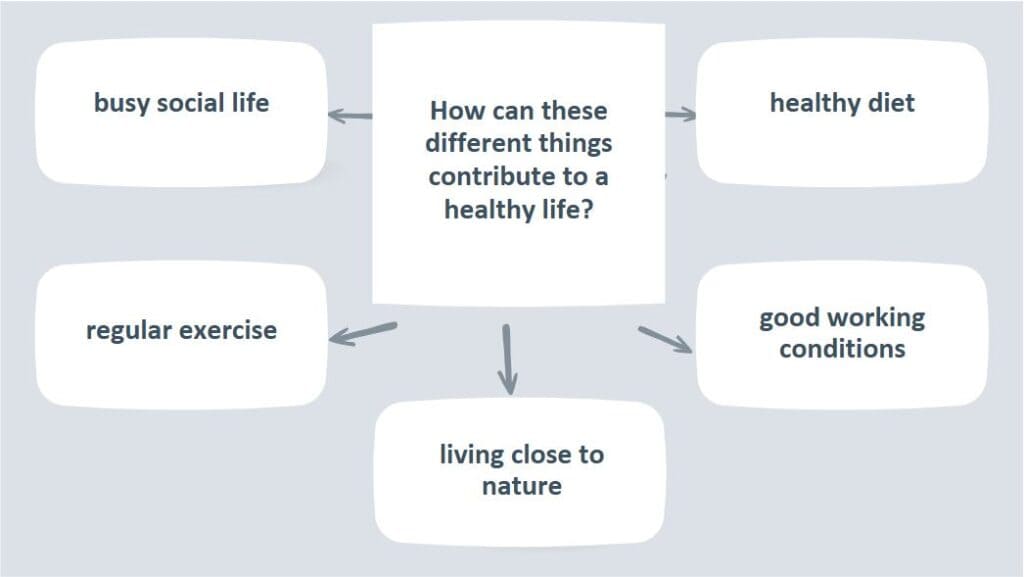
Sample Answer – Discussion
There is two minutes to discuss how each part influences the central question.
A: Do you mind if I begin?
B: Not at all, go ahead.
A: Well, I think regular exercise is crucial for a healthy lifestyle. Not only does it help your heart and reduce stress, but it also helps maintain a healthy weight, which is a big part of overall well-being. What do you think?
B: Absolutely. I’d say a healthy diet goes hand in hand with that, to be honest. You can exercise all you want, but if you’re eating poorly, it won’t be enough. Eating nutritious food gives you the energy and nutrients your body needs to function properly.
A: That’s true. Another one that stands out to me is good working conditions. Don’t you agree that if your job is stressful, or your hours are too long, it can have a serious impact on both mental and physical health.
B: Yes, and a busy social life could also play a big role, especially when it comes to mental health. Feeling connected to others and having a strong support network can really boost your mood and help you manage stress. But you have to balanced.
A: Definitely. I also think living close to nature has its advantages. It can encourage people to be more active, reduce anxiety, and provide a break from urban noise and pollution. Would that be good for you?
B: Sure it would. Though it depends on the person – some people thrive in cities. Still, having green spaces nearby seems to benefit most people.
Sample Answer – Reaching a Decision
There is one minute for the candidates to reach a decision about which activity would contribute most to a healthy life?
B: So, if we had to choose, I’d say regular exercise and a healthy diet are the two most fundamental. Without those, it’s hard to stay physically healthy.
A: I agree. Everything else supports well-being, but those two are really the foundation of a healthy life.
B: Shall we go with regular exercise as the top priority, followed by diet?
A: Yes, that makes sense. It’s hard to argue against the physical and mental benefits of staying active.
B: Great, let’s go with that then.
CAE Speaking Part 4 Quiz: Are You The Best?

C1 Advanced Speaking Part 4
One candidate is asked a Part 4 question, then the other one is asked to give a shorter opinion on it too.
Questions
- How important do you think it is for people to be aware of problems that affect people in other countries?…(Why? / Why not?)
- Some people say that it is better to solve problems in our own countries before thinking about world problems. What do you think?
- What do you think is the best way to bring world issues to people’s attention?…(Why? / Why not?)
- Do you think that ordinary individuals can help solve big, international problems?…(Why? / Why not?)
- Is it important to donate money to international charities?… (Why? / Why not?)
- Some people believe that certain global problems are too big to solve and that it’s too late to try. What do you think?
Sample Answers
1. How important do you think it is for people to be aware of problems that affect people in other countries? Why / Why not?
I think it’s very important because we live in an increasingly connected world. Problems like climate change, poverty, and conflict often cross borders and affect us all in some way. Being aware can help people make more responsible choices and feel more empathy toward others. It also encourages international cooperation, which is often essential for solving these issues.
2. Some people say that it is better to solve problems in our own countries before thinking about world problems. What do you think?
I understand why some people feel that way, especially if their country is facing serious challenges. However, I believe we can work on both local and global issues at the same time. Many world problems, like pandemics or economic crises, also affect individual countries, so ignoring them doesn’t help in the long run. Collaboration often leads to better solutions for everyone.
3. What do you think is the best way to bring world issues to people’s attention? Why / Why not?
I think education and media play a key role. Documentaries, social media campaigns, and school programs can help people understand the issues more deeply. Personal stories, in particular, can be very powerful in making people care. It’s important, though, that the information is accurate and balanced so people aren’t misled or overwhelmed.
4. Do you think that ordinary individuals can help solve big, international problems? Why / Why not?
Yes, I do. While individuals can’t fix everything alone, small actions—like reducing waste, voting for responsible leaders, or supporting ethical companies—can have a big impact when many people do them. Also, individuals often start movements or raise awareness that leads to real change. It’s easy to feel powerless, but every positive action counts.
5. Is it important to donate money to international charities? Why / Why not?
Yes, I believe it is, especially if the charity is transparent and trustworthy. Donations can provide urgent support in places affected by disasters, war, or poverty, where local help isn’t enough. Of course, not everyone can give money, but for those who can, it’s one meaningful way to contribute. That said, it’s also important to support long-term solutions, not just emergency aid.
6. Some people believe that certain global problems are too big to solve and that it’s too late to try. What do you think?
I think that kind of thinking is dangerous because it leads to inaction. While it’s true that some problems are very serious and complex, giving up won’t improve the situation. History shows that progress is possible when people work together with determination and creativity. Even if we can’t solve everything completely, we can still make things better.
Related Content
18 Terrific Ways to Improve Your C1 Advanced Speaking

One of the most effective ways to prepare for your C1 Advanced Speaking test is to watch this official test video. Such videos provide a realistic view of the test,…
Better C1 Advanced Speaking Part 2: Answer Structure

C1 Advanced Speaking Part 2 is a critical section of the exam where you need to deliver a well-structured, fluent, and engaging talk, should only take one minute. Whether you’re…
Better Discussions for C1 Advanced Speaking Part 3

In C1 Advanced Speaking Part 3, you and the other student need to discuss the different options of the central theme, described in the mind map or picture. You need…
C1 Advanced Speaking Information and Advice

Many students seem to miss basic facts about the C1 Advanced Speaking test, so this page is to fill in some of that missing information. There are also separate pages…
C1 Advanced Speaking Part 1 Information and Advice

Many students seem to miss basic facts about the C1 Advanced Speaking Part 1, so this page is to fill in some of that missing information about Part 1. There…
C1 Advanced Speaking Part 1 Questions

Introduction Many students think that the Speaking Part 1 questions in C1 Advanced are the easiest and simplest of the four parts, but it is a great time to show…
C1 Advanced Speaking Part 1 Quiz: Do You Know Enough?

Many think of C1 Advanced Speaking Part 1 as the easiest part, but you should be aware that every part of the speaking test is considered just as important as…
C1 Advanced Speaking Part 1 Sample Answers
This is a list of sample answers for C1 Advanced Speaking Part 1 questions. There are three different methods for answering each question. All have transcripts of the answers. Some…
C1 Advanced Speaking Part 1: 4 Great Tips

Many students think that the C1 Advanced Speaking Part 1 questions are the easiest and simplest of the four parts, but it is a great time to show off what…
C1 Advanced Speaking Part 1: How to Vary Your Answers

Introduction Many students think that the questions in C1 Speaking Part 1 in the C1 Advanced English test are the easiest and simplest of the four parts, but it is…
C1 Advanced Speaking Part 2 Information and Advice

Many students seem to miss basic facts about the C1 Advanced Speaking Part 2, so this page is to fill in some of that missing information about Part 2. There…
C1 Advanced Speaking Part 2 Quiz: Enough Time for You?

Do you know as much about C1 Advanced Speaking Part 2 as you think do? Take this quiz to test your knowledge. There’s nothing worse than being unprepared, especially when…
C1 Advanced Speaking Part 2 Sample Answers
This is a list of sample answers for C1 Advanced Speaking Part 2 questions. All have transcripts of the answers. Some have video, some audio. Home > C1 Advanced >…
C1 Advanced Speaking Part 2: Compare and Contrast

C1 Advanced Speaking Part 2 is a tricky part of the speaking test. It seems easy because you are given photos to contrast and compare, but you only have a…
C1 Advanced Speaking Part 2: People Vocabulary

In C1 Advanced Speaking Part 2, you need to choose two pictures from a set of three, then compare and contrast them while answering the two questions. You need to do…
C1 Advanced Speaking Part 2: Planning

C1 Advanced Speaking Part 2 is a tricky part of the test which really worries many candidates. A reliable route to a confident Part 2, is to use dedicated practice,…
C1 Advanced Speaking Part 2: Speculating

In C1 Advanced Speaking Part 2, you need to choose two pictures from a set of three, then compare and contrast them while answering the two questions. You need to do…
C1 Advanced Speaking Part 3 Information and Advice

Many students seem to miss basic facts about C1 Advanced Speaking Part 3, so this page is to fill in some of that missing information about Part 3. There is…
C1 Advanced Speaking Part 3 Quiz: Do You Know?

Although you have other test takers to speak to in Part 3, it’s easy to let them influence you too much. Take this quiz to test what you know about…
C1 Advanced Speaking Part 3: Asking for, and Giving Opinions

In C1 Advanced Speaking Part 3, test takers need to discuss the topics in the given diagram. To do this, they need to ask for and give opinions as well…