
These are high-scoring sample answers for the following Cambridge B2 First Speaking Parts 3 and 4. Read them and the analysis to understand what you need to talk about and the kind of answers you need to give for a good B2 First speaking score.
Home > B2 First > Speaking > Part 3 / Part 4
B2 First Speaking Part 3 Quiz: Pass or Fail?


B2 First Part 3
Question
Sample Answer – Discussion
There is two minutes to discuss how each part influences the central question.
2-minute discussion (as a dialogue)
Candidate A:
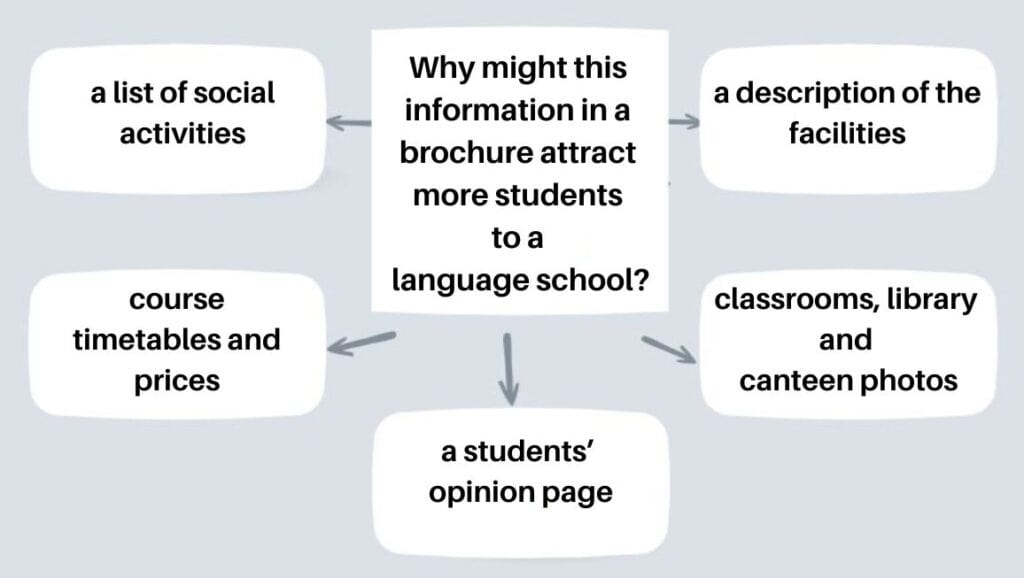
So, we’re discussing why this kind of information might attract more students to a language school. Maybe we could start with the photos of the classrooms, library and canteen?
Candidate B:
Yeah, I think that’s a great place to start. When people see pictures of the facilities, it gives them a better idea of what to expect. If everything looks modern and clean, it definitely makes the school more appealing.
Candidate A:
Absolutely. And the description of the facilities adds more detail. For example, if the brochure says the library has lots of useful materials, or the canteen offers healthy food, that could be a deciding factor for some students.
Candidate B:
True, but I think the students’ opinion page is probably even more powerful. If potential students read that others had a great experience, they’re more likely to trust the school.
Candidate A:
Good point. Personal opinions often feel more reliable than official descriptions. What do you think about the list of social activities?
Candidate B:
That could be very persuasive too, especially for international students who want to make friends and feel part of a community.
Candidate A:
Yes, and it also shows the school is about more than just studying. What about the course timetable and prices?
Candidate B:
That’s practical information and very important, but maybe not the most exciting thing. Still, if the prices are reasonable and there are flexible options, it could attract more people.
Candidate A:
Definitely. So, should we move on to choosing which one might attract the most students?
Sample Answer – Reaching a Decision
There is one minute for the candidates to reach a decision about which activity needs the most concentration.
1-minute decision (collaborative choice)
Candidate B:
I think we both agree that the students’ opinion page is really effective. When you see real feedback from other learners, it builds trust.
Candidate A:
Yes, I’d put that at the top too. And maybe the photos as a close second — they help people imagine themselves at the school.
Candidate B:
Exactly. The combination of visuals and real experiences makes it easier to decide. So are we saying the opinion page is probably the most persuasive?
Candidate A:
Yes, definitely. It gives a more personal impression of the school.
B2 First Speaking Part 4 Quiz: Try Now!

B2 First Speaking Part 4
One candidate is asked a Part 4 question, then the other one is asked to give a shorter opinion on it too.
Questions
- Do you think it is better to have language lessons in a group or individually?
- How much can you learn by using the Internet?
- What is the best age to start learning a foreign language?
- How important is it to enjoy the experience of learning?
- Do you think that people are influenced by advertisements they see?
Sample Answers
1. Do you think it is better to have language lessons in a group or individually?
I think both have advantages, but personally, I prefer group lessons. In a group, you can practise speaking with different people, which helps you become more confident in real-life situations. It also makes the lessons more dynamic and fun. However, individual lessons can be better if you want to focus on your personal needs or move at your own pace. So it really depends on your learning style and goals.
2. How much can you learn by using the Internet?
You can actually learn a lot. There are videos, podcasts, online courses, and language apps that make studying more flexible and interesting. The Internet also gives you access to native speakers through things like conversation exchanges or social media. Of course, you still need to be motivated and use good resources, but I think it’s a very powerful tool for learning, especially if you use it regularly.
3. What is the best age to start learning a foreign language?
I believe the earlier, the better. Children usually learn languages more naturally, and they’re not afraid to make mistakes. They can also develop better pronunciation if they start young. However, adults can still learn successfully if they are motivated and practise often. In the end, it’s not just about age—it’s also about attitude and effort.
4. How important is it to enjoy the experience of learning?
I think it’s extremely important. When you enjoy learning, you stay motivated and you’re more likely to continue. If the process is boring or stressful, people often give up. Enjoying the experience doesn’t mean everything has to be easy, but it should be interesting and rewarding. That’s why good teachers and fun materials make such a big difference.
5. Do you think that people are influenced by advertisements they see?
Yes, definitely. Even if people don’t realise it, advertisements affect the way we think about products and brands. For example, seeing something again and again can make it feel more familiar or trustworthy. Some ads are very emotional or clever, and they make people want to buy things they don’t really need. I think we all need to be more aware of how ads try to influence us.
Less Common Vocabulary
- canteen – a restaurant provided by an organization such as a college, factory, or company for its students or staff
- appealing- attractive or interesting
- facilities – a place, amenity, or piece of equipment provided for a particular purpose
- a deciding factor – a circumstance or element that has the most significant influence on a final result, decision, or choice
- potential – having or showing the capacity to develop into something in the future
- dynamic – characterized by constant change, activity, or progress
- focus – the centre of interest or activity.
- flexible – able to be easily modified
- give up – cease making an effort; admit defeat.
Related Content
How to Avoid Making Sweeping Statements

Sweeping statements are statements which cover a broad topic in a concise or even terse manner. They make it seem as if everybody does something. This is really common in…
Cambridge B2 First Speaking: 17 of the Best Ways to Improve

Improve Your Skills! Discover 17 effective strategies to ace the Cambridge B2 First Speaking test, from understanding the test format to mastering vocabulary and body language. Some readers have been…
B2 First Speaking: Your Guide to Success
The B2 First Speaking test is designed to assess your ability to communicate effectively in English across a variety of situations. You’ll be tested on everything from interacting with a…
B2 First Speaking Rubric: How To Score Well

Get the Facts! Discover what the B2 First Speaking rubric really means and how to prepare for each part of the test to maximize your score. Try it Now! How…
B2 First Speaking Parts 3 & 4 Sample Answers: Easy Learning!
Sample Answers: High scoring B2 First Speaking Part 3 and Par 4 sample answers to guide to a better score. Practice your skills. All have answer transcripts. Home > B2…
B2 First Speaking Part 4: Powerful Quantities and Types of People

Improve Your Skills! Accurately talk about people in B2 First Speaking Part 4 using these expressions for quantities and types of people and types of people. In B2 First Speaking…
B2 First Speaking Part 4: How to Talk About Unfamiliar Topics

Improve Your Skills! B2 First Speaking Part 4 is an English test, not a general knowledge one. Even if you don’t know the answer, you still have to speak. Taking…
B2 First Speaking Part 4: 2 Simple Ways to Improve

Improve Your Skills! Don’t make the two most common B2 First Speaking Part 4 errors. Follow this guide for a solid foundation to any part 4 question. Some seem to…
B2 First Speaking Part 4 Quiz: Try Now!

Quiz: How much do you know about what makes a good answer in B2 First Speaking Part 4? If you think you know everything, give this quiz a try and…
B2 First Speaking Part 4 Information and Advice

Get the Facts! Master B2 First Speaking Part 4 by learning the format, preparation, essential advice and sample questions. Know what to do, to have a calm exam. There is…