These are high-scoring sample answers for the following Cambridge C1 Advanced Speaking Parts 3 and 4. Read them to understand what you need to talk about and the kind of answers you need to give for a good C1 Advanced speaking score.
Home > C1 Advanced > Speaking > Part 3 & 4 Sample Answers
C1 Advanced Speaking Part 3 Quiz: Do You Know?


C1 Advanced Speaking Part 3
Question
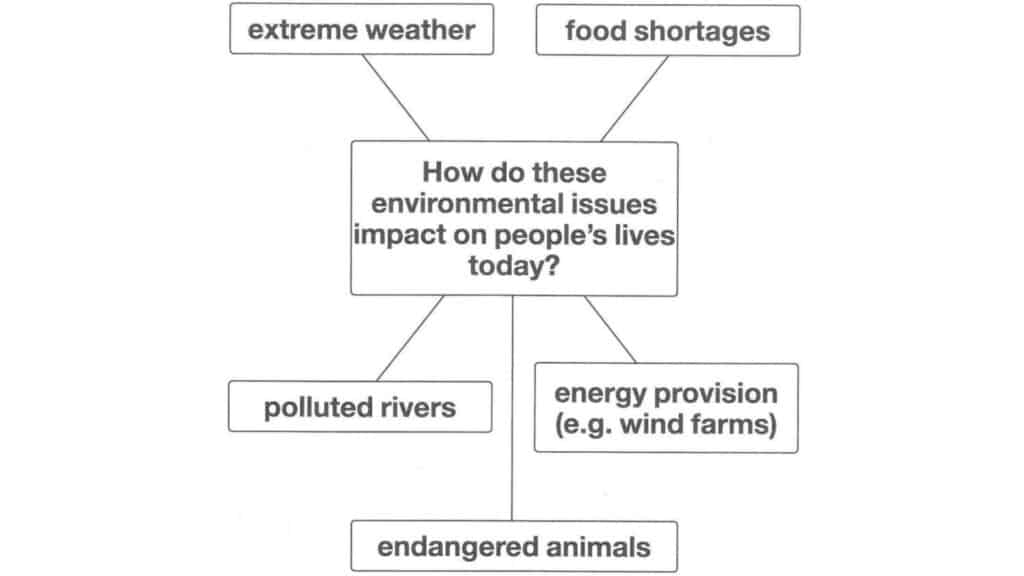
Sample Answer – Discussion
There is two minutes to discuss how each part influences the central question.
A: Shall I begin?
B: Yes, go ahead.
A: I think extreme weather is one of the most immediate issues people face. Floods, droughts, and heatwaves can disrupt daily life, damage homes, and affect transport and agriculture. What do you think?
B: Absolutely. And don’t you think food shortages are often a result of that. When crops fail due to weather or pollution, prices rise and people struggle to afford basics – especially in vulnerable areas.
A: Yes, and in my opinion polluted rivers also play a part. They not only harm wildlife but also affect drinking water and farming, especially in communities that rely directly on river systems.
B: That’s true. I also think energy provision is becoming more important. With the move towards wind farms and solar power, people are having to adapt, but some see the change as expensive or inconvenient in the short term. What about you?
A: I completely agree. And endangered animals might seem less directly related to daily life, but they’re part of larger ecosystems that keep our planet in balance. Losing them can affect things like pollination, pest control, and tourism.
Sample Answer – Reaching a Decision
There is one minute for the candidates to reach a decision about which environmental issue has the biggest impact on people’s lives.
B: I’d say extreme weather – it’s so visible and affects people across the globe in very immediate ways.
A: I agree, especially because it’s linked to food shortages and even energy supply. Maybe extreme weather and food shortages together?
B: Yes, they’re very closely connected and probably affect the most people.
A: Let’s go with those two then.
CAE Speaking Part 4 Quiz: Are You The Best?

C1 Advanced Speaking Part 4
One candidate is asked a Part 4 question, then the other one is asked to give a shorter opinion on it too.
Questions
- Do you feel that people are fully aware of the environmental problems we face these days?…(Why? / Why not?)
- Some people say that it won’t be possible to reverse any environmental damage done so far. What’s your view?
- Do you think it’s a good idea to encourage children to cycle from an early age?…(Why? / Why not?)
- Do you think it would be a good idea to reward people for the amount of rubbish they recycle?…(Why? / Why not?)
- Charities raise a lot of money for the environment. How helpful do you think this fundraising is?…(Why? / Why not?)
- Some people say we should only live for today and not be concerned about the future. Do you agree?…(Why? / Why not?)
Sample Answers
1. Do you feel that people are fully aware of the environmental problems we face these days? Why / Why not?
I think people are more aware than in the past, but many still don’t fully understand how serious the situation is. Topics like climate change and plastic pollution are in the news, but not everyone connects these issues to their everyday actions. Some choose to ignore the problem because it feels too overwhelming. Awareness is improving, but there’s still a long way to go.
2. Some people say that it won’t be possible to reverse any environmental damage done so far. What’s your view?
I believe that while we may not be able to undo all the damage, we can definitely reduce its impact. For example, reforestation and cleaner energy sources are already making a difference. It might take time and global cooperation, but giving up completely would only make things worse. Even small improvements are better than none at all.
3. Do you think it’s a good idea to encourage children to cycle from an early age? Why / Why not?
Yes, absolutely. Cycling is a healthy habit, and starting early helps children build confidence and independence. It also teaches them about sustainability and reduces the need for car travel. Of course, it’s important to make sure it’s safe for them, but overall it’s a very positive step.
4. Do you think it would be a good idea to reward people for the amount of rubbish they recycle? Why / Why not?
Yes, I think rewards can be a good motivation, especially for people who wouldn’t otherwise make the effort. It creates a sense of responsibility and turns recycling into something more rewarding. However, it should be combined with education so that people understand why it matters and don’t just do it for the reward.
5. Charities raise a lot of money for the environment. How helpful do you think this fundraising is? Why / Why not?
I think it’s very helpful, especially when the money goes to well-organised projects. Charities often support research, conservation, and education campaigns that governments may not prioritise. They also raise public awareness and get communities involved. Fundraising alone isn’t enough, but it’s a valuable part of the solution.
6. Some people say we should only live for today and not be concerned about the future. Do you agree? Why / Why not?
I disagree with that view. Of course, it’s important to enjoy the present, but ignoring the future can lead to serious problems. Planning ahead helps us make better decisions, especially when it comes to issues like health, finance, or the environment. A balanced approach is best—live in the moment, but keep an eye on what lies ahead.
Related Content
18 Terrific Ways to Improve Your C1 Advanced Speaking

One of the most effective ways to prepare for your C1 Advanced Speaking test is to watch this official test video. Such videos provide a realistic view of the test,…
Better C1 Advanced Speaking Part 2: Answer Structure

C1 Advanced Speaking Part 2 is a critical section of the exam where you need to deliver a well-structured, fluent, and engaging talk, should only take one minute. Whether you’re…
Better Discussions for C1 Advanced Speaking Part 3

In C1 Advanced Speaking Part 3, you and the other student need to discuss the different options of the central theme, described in the mind map or picture. You need…
C1 Advanced Speaking Information and Advice

Many students seem to miss basic facts about the C1 Advanced Speaking test, so this page is to fill in some of that missing information. There are also separate pages…
C1 Advanced Speaking Part 1 Information and Advice

Many students seem to miss basic facts about the C1 Advanced Speaking Part 1, so this page is to fill in some of that missing information about Part 1. There…
C1 Advanced Speaking Part 1 Questions

Introduction Many students think that the Speaking Part 1 questions in C1 Advanced are the easiest and simplest of the four parts, but it is a great time to show…
C1 Advanced Speaking Part 1 Quiz: Do You Know Enough?

Many think of C1 Advanced Speaking Part 1 as the easiest part, but you should be aware that every part of the speaking test is considered just as important as…
C1 Advanced Speaking Part 1 Sample Answers
This is a list of sample answers for C1 Advanced Speaking Part 1 questions. There are three different methods for answering each question. All have transcripts of the answers. Some…
C1 Advanced Speaking Part 1: 4 Great Tips

Many students think that the C1 Advanced Speaking Part 1 questions are the easiest and simplest of the four parts, but it is a great time to show off what…
C1 Advanced Speaking Part 1: How to Vary Your Answers

Introduction Many students think that the questions in C1 Speaking Part 1 in the C1 Advanced English test are the easiest and simplest of the four parts, but it is…
C1 Advanced Speaking Part 2 Information and Advice

Many students seem to miss basic facts about the C1 Advanced Speaking Part 2, so this page is to fill in some of that missing information about Part 2. There…
C1 Advanced Speaking Part 2 Quiz: Enough Time for You?

Do you know as much about C1 Advanced Speaking Part 2 as you think do? Take this quiz to test your knowledge. There’s nothing worse than being unprepared, especially when…
C1 Advanced Speaking Part 2 Sample Answers
This is a list of sample answers for C1 Advanced Speaking Part 2 questions. All have transcripts of the answers. Some have video, some audio. Home > C1 Advanced >…
C1 Advanced Speaking Part 2: Compare and Contrast

C1 Advanced Speaking Part 2 is a tricky part of the speaking test. It seems easy because you are given photos to contrast and compare, but you only have a…
C1 Advanced Speaking Part 2: People Vocabulary

In C1 Advanced Speaking Part 2, you need to choose two pictures from a set of three, then compare and contrast them while answering the two questions. You need to do…
C1 Advanced Speaking Part 2: Planning

C1 Advanced Speaking Part 2 is a tricky part of the test which really worries many candidates. A reliable route to a confident Part 2, is to use dedicated practice,…
C1 Advanced Speaking Part 2: Speculating

In C1 Advanced Speaking Part 2, you need to choose two pictures from a set of three, then compare and contrast them while answering the two questions. You need to do…
C1 Advanced Speaking Part 3 Information and Advice

Many students seem to miss basic facts about C1 Advanced Speaking Part 3, so this page is to fill in some of that missing information about Part 3. There is…
C1 Advanced Speaking Part 3 Quiz: Do You Know?

Although you have other test takers to speak to in Part 3, it’s easy to let them influence you too much. Take this quiz to test what you know about…
C1 Advanced Speaking Part 3: Asking for, and Giving Opinions

In C1 Advanced Speaking Part 3, test takers need to discuss the topics in the given diagram. To do this, they need to ask for and give opinions as well…