For most IELTS Speaking test-takers, knowing what they need to do to get a higher band score is extremely vague. It is almost impossible for them to predict what score they will get, so often, they can only use their last IELTS Speaking test score as a guide.
Home > IELTS > Speaking > Sample Answers
Chat GPT has created these sample answers so such students can discover the changes they need to make to their speaking responses to improve their results and reach their target IELTS Speaking score.
This page is for the IELTS Speaking Part 2 question below and its associated Part 3 questions:
Describe a place in your city you have been to where you can see wildlife (eg. animals, birds, insects, plants)
You should say
Where it is
When you went there
What animals you saw there
How you feel about the place
Pros and Cons of This Method
Pros:
- Grammar: You can easily see the differences in the grammar used in each question.
- Vocabulary: You can easily see how the words and phrases are to a higher standard as the scores improve.
- Fluency and Coherence: As the score improves, you can see the increased use of sequence or discourse markers to assure the listener knows what is happening and when.
- Pronunciation: This is worth 20% of your score, so you should pay attention to the differences here. A simple way to improve
Cons:
- Grammar: Although there are differences between the answers, there are no mistakes, which is uncommon for these band scores.
- Vocabulary: While it is easy to see what is needed, to use better vocabulary, you need to practice seriously so you can include it fluently in your answers.
- Fluency and Coherence: There are very few pauses or hesitations which usually mark an IELTS Speaking test-takers Part 2 response.
- Pronunciation: Obviously, without audio or video, it’s impossible to get an example of the differences between the scores.
Author’s Thoughts:
- Video. Although it seems to be standard to put a video on YouTube with a teacher’s own answer to these questions, I don’t have the time or the patience to do that.
- Why Chat GPT?: I can make more sample answers with Chat GPT in a short time. Anyone could do that, but many don’t want to or are too lazy.
- Different scores: The idea is to show the differences between the answers, rather than having perfect answers. Some of these answers are too short, or they repeat the question in the first sentence. They are not perfect, but they inform students what they need to do to improve!
- Me: I used to make videos of speaking answers, but it’s not about me or how good my course is, or how many likes I get on Instagram or YouTube. It’s about trying to help you pass your speaking test and changing your life.
- You: If you have any ideas on how this could be improved, any other pros and cons, or would just like to comment, please use the comment box at the bottom of the page. If you like the content, please share it.
IELTS Speaking Part 2 Quiz: It Doesn’t Need to be Hell!


IELTS Speaking Part 2 AI Answers
Describe a place in your city you have been to where you can see wildlife (eg. animals, birds, insects, plants)
You should say
Where it is
When you went there
What animals you saw there
How you feel about the place
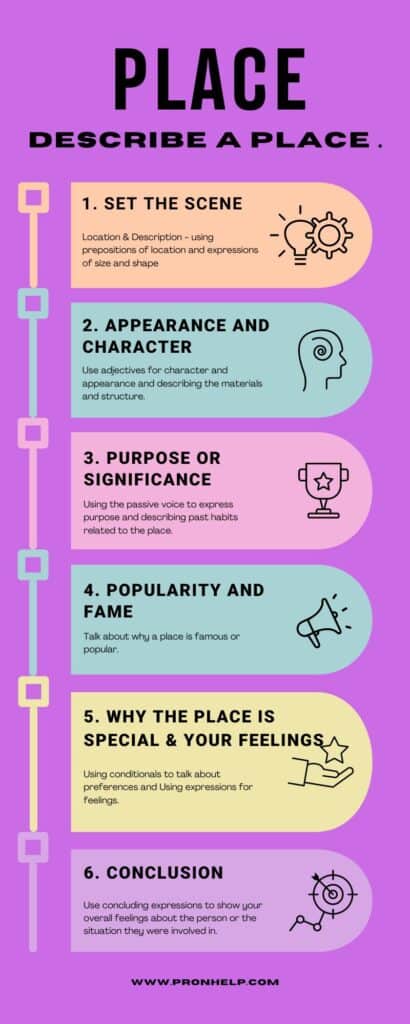
Compare the different band scores to check what you can do to improve your score!
IELTS Band 6 Answer and Explanation
I want to talk about a park in my city called Greenfield Park. It’s located in the north part of the city, near the river. I went there last weekend with my family. The park is quite big, with lots of trees and a small lake in the middle. You can also see lots of birds, like ducks and pigeons, near the water.
When I was there, I saw some squirrels running around the trees and some insects, like butterflies and bees, flying around the flowers. The park is really peaceful, and I like going there because it’s a good place to relax and see nature. I feel happy when I’m there because it’s very quiet, and I can get away from the busy city life.
In conclusion, Greenfield Park is a nice place to visit if you want to enjoy nature and see some wildlife. I’ll probably go again soon because it’s a great place to spend time with family and get fresh air.
Explanation of Band 6:
- Grammar: Basic sentence structures using the present and past simple. Occasional use of prepositions but limited complexity.
- Vocabulary: Simple adjectives like “big,” “peaceful,” and repetitive expressions like “nice place.”
- Fluency and Coherence: Speech is clear but basic, with a few hesitations.
- Pronunciation: Clear but somewhat flat and lacking natural stress or rhythm.
IELTS Band 7 Answer and Explanation
One of my favorite places to see wildlife in the city is Greenfield Park, which is located on the northern edge of town, close to the river. I went there last Saturday with my family. The park is quite large, and it’s shaped like a long rectangle. There’s a small lake in the center, and around it, there are trees and open grassy areas where you can spot a lot of wildlife.
During our visit, we saw ducks and geese near the lake, and I even saw a few squirrels running up the trees. There were also lots of butterflies fluttering around the flower beds, which made the place feel very lively. Greenfield Park is a peaceful spot, and it’s popular with locals who want to escape the noise of the city. I always feel calm when I’m there, and I love how it offers a bit of nature in the middle of the urban environment.
Overall, it’s a special place for me because it provides a much-needed break from city life, and it’s a great place to enjoy wildlife without having to leave the city.
Explanation of Band 7:
- Grammar: More complex structures, including prepositions, adjectives, and some passive voice. Greater variety in sentence length and complexity.
- Vocabulary: Broader range of adjectives, such as “lively,” “calm,” and phrases like “provides a much-needed break.”
- Fluency and Coherence: Speech is more natural with few hesitations, and ideas are clearly linked.
- Pronunciation: Clear with better intonation and rhythm, making the speech more engaging.
IELTS Band 8 Answer and Explanation
IELTS Band 8 Answer:
I’d like to describe Greenfield Park, which is one of the largest green spaces in my city. It’s located in the northern part of town, next to the river, and it stretches for several kilometers in a rectangular shape. I visited it last weekend with my family to enjoy the outdoors. The park itself is quite beautiful, with a lake at the center and plenty of trees lining the walking paths. It’s designed in such a way that it feels like a natural haven in the middle of the city.
When we were there, I noticed a variety of wildlife. Ducks and geese were swimming near the lake, while squirrels darted around the trees, climbing and playing. What struck me the most were the butterflies and bees hovering over the flower beds, which made the whole park feel alive with nature. Greenfield Park is a well-known spot for locals and tourists alike, especially those interested in birdwatching or simply enjoying a quiet day surrounded by greenery.
For me, this place holds a special significance because it offers a sense of calm that you don’t often find in the city. If it weren’t for this park, I think I’d find the city a lot more stressful. Every time I visit, I feel recharged and connected to nature.
To conclude, Greenfield Park is a peaceful and vibrant place that gives people a chance to appreciate wildlife without having to travel far from the city center.
Explanation of Band 8:
- Grammar: Wide range of complex structures, including conditionals and passive voice. Ideas are clearly developed with sophisticated language.
- Vocabulary: High-level adjectives and expressions like “natural haven,” “struck me,” and “recharged and connected to nature.”
- Fluency and Coherence: Speech flows smoothly with no significant pauses, and ideas are well connected.
- Pronunciation: Clear with natural rhythm, stress, and intonation, making the speech highly engaging.
Key Differences Between the Band Scores:
Grammar:
- Band 6 uses basic grammar structures with simple prepositions and limited sentence variety.
- Band 7 introduces more complex structures, including passive voice and varied sentence types.
- Band 8 demonstrates a wide range of grammatical constructions, including conditionals and more sophisticated linking phrases.
Vocabulary:
- Band 6 relies on basic adjectives and limited vocabulary for description.
- Band 7 has a wider range of descriptive adjectives and phrases, like “escape the noise” and “lively.”
- Band 8 uses advanced vocabulary and phrases that convey more nuanced meanings, such as “natural haven” and “connected to nature.”
Fluency and Coherence:
- Band 6 shows some hesitation and repetition, while Band 7 is more fluent with only minor pauses.
- Band 8 is fluent and cohesive, with ideas logically progressing and no hesitations.
Pronunciation:
- Band 6 is clear but lacks variation in intonation.
- Band 7 has more natural intonation and stress.
- Band 8 features smooth, dynamic speech with natural rhythm and expressive intonation.
IELTS Speaking Part 3 Quiz: Do You Know it All?

IELTS Speaking Part 3 AI Answers
Compare the different band scores to check what you can do to improve your score!
IELTS Speaking Part 3 Band 6 Answers:
IELTS Band 6 Answers:
1. Why are most children interested in wild animals?
Children like wild animals because they are different from pets. Wild animals are big, strong, and sometimes dangerous, which makes them interesting. Also, many children watch cartoons or read books about animals, so they like them.
2. Should parents take their children to the zoo to see wild animals?
Yes, I think parents should take their children to the zoo. It’s a good way to learn about animals. Children can see them up close, and it’s fun for them. They can also learn to respect animals.
3. Are wild animals easy to spot in your country?
No, in my country, it’s not easy to see wild animals. Most animals live in forests, and many people live in cities. You usually have to go to a zoo or wildlife park to see them.
4. Are there many documentaries about wildlife in your country?
Yes, there are some documentaries about wildlife on TV, but not too many. Most people watch foreign documentaries because they are more popular. Sometimes there are local shows about the animals in our country.
5. What impact does only seeing wild animals in zoos have on children’s understanding of these animals?
If children only see animals in zoos, they might not understand how animals live in the wild. Zoos are different from nature. But zoos are good because children can still learn about animals and see them in real life.
6. Which is the better way to see wildlife, watching documentaries or going into the wild?
Watching documentaries is easier and safer, but going into the wild is more exciting. You can see animals in their natural home. I think both are good ways to learn about wildlife.
Explanation of Band 6:
- Grammar: Basic sentence structures with limited complexity, mainly using simple tenses.
- Vocabulary: Limited vocabulary, with repetition of basic words like “see,” “learn,” and “good.”
- Fluency and Coherence: Responses are clear but lack depth. Some hesitation, and ideas are not always well-developed.
- Pronunciation: Understandable, but lacks variety in stress and intonation, making it sound less engaging.
IELTS Speaking Part 3 Band 7 Answers:
IELTS Band 7 Answers:
1. Why are most children interested in wild animals?
Children are naturally curious, and wild animals are often very different from what they experience in daily life. Animals like lions, tigers, and elephants seem exotic and exciting to them. They also encounter these animals in cartoons, movies, and books, which makes them even more fascinated.
2. Should parents take their children to the zoo to see wild animals?
Yes, I think parents should take their children to the zoo, but it’s important to choose a zoo where animals are treated well. Zoos can help children learn more about wildlife and conservation, and it’s a fun experience for them to see animals up close.
3. Are wild animals easy to spot in your country?
No, not really. Wild animals are mostly found in protected areas or national parks, and it’s quite rare to see them in cities or towns. However, if you travel to the countryside or forest areas, you might spot some wild animals like deer or birds.
4. Are there many documentaries about wildlife in your country?
Yes, we have quite a few wildlife documentaries available, especially on channels like National Geographic and local television. These documentaries focus on different species and habitats, both local and international, which helps people learn more about wildlife.
5. What impact does only seeing wild animals in zoos have on children’s understanding of these animals?
If children only see animals in zoos, their understanding may be limited. Zoos can’t replicate the natural environment, so children might not fully understand how these animals behave in the wild. However, zoos can still provide important educational information.
6. Which is the better way to see wildlife, watching documentaries or going into the wild?
Watching documentaries is informative and accessible, but I think going into the wild offers a more immersive experience. In the wild, you can see animals in their natural habitat, which gives you a better understanding of how they live. However, documentaries are useful for learning about animals you can’t easily see in real life.
Explanation of Band 7:
- Grammar: Uses more complex structures, including conditional statements and passive voice.
- Vocabulary: A wider range of vocabulary is used, including more specific terms like “conservation” and “natural habitat.”
- Fluency and Coherence: Generally fluent, with well-organized and developed ideas. Occasional hesitations but overall coherent responses.
- Pronunciation: Clear with more varied intonation and rhythm, making speech more engaging.
IELTS Speaking Part 3 Band 8 Answers:
IELTS Band 8 Answers:
1. Why are most children interested in wild animals?
Children are inherently fascinated by the unknown, and wild animals represent a world they don’t typically encounter. The size, power, and mystery of animals like tigers, elephants, and whales spark their imagination. Media, like documentaries and animated films, also play a huge role in sustaining this interest by making these creatures seem both accessible and magical.
2. Should parents take their children to the zoo to see wild animals?
Yes, I believe taking children to the zoo can be an educational experience if done responsibly. However, I think it’s essential for parents to explain the difference between animals in captivity and those in the wild. Zoos offer children a rare opportunity to see animals up close, which can inspire interest in conservation efforts, but it’s crucial that the welfare of the animals is a priority.
3. Are wild animals easy to spot in your country?
Not really. Most wild animals in my country are confined to remote national parks and conservation areas. You’d have to travel quite far to see animals like leopards or elephants. In urban areas, the closest you’ll get to wildlife are birds and small mammals, but larger, more exotic species are rarely spotted outside their natural habitats.
4. Are there many documentaries about wildlife in your country?
Yes, there are plenty of wildlife documentaries available, especially on popular streaming platforms and national TV channels. These documentaries range from global series to those focusing on the local ecosystem, which help raise awareness about endangered species and the importance of conservation.
5. What impact does only seeing wild animals in zoos have on children’s understanding of these animals?
When children only see animals in zoos, their understanding may become somewhat skewed. They may not grasp the complexity of the animal’s natural behavior or environment because a zoo, no matter how well-designed, is an artificial setting. This limited view could prevent them from appreciating the real challenges these animals face in the wild.
6. Which is the better way to see wildlife, watching documentaries or going into the wild?
While documentaries offer an in-depth, safe, and informative way to observe animals, there’s nothing quite like seeing wildlife in its natural habitat. It provides a more authentic and emotional experience, as you witness animals interacting in their own environment. That said, for many people, documentaries are the only practical way to see certain species, and they offer a wealth of information.
Explanation of Band 8:
- Grammar: Mastery of complex structures, such as conditional clauses, passive voice, and relative clauses.
- Vocabulary: Sophisticated and precise vocabulary, including terms like “artificial setting,” “ecosystem,” and “conservation efforts.”
- Fluency and Coherence: Speech is highly fluent and coherent, with smooth transitions between ideas. No hesitations, and responses are well-developed and thoughtful.
- Pronunciation: Clear with excellent use of stress, rhythm, and intonation, making the speech dynamic and engaging.
Key Differences Between the Band Scores:
Key Differences Between the Band Scores:
Grammar:
- Band 6 uses basic grammar with mostly simple sentences and limited complexity.
- Band 7 incorporates more complex sentence structures, like conditionals and passive voice.
- Band 8 demonstrates complete mastery of grammar, using varied and sophisticated sentence types.
Vocabulary:
- Band 6 uses simple and repetitive vocabulary with limited precision.
- Band 7 expands on vocabulary, using more specific terms related to the topic.
- Band 8 employs advanced and precise vocabulary with natural collocations and idiomatic expressions.
Fluency and Coherence:
- Band 6 has some hesitations and lacks depth in answers.
- Band 7 is mostly fluent with more developed ideas and clearer structure.
- Band 8 is entirely fluent, with well-organized and elaborated responses that flow smoothly.
Pronunciation:
· Band 6 is understandable but flat in terms of intonation and stress.
· Band 7 shows more varied and natural intonation patterns.
· Band 8 features dynamic and natural pronunciation, with excellent control of stress and intonation.
Related Content
21 Simple Steps to the IELTS Speaking Score You Want

Achieving a high score in the IELTS Speaking test requires both practice and strategy. While there are many methods to help you improve, these 21 tips will make a significant…
How to Answer If You Know Nothing in IELTS Speaking

Taking tests such as IELTS Speaking are extremely challenging for many reasons, with one of the main ones being that a certain amount of life experience is needed to be…
How to Avoid Making Sweeping Statements

Sweeping statements are statements which cover a broad topic in a concise or even terse manner. They make it seem as if everybody does something. This is really common in…
How to Best Use the Latest IELTS Speaking Questions

There are several pages on this site that are dedicated to the ‘latest’ IELTS speaking questions. These questions are released for three periods of four months each year. January to…
How to Describe A Person: The Ultimate Guide

In IELTS Speaking Part 2, it is really common to be asked to describe a person. Whether it they are an old person, someone who is patient, a relative you…
How to Describe a Place: The Ultimate Guide

In the IELTS Speaking test, especially in Part 2, candidates are often asked to describe a place. Whether it’s a flat you would like to own, a favorite spot in…
How to Describe a Time or Event: The Ultimate Guide

In the IELTS Speaking test, especially in IELTS Speaking Part 2, candidates are often asked to describe a time when they did something memorable or significant. This guide will walk…
How to Easily Boost Your IELTS Vocabulary Score

If your job or course involves technical language in English, integrating it into your IELTS vocabulary in your speaking responses can significantly enhance your performance. By steering your answers toward…
How to Eliminate Hesitation in IELTS Speaking Part 2

In IELTS Speaking Part 2, the examiner will give you a cue card. You have one minute to make some notes to help you speak on that topic/question for between…
How to Speak for Longer in IELTS Speaking Part 2

This is a great way to extend your answer for IELTS Speaking Part 2. You use a strategy to suit the question, you do well, but there is still too…
How to Use Chunking in IELTS Speaking Part 2

Don’t memorise your answers in IELTS Speaking Part 2, that’s one of the worst things you can do. It’s really easy for an examiner to know when IELTS Speaking test…
How to Use Natural English Expressions for Better Precision

Improve Your Skills! Master that feeling that you MUST answer correctly by using these natural expressions to show what you know or don’t know about a topic. There is no…
How to Zoom In: The Most Useful Technique for IELTS Speaking

Imagine you are just starting to watch your favourite TV series. The theme music is playing, you see a view of a city, then a neighbourhood, then a street, then a…
IELTS Speaking
Latest questions, sample answers as well as many resources that will boost your journey to IELTS speaking success, Strategies for each part of the test! IELTS Speaking General IELTS Speaking…
IELTS Speaking Format, Preparation and 8 Great Hacks for Success

It’s madness to go into any English-speaking test expecting to do well. The IELTS Speaking test is demanding, so you should use any knowledge you can glean to your advantage….
IELTS Speaking Part 1 Format and 6 Simple Little Tricks To Help You

Many students think IELTS Speaking Part 1 is easy. It is an ideal time to add more challenging English, but knowing little tricks helps too. Know the format, how to…
IELTS Speaking Part 1 Questions

Many students think that the IELTS Speaking Part 1 questions are the easiest and simplest of the three parts, but it is a great time to show off what you…
IELTS Speaking Part 1 Quiz: Is It as Easy as You Think?

Test your IELTS Speaking Part 1 knowledge by taking this quick quiz. How much do you really know about this part of the speaking test? Try it and find out!…
IELTS Speaking Part 1 Sample Answers
This is a list of sample answers for IELTS Speaking Part 1 questions. All have transcripts of the answers. Some of them have video, some audio. Home > IELTS >…
IELTS Speaking Part 1: 16 Great Ways Start Your Test!

Many students think that the IELTS Speaking Part 1 Questions are the easiest and simplest of the three parts, but it is a great time to show off what you…
IELTS Speaking Part 2 – Phrases and Vocabulary

Here are some sentences and phrases to help you with IELTS Speaking Part 2. These are particularly useful for students who are using one of my strategies. This is a…
IELTS Speaking Part 2 Quiz: It Doesn’t Need To Be Hell!

Most students fear Part 2 of the IELTS Speaking test, but using strategies common to every topic, it can really boost your speaking score. How much do you know about…
IELTS Speaking Part 2 Sample Answers
This is a list of sample answers for IELTS Speaking Part 2 questions. All have transcripts of the answers. Some have video, some audio. Home > IELTS > Speaking > Part 2
IELTS Speaking Part 2: Format, Tips, and 5 Powerful Hacks

Are you worried about your IELTS Speaking test? Many students feel overwhelmed, especially when it comes to Part 2 of the exam. But fear not! This guide will help you…
IELTS Speaking Part 3 – Quantities and Types of People

In IELTS Speaking Part 3, when many questions ask about ‘people’ or ‘children’ or ‘businesses’, it is much easier to answer if you use expressions for quantities of people and…