For most IELTS Speaking test-takers, knowing what they need to do to get a higher band score is extremely vague. It is almost impossible for them to predict what score they will get, so often, they can only use their last IELTS Speaking test score as a guide.
Home > IELTS > Speaking > Sample Answers
An AI has created these sample answers so such students can discover the changes they need to make to their speaking responses to improve their results and reach their target IELTS Speaking score.
This page is for the IELTS Speaking Part 2 question below and its associated Part 3 questions:
Describe a person who has chosen a career in the medical field (e.g. a doctor, a nurse)
You should say:
Who he/she is
What he/she does
Why he/she chose this career
And explain how you feel about him/her
Pros and Cons of This Method
Pros:
- Grammar: You can easily see the differences in the grammar used in each question.
- Vocabulary: You can easily see how the words and phrases are to a higher standard as the scores improve.
- Fluency and Coherence: As the score improves, you can see the increased use of sequence or discourse markers to assure the listener knows what is happening and when.
- Pronunciation: This is worth 20% of your score, so you should pay attention to the differences here. A simple way to improve
Cons:
- Grammar: Although there are differences between the answers, there are no mistakes, which is uncommon for these band scores.
- Vocabulary: While it is easy to see what is needed, to use better vocabulary, you need to practice seriously so you can include it fluently in your answers.
- Fluency and Coherence: There are very few pauses or hesitations which usually mark an IELTS Speaking test-takers Part 2 response.
- Pronunciation: Obviously, without audio or video, it’s impossible to get an example of the differences between the scores.
Author’s Thoughts:
- Video. Although it seems to be standard to put a video on YouTube with a teacher’s own answer to these questions, I don’t have the time or the patience to do that.
- Why AI?: I can make more sample answers with an AI in a short time. Anyone could do that, but many don’t want to or are too lazy.
- Different scores: The idea is to show the differences between the answers, rather than having perfect answers. Some of these answers are too short, or they repeat the question in the first sentence. They are not perfect, but they inform students what they need to do to improve!
- Me: I used to make videos of speaking answers, but it’s not about me or how good my course is, or how many likes I get on Instagram or YouTube. It’s about trying to help you pass your speaking test and changing your life.
- You: If you have any ideas on how this could be improved, any other pros and cons, or would just like to comment, please use the comment box at the bottom of the page. If you like the content, please share it.
IELTS Speaking Part 2 Quiz: It Doesn’t Need to be Hell!


IELTS Speaking Part 2 AI Answers
Describe a person who has chosen a career in the medical field (e.g. a doctor, a nurse)
You should say:
Who he/she is
What he/she does
Why he/she chose this career
And explain how you feel about him/her
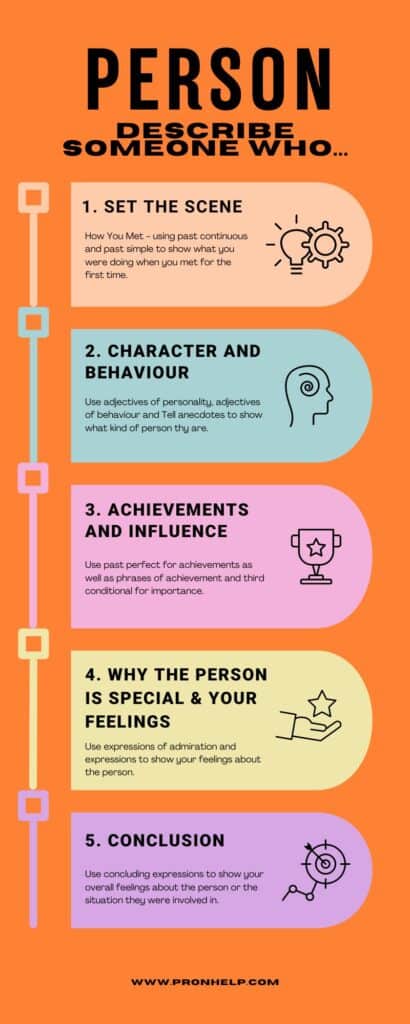
IELTS Band 6 Answer:
I’d like to talk about my cousin, Sarah. She’s a nurse at a hospital in my city. We met when I was, um, around 8 years old, and we’ve always been quite close. Sarah is a very kind person. She always helps others and takes care of her family too. One time, I remember, she, um, stayed up all night to help my grandmother when she was sick.
Sarah decided to become a nurse because she likes helping people. She thought it was a good job for her since she loves being around people and wants to do something useful for the community. I think, um, being a nurse is not easy, but she’s really good at it.
I really admire Sarah. She works hard, and even though her job is difficult, she always stays positive. I feel proud of her because she’s helping people every day, and I hope one day I can be as hardworking as her.
Explanation of Band 6:
- Grammar: Basic use of past tenses with occasional hesitation. Errors like overusing “um” and simple past continuous constructions, but generally understandable.
- Vocabulary: Simple adjectives like “kind,” “helpful,” and repetitive phrases like “helping people.”
- Fluency and Coherence: Slight hesitations, and lacks complex structures or variety in sentence length.
- Pronunciation: Clear but slightly monotonous with limited intonation.
IELTS Band 7 Answer:
I want to talk about my cousin Sarah, who’s been working as a nurse in one of the busiest hospitals in our city. We first met when I was a child, and we’ve stayed in touch ever since. She’s always been a caring and compassionate person, which I think is why she chose this career. I remember once, she spent the whole night taking care of my grandmother when she was seriously ill. This shows her dedication and commitment to her work.
Sarah became a nurse because she wanted to do something meaningful. She was always fascinated by medicine and the idea of helping others. I believe she felt that nursing was a career where she could make a difference. She’s achieved a lot in her job, and the hospital even recognized her efforts by awarding her Nurse of the Year. If she hadn’t chosen this path, I’m not sure how she would have found a career as fulfilling.
I feel really proud of Sarah. I admire how hardworking she is, and I think her job is incredibly tough, both physically and emotionally. It’s not something I could do, but Sarah manages it with grace and positivity, and I really respect her for that.
Explanation of Band 7:
- Grammar: More complex sentence structures and varied use of tenses (simple past, past continuous, and past perfect).
- Vocabulary: More specific vocabulary, like “fascinated by medicine” and “dedication.”
- Fluency and Coherence: Generally smooth, with fewer hesitations, but still some minor pauses.
- Pronunciation: Clear with some natural intonation and stress patterns.
IELTS Band 8 Answer:
I’d like to talk about my cousin Sarah, who has dedicated her life to nursing. We met, or rather, I first got to know her well, when I was quite young, and from the start, I noticed her compassion and selflessness. She’s been working in a busy hospital for over 10 years now, and I’ve always admired her dedication. Once, when our grandmother was seriously ill, Sarah stayed up for several nights in a row, making sure she was comfortable. That memory has always stuck with me.
Sarah’s choice to pursue nursing wasn’t a surprise to anyone who knew her. She’s always had a strong desire to make a difference in people’s lives, and she felt that working in the medical field would allow her to do exactly that. In fact, she had even been awarded a prestigious recognition as Nurse of the Year for her achievements at the hospital. Had she not chosen this path, I think she would have found another way to contribute to society, but nursing seems to be her calling.
I have nothing but admiration for Sarah. I think it takes a special kind of person to do what she does, day in and day out, and still maintain such a positive attitude. Her work is incredibly demanding, both physically and emotionally, and yet, she handles it with grace. I feel inspired by her, and it’s made me appreciate the medical profession even more.
Explanation of Band 8:
- Grammar: Wide range of structures, including past perfect and conditional. Uses more complex linking phrases (e.g., “Had she not chosen this path”).
- Vocabulary: Higher-level vocabulary like “selflessness,” “prestigious recognition,” and “contribute to society.”
- Fluency and Coherence: Very smooth and natural, with a wide variety of sentence structures. Ideas flow logically.
- Pronunciation: Clear, with natural rhythm and intonation that makes the speech sound very fluent.
Key Differences Between the Band Scores:
Grammar:
- Band 6 uses basic tenses with occasional mistakes.
- Band 7 introduces more complex structures, like past perfect.
- Band 8 shows mastery of a wide range of tenses, including third conditionals.
Vocabulary:
- Band 6 uses basic adjectives and repetitive phrases.
- Band 7 has a broader range of adjectives and more descriptive expressions.
- Band 8 employs advanced vocabulary with precise word choices.
Fluency and Coherence:
- Band 6 has more hesitations and simpler sentences.
- Band 7 shows better flow with occasional pauses for thought.
- Band 8 is fluent and cohesive with varied sentence structures and logical progression of ideas.
Pronunciation:
- Band 6 is clear but flat in intonation.
- Band 7 is more dynamic with some intonation.
- Band 8 uses natural stress patterns and rhythm, enhancing the expressiveness of the answer.
IELTS Speaking Part 3 Quiz: Do You Know it All?

IELTS Speaking Part 3 AI Answers
IELTS Band 6 Answers:
1. Do you think doctors and nurses are very important?
Yes, I think doctors and nurses are very important. They help people who are sick or injured. Doctors give medicine, and nurses take care of the patients. Without them, many people would not get better. They do a good job.
2. Who plays a more important role, doctors or nurses?
I think both are important, but maybe doctors are more important because they decide the treatment. Nurses help the patients, but doctors make the big decisions, so I think doctors are more important.
3. Do you think that doctors and nurses are not paid enough?
I don’t think they are paid enough. Their jobs are very hard, and they have to work long hours. I think they should be paid more because they do a lot for people.
4. Do you think it is necessary to learn first aid skills?
Yes, I think it’s necessary. If you know first aid, you can help people in an emergency before the doctor comes. It’s good to know how to help others in dangerous situations.
5. What are the differences between the work of a doctor and a nurse?
Doctors and nurses have different jobs. Doctors check the patients and give medicine. Nurses take care of the patients, like giving them food and checking their health. Doctors make the big decisions, and nurses help with smaller things.
6. Can a hospital function effectively without nurses?
No, I don’t think so. Nurses do a lot of work, like helping the patients and doing things the doctors don’t have time for. A hospital needs nurses to work well.
Explanation of Band 6:
- Grammar: Basic sentence structures with simple tenses. Some errors but generally understandable. Limited use of complex sentences.
- Vocabulary: Simple, repetitive words like “important” and “good job” with limited range.
- Fluency and Coherence: Speech is clear but lacks fluency, with some pauses and hesitations. Ideas are straightforward but not developed in depth.
- Pronunciation: Clear but may lack stress and intonation variety.
IELTS Band 7 Answers:
1. Do you think doctors and nurses are very important?
Yes, I believe doctors and nurses are extremely important because they save lives and provide essential healthcare. Without them, people wouldn’t receive the treatment they need, and illnesses could become much worse. They play a crucial role in maintaining public health.
2. Who plays a more important role, doctors or nurses?
I think both doctors and nurses are equally important, but they have different responsibilities. Doctors diagnose and decide on treatment, while nurses take care of patients daily and ensure they recover well. Without one, the other’s job would be much more difficult, so both are essential.
3. Do you think that doctors and nurses are not paid enough?
In many countries, I believe doctors and nurses are underpaid considering the hard work they do. They work long hours and deal with high-stress situations, and their work has a direct impact on people’s lives. I think they deserve better pay for their contribution to society.
4. Do you think it is necessary to learn first aid skills?
Yes, learning first aid is very important. It allows ordinary people to respond to emergencies and potentially save lives before professional help arrives. First aid skills are useful not only in emergencies but also for minor injuries and health issues.
5. What are the differences between the work of a doctor and a nurse?
Doctors focus more on diagnosing illnesses and deciding on treatment plans, while nurses are involved in the day-to-day care of the patients. Nurses monitor the patients’ progress, administer medication, and provide emotional support. While doctors deal with more complex medical decisions, nurses play a key role in patient recovery.
6. Can a hospital function effectively without nurses?
No, a hospital would not function properly without nurses. They are essential for providing continuous care and ensuring that patients’ needs are met. Nurses often spend more time with patients than doctors, which is crucial for their recovery. Without nurses, doctors would be overwhelmed with work, and patients wouldn’t get the attention they need.
Explanation of Band 7:
- Grammar: More complex sentences with varied tenses, including modal verbs and conditional statements.
- Vocabulary: Broader range of vocabulary, such as “diagnose,” “recovery,” and “underpaid.”
- Fluency and Coherence: Generally fluent with occasional minor pauses. Ideas are more developed and connected with better coherence.
- Pronunciation: Clear with good intonation and stress patterns, making speech more engaging.
IELTS Band 8 Answers:
1. Do you think doctors and nurses are very important?
Absolutely. Doctors and nurses are the backbone of any healthcare system. They provide essential medical care, from diagnosing conditions to offering long-term support for patients. Without their expertise, our healthcare system would collapse, and the health of the public would be severely impacted.
2. Who plays a more important role, doctors or nurses?
I think it’s difficult to say one is more important than the other because their roles complement each other. Doctors make critical decisions regarding diagnosis and treatment, but nurses ensure that patients are comfortable and that their recovery goes smoothly. Both are vital to the success of a hospital, and one couldn’t work effectively without the other.
3. Do you think that doctors and nurses are not paid enough?
In many parts of the world, I believe that doctors and especially nurses are underpaid. Considering the long hours, emotional strain, and the responsibility they carry, they deserve higher wages. They are on the front lines, dealing with life-and-death situations, and their compensation should reflect the importance of their roles.
4. Do you think it is necessary to learn first aid skills?
Definitely. First aid skills are invaluable, especially in emergency situations where every second counts. Being able to perform CPR or treat a minor injury can make a huge difference before professional help arrives. In fact, I think basic first aid should be taught in schools as part of the curriculum, as it’s a life skill everyone should have.
5. What are the differences between the work of a doctor and a nurse?
The primary difference lies in their responsibilities. Doctors are more focused on diagnosing illnesses, creating treatment plans, and performing surgeries, whereas nurses are more involved in the daily care and monitoring of patients. Nurses provide hands-on care and emotional support, while doctors focus more on the medical aspects. Both roles require a high level of expertise, but their functions are different.
6. Can a hospital function effectively without nurses?
No, I don’t believe a hospital could function without nurses. Nurses are the backbone of patient care. They are with the patients constantly, monitoring their condition, administering medication, and providing emotional support. Without nurses, doctors wouldn’t be able to focus on diagnosis and treatment because they would be overwhelmed with other tasks. Hospitals rely on nurses to run smoothly.
Explanation of Band 8:
- Grammar: Sophisticated and varied sentence structures, including complex sentences and passive voice.
- Vocabulary: Advanced vocabulary, such as “complement,” “expertise,” “invaluable,” and “emotional strain.”
- Fluency and Coherence: Speech is fluent, cohesive, and ideas are well-organized and fully developed. No noticeable hesitations.
- Pronunciation: Clear and natural with varied intonation, rhythm, and stress patterns, making the speech highly engaging and expressive.
Key Differences Between the Band Scores:
Grammar:
- Band 6 uses basic grammar and simple tenses, with limited complexity.
- Band 7 introduces more complex structures, including conditional statements and modal verbs.
- Band 8 demonstrates mastery of grammar, including advanced structures like passive voice and complex sentences.
Vocabulary:
- Band 6 uses simple and repetitive vocabulary.
- Band 7 has a wider range of vocabulary and includes more specific terms.
- Band 8 employs advanced vocabulary with precise word choices and idiomatic expressions.
Fluency and Coherence:
- Band 6 has some hesitations and lacks depth in answers.
- Band 7 shows better flow and more fully developed ideas, though occasional pauses remain.
- Band 8 is smooth, fluent, and highly coherent with well-organized thoughts and no hesitations.
Pronunciation:
- Band 6 is clear but somewhat flat.
- Band 7 has good intonation and natural stress patterns.
- Band 8 features dynamic speech with varied rhythm, stress, and natural intonation, making it engaging.
Related Content
21 Simple Steps to the IELTS Speaking Score You Want

Achieving a high score in the IELTS Speaking test requires both practice and strategy. While there are many methods to help you improve, these 21 tips will make a significant…
How to Answer If You Know Nothing in IELTS Speaking

Taking tests such as IELTS Speaking are extremely challenging for many reasons, with one of the main ones being that a certain amount of life experience is needed to be…
How to Avoid Making Sweeping Statements

Sweeping statements are statements which cover a broad topic in a concise or even terse manner. They make it seem as if everybody does something. This is really common in…
How to Best Use the Latest IELTS Speaking Questions

There are several pages on this site that are dedicated to the ‘latest’ IELTS speaking questions. These questions are released for three periods of four months each year. January to…
How to Describe A Person: The Ultimate Guide

In IELTS Speaking Part 2, it is really common to be asked to describe a person. Whether it they are an old person, someone who is patient, a relative you…
How to Describe a Place: The Ultimate Guide

In the IELTS Speaking test, especially in Part 2, candidates are often asked to describe a place. Whether it’s a flat you would like to own, a favorite spot in…
How to Describe a Time or Event: The Ultimate Guide

In the IELTS Speaking test, especially in IELTS Speaking Part 2, candidates are often asked to describe a time when they did something memorable or significant. This guide will walk…
How to Easily Boost Your IELTS Vocabulary Score

If your job or course involves technical language in English, integrating it into your IELTS vocabulary in your speaking responses can significantly enhance your performance. By steering your answers toward…
How to Eliminate Hesitation in IELTS Speaking Part 2

In IELTS Speaking Part 2, the examiner will give you a cue card. You have one minute to make some notes to help you speak on that topic/question for between…
How to Speak for Longer in IELTS Speaking Part 2

This is a great way to extend your answer for IELTS Speaking Part 2. You use a strategy to suit the question, you do well, but there is still too…
How to Use Chunking in IELTS Speaking Part 2

Don’t memorise your answers in IELTS Speaking Part 2, that’s one of the worst things you can do. It’s really easy for an examiner to know when IELTS Speaking test…
How to Use Natural English Expressions for Better Precision

Improve Your Skills! Master that feeling that you MUST answer correctly by using these natural expressions to show what you know or don’t know about a topic. There is no…
How to Zoom In: The Most Useful Technique for IELTS Speaking

Imagine you are just starting to watch your favourite TV series. The theme music is playing, you see a view of a city, then a neighbourhood, then a street, then a…
IELTS Speaking
Latest questions, sample answers as well as many resources that will boost your journey to IELTS speaking success, Strategies for each part of the test! IELTS Speaking General IELTS Speaking…
IELTS Speaking Format, Preparation and 8 Great Hacks for Success

It’s madness to go into any English-speaking test expecting to do well. The IELTS Speaking test is demanding, so you should use any knowledge you can glean to your advantage….
IELTS Speaking Part 1 Format and 6 Simple Little Tricks To Help You

Many students think IELTS Speaking Part 1 is easy. It is an ideal time to add more challenging English, but knowing little tricks helps too. Know the format, how to…
IELTS Speaking Part 1 Questions

Many students think that the IELTS Speaking Part 1 questions are the easiest and simplest of the three parts, but it is a great time to show off what you…
IELTS Speaking Part 1 Quiz: Is It as Easy as You Think?

Test your IELTS Speaking Part 1 knowledge by taking this quick quiz. How much do you really know about this part of the speaking test? Try it and find out!…
IELTS Speaking Part 1 Sample Answers
This is a list of sample answers for IELTS Speaking Part 1 questions. All have transcripts of the answers. Some of them have video, some audio. Home > IELTS >…
IELTS Speaking Part 1: 16 Great Ways Start Your Test!

Many students think that the IELTS Speaking Part 1 Questions are the easiest and simplest of the three parts, but it is a great time to show off what you…
IELTS Speaking Part 2 – Phrases and Vocabulary

Here are some sentences and phrases to help you with IELTS Speaking Part 2. These are particularly useful for students who are using one of my strategies. This is a…
IELTS Speaking Part 2 Quiz: It Doesn’t Need To Be Hell!

Most students fear Part 2 of the IELTS Speaking test, but using strategies common to every topic, it can really boost your speaking score. How much do you know about…
IELTS Speaking Part 2 Sample Answers
This is a list of sample answers for IELTS Speaking Part 2 questions. All have transcripts of the answers. Some have video, some audio. Home > IELTS > Speaking > Part 2
IELTS Speaking Part 2: Format, Tips, and 5 Powerful Hacks

Are you worried about your IELTS Speaking test? Many students feel overwhelmed, especially when it comes to Part 2 of the exam. But fear not! This guide will help you…
IELTS Speaking Part 3 – Quantities and Types of People

In IELTS Speaking Part 3, when many questions ask about ‘people’ or ‘children’ or ‘businesses’, it is much easier to answer if you use expressions for quantities of people and…