For most IELTS Speaking test-takers, knowing what they need to do to get a higher band score is extremely vague. It is almost impossible for them to predict what score they will get, so often, they can only use their last IELTS Speaking test score as a guide.
Home > IELTS > Speaking > Sample Answers
An AI has created these sample answers so such students can discover the changes they need to make to their speaking responses to improve their results and reach their target IELTS Speaking score.
This page is for the IELTS Speaking Part 2 question below and its associated Part 3 questions:
Describe a person who likes to make things by hand (e.g. toys, furniture)
You should say:
Who this person is
What he/she makes
Why he/she likes to make things by hand
And explain how you feel about the person
Pros and Cons of This Method
Pros:
- Grammar: You can easily see the differences in the grammar used in each question.
- Vocabulary: You can easily see how the words and phrases are to a higher standard as the scores improve.
- Fluency and Coherence: As the score improves, you can see the increased use of sequence or discourse markers to assure the listener knows what is happening and when.
- Pronunciation: This is worth 20% of your score, so you should pay attention to the differences here. A simple way to improve
Cons:
- Grammar: Although there are differences between the answers, there are no mistakes, which is uncommon for these band scores.
- Vocabulary: While it is easy to see what is needed, to use better vocabulary, you need to practice seriously to include it fluently in your answers.
- Fluency and Coherence: There are very few pauses or hesitations which usually mark an IELTS Speaking test-takers Part 2 response.
- Pronunciation: Obviously, without audio or video, it’s impossible to get an example of the differences between the scores.
Author’s Thoughts:
- Video. Although it seems to be standard to put a video on YouTube with a teacher’s own answer to these questions, I don’t have the time or the patience to do that.
- Why AI?: I can make more sample answers with an AI in a short time. Anyone could do that, but many don’t want to or are too lazy.
- Different scores: The idea is to show the differences between the answers, rather than having perfect answers. Some of these answers are too short, or they repeat the question in the first sentence. They are not perfect, but they inform students what they need to do to improve!
- Me: I used to make videos of speaking answers, but it’s not about me or how good my course is, or how many likes I get on Instagram or YouTube. It’s about trying to help you pass your speaking test and changing your life.
- You: If you have any ideas on how this could be improved, any other pros and cons, or would just like to comment, please use the comment box at the bottom of the page. If you like the content, please share it.
IELTS Speaking Part 2 Quiz: It Doesn’t Need to be Hell!


IELTS Speaking Part 2 AI Answers
Describe a person who likes to make things by hand (e.g. toys, furniture)
You should say:
Who this person is
What he/she makes
Why he/she likes to make things by hand
And explain how you feel about the person
IELTS Band 6 Answer:
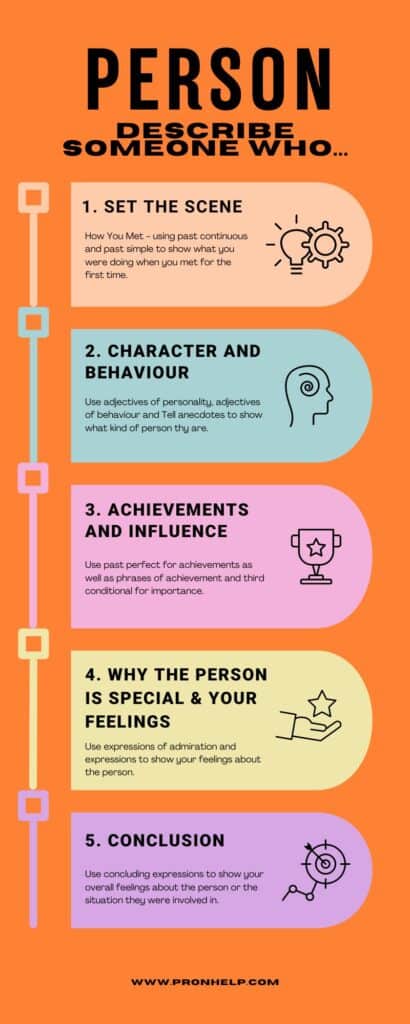
Setting the Scene: I met my friend Sarah when we were both working at a local café. At that time, she was already making handmade toys, but I didn’t know about it until later.
Describing Character and Behaviour: Sarah is a very patient and creative person. She loves spending time alone, making toys, which I think shows her calm personality. She’s also very focused and doesn’t give up easily, even if a project is hard. One time, she worked all night to finish a toy for her niece, and it turned out amazing.
Expressing Achievements and Influence: She had already made dozens of toys by the time I found out about her hobby. If she hadn’t started making them as a hobby, she probably wouldn’t be as skilled as she is today.
Discussing Why the Person is Special and Your Feelings: I really admire her because she makes toys for people she cares about. It makes me feel happy to see how much effort she puts into making others smile.
Concluding Your Monologue: In conclusion, I feel lucky to know Sarah because she is not only talented but also a very thoughtful person.
Explanation:
- Grammar: The candidate uses basic past simple and past continuous but struggles to use more complex structures like the past perfect or third conditional.
- Vocabulary: The adjectives are simple and repetitive (e.g., “patient,” “creative”), with limited range.
- Fluency: The speech is a bit slow, with hesitations.
- Coherence: The ideas are connected but not very developed.
IELTS Band 7 Answer:
Setting the Scene: I first met Sarah when I was working part-time at a café, and she was my colleague. At the time, she was in the middle of working on a handmade wooden toy, and I was curious to know more about her hobby.
Describing Character and Behaviour: Sarah is incredibly patient and creative. She enjoys spending hours designing and making these beautiful wooden toys. I remember once she told me how she stayed up until 3 a.m. to finish a toy for a charity event. She’s always been hardworking and determined to perfect her craft, which is a trait I really admire.
Expressing Achievements and Influence: By the time I met her, she had already created several amazing pieces. If she hadn’t put so much effort into learning and practicing, she wouldn’t have been able to produce such intricate designs. Her skills have improved so much, and she often talks about how this hobby has taught her patience and attention to detail.
Discussing Why the Person is Special and Your Feelings: What makes Sarah special is not just her skill but her passion for making things by hand. She puts love and care into each project, and I really admire that about her. Seeing how dedicated she is makes me feel inspired to take on my own creative hobbies.
Concluding Your Monologue: Overall, I believe Sarah’s dedication to her craft is truly inspiring, and I’m lucky to know such a talented and kind person.
Explanation:
- Grammar: The candidate uses a wider range of tenses, including past perfect and conditional, though there are occasional minor errors.
- Vocabulary: The vocabulary is more varied, with adjectives like “incredibly patient” and “hardworking,” and there is better use of specific phrases.
- Fluency: The speech is more fluid, with fewer pauses.
- Coherence: The ideas are more developed and clearly connected, providing a clearer narrative.
IELTS Band 8 Answer:
Setting the Scene: I first met Sarah several years ago while I was working at a café. At that time, she was crafting a wooden toy during her breaks, and I remember being fascinated by the level of detail she put into her work. We got to talking, and she explained that making things by hand was her passion.
Describing Character and Behaviour: Sarah is someone who can be described as both meticulous and incredibly imaginative. She has this ability to transform simple materials into something extraordinary. I remember a particular incident when she was creating a custom toy for a charity auction. She spent hours refining every little detail, determined to make it perfect. This kind of dedication really speaks to her character—she’s both driven and deeply caring.
Expressing Achievements and Influence: By the time I got to know her well, she had already completed numerous intricate handmade pieces, and her work had been showcased in local exhibitions. If she hadn’t embraced this hobby, she wouldn’t have had such a positive impact on the community. Her creations have inspired others to take up similar crafts, and she’s even started teaching workshops to help others develop their skills. I think her influence is far-reaching because she encourages creativity in everyone around her.
Discussing Why the Person is Special and Your Feelings: What makes Sarah truly exceptional is her ability to bring people joy through her handmade creations. I admire her not just for her technical skills but for the love and care she pours into each project. Watching her work and seeing how she affects the lives of others makes me feel both proud and inspired. She’s someone who embodies the idea that creativity can change lives.
Concluding Your Monologue: In conclusion, Sarah is a remarkable person whose passion and creativity not only define her but also make a lasting impression on those fortunate enough to know her.
Explanation:
- Grammar: The candidate uses a wide range of complex structures, including past perfect, third conditional, and perfect continuous, accurately.
- Vocabulary: The vocabulary is rich and varied, with precise adjectives like “meticulous” and “imaginative.” There are also well-developed expressions of admiration and achievement.
- Fluency: The answer flows naturally and smoothly with few hesitations.
- Coherence: The response is cohesive and well-organized, with each part of the answer contributing to a clear, engaging narrative.
Key Differences:
- Band 6: The answer is clear but uses basic grammar and vocabulary, with less detail. Ideas are connected but not well-developed.
- Band 7: More complex grammar and varied vocabulary are used, with more developed ideas and better fluency.
- Band 8: A sophisticated range of structures and vocabulary is used, with well-organized, detailed ideas and smooth fluency.
IELTS Speaking Part 3 Quiz: Do You Know it All?

IELTS Speaking Part 3 AI Answers
Question 1: Are traditional handicrafts important to tourism?
Band 6 Answer: “Yes, I think traditional handicrafts are important for tourism because tourists like to buy them as souvenirs. They remind them of their trip, and it’s a way for them to take something home that represents the culture. Also, handicrafts are usually made by local people, so it helps support the local economy.”
Band 7 Answer: “Yes, I believe traditional handicrafts play a significant role in tourism. Many tourists enjoy purchasing these items as unique souvenirs that reflect the culture of the country they visit. Additionally, handicrafts are often handmade, which adds a sense of authenticity and makes the product more valuable. Supporting local artisans also benefits the local economy and helps preserve cultural traditions.”
Band 8 Answer: “Traditional handicrafts are certainly crucial to tourism as they offer a tangible connection to a region’s cultural heritage. Tourists not only value them as souvenirs but also as authentic representations of the local artistry and craftsmanship. Moreover, the sale of such items can significantly contribute to the economic development of communities, particularly in rural areas. These crafts also help to preserve age-old traditions, as increased tourist interest encourages artisans to continue practising their skills and passing them down to future generations.”
Explanation:
- Band 6: The answer is simple and clear, with basic grammar and vocabulary. The student communicates their ideas but does not develop them deeply.
- Band 7: The answer is more developed, with additional details such as the value of authenticity and how handicrafts support the local economy. There is more variety in sentence structure and vocabulary.
- Band 8: The response shows a higher level of sophistication with complex sentence structures, advanced vocabulary, and a more detailed analysis of how handicrafts affect tourism, culture, and the economy.
Question 2: What are the benefits for students to learn to make things by hand?
Band 6 Answer: “I think learning to make things by hand is good for students because it helps them to be creative and work with their hands. It also teaches them how to solve problems and think about how to make something. Plus, it can be relaxing and fun for students.”
Band 7 Answer: “I believe there are several benefits for students in learning to make things by hand. It encourages creativity and helps develop fine motor skills. Additionally, it teaches problem-solving and patience, as students have to figure out how to create something from scratch. Working with their hands also provides a break from screen-based activities, which can be beneficial for mental health.”
Band 8 Answer: “Learning to make things by hand offers numerous benefits for students, both cognitively and emotionally. On the one hand, it fosters creativity and innovation, as students learn to conceptualize ideas and bring them to life through manual effort. On the other hand, it enhances fine motor skills and hand-eye coordination, which are essential for many practical tasks. Moreover, hands-on learning nurtures patience, focus, and resilience, as students often need to overcome challenges during the creation process. This type of learning also offers a refreshing break from digital distractions, contributing positively to their mental well-being.”
Explanation:
- Band 6: This answer is basic, covering only the main benefits without much elaboration. The vocabulary and grammar are simple.
- Band 7: The answer is more detailed, discussing creativity, motor skills, and problem-solving. The language is varied, and the student connects different benefits logically.
- Band 8: The response provides a highly developed argument, covering a wide range of benefits in a more sophisticated manner. Complex vocabulary and sentence structures are used, and the student shows deeper insight into how manual activities benefit students both mentally and physically.
Question 3: Why do many children like to make things by hand?
Band 6 Answer: “I think children like to make things by hand because it’s fun. They can use their imagination and create whatever they want. Also, making things by hand is a good way for them to spend time, and they feel proud when they finish something they made themselves.”
Band 7 Answer: “Children often enjoy making things by hand because it allows them to be creative and use their imagination. It gives them a sense of accomplishment when they complete something they’ve worked on. Additionally, it’s a hands-on activity that keeps them engaged, and it can also be a way for them to express themselves.”
Band 8 Answer: “Many children are naturally drawn to making things by hand because it provides a stimulating outlet for their creativity and imagination. Through such activities, they experience a sense of achievement and pride as they physically build or craft something from start to finish. This hands-on engagement also helps to develop important skills like problem-solving and fine motor abilities, all while allowing them to express themselves in ways that go beyond verbal communication. Additionally, it can offer a break from more structured, academic tasks, making it a fun and rewarding experience.”
Explanation:
- Band 6: The answer is simple and focuses on why children enjoy making things. The ideas are straightforward, and there is little expansion on the reasons.
- Band 7: This response offers more detailed reasons, such as the sense of accomplishment and self-expression. The student uses a wider range of vocabulary and links ideas more smoothly.
- Band 8: The answer is highly detailed, with a thorough explanation of the reasons behind children’s enjoyment of hands-on activities. Complex grammar and advanced vocabulary are used, and the student includes additional points, like the development of skills and the contrast with academic tasks.
General Explanation of Differences:
- Band 6 answers: These are clear but simple. They provide basic reasons without much elaboration. The vocabulary and sentence structures are limited.
- Band 7 answers: These responses go into more depth, offering multiple reasons for each answer. The student uses more complex structures and a wider variety of vocabulary.
- Band 8 answers: These answers are well-developed and include detailed reasoning and analysis. The student demonstrates a strong command of grammar and vocabulary, and they connect ideas in a logical and sophisticated way.
Question 4: How important are traditional handicrafts to a country’s industry?
Band 6 Answer: “I think traditional handicrafts are important because they show the culture and history of a country. They also help local people make money, especially in small villages where people make these things by hand. Tourists like to buy them, so it helps the tourism industry too.”
Band 7 Answer: “Traditional handicrafts play a significant role in a country’s industry, especially in terms of preserving cultural heritage and promoting tourism. They provide employment opportunities in rural areas and contribute to local economies. Additionally, these handmade products often attract tourists who are interested in purchasing unique items, which can help boost the overall economy.”
Band 8 Answer: “Traditional handicrafts are vital to a country’s industry for multiple reasons. First, they help preserve the country’s cultural heritage and contribute to a sense of national identity. Economically, they create jobs, especially in rural communities where modern industries may not be prevalent. Furthermore, handicrafts have become an integral part of the tourism industry, with many tourists seeking out authentic, locally-made products as souvenirs. This not only provides a direct economic boost but also raises the country’s profile on the international stage.”
Explanation:
- Band 6: The answer is clear but basic. The student touches on the cultural and economic importance of handicrafts but doesn’t go into much depth. Vocabulary and sentence structures are simple.
- Band 7: The answer is more detailed, discussing employment and local economies. The student introduces more specific ideas and uses a range of vocabulary and sentence structures.
- Band 8: The answer is sophisticated, providing a deeper analysis of the cultural and economic roles of handicrafts. The student uses complex sentences and advanced vocabulary, presenting a well-rounded argument.
Question 5: Is it reasonable to charge a high price for handmade things?
Band 6 Answer: “Yes, I think it’s fair to charge more for handmade things because they take more time to make. Also, handmade products are usually made with better materials and more care, so they are better quality than things made in factories. That’s why they are more expensive.”
Band 7 Answer: “I believe it’s reasonable to charge a higher price for handmade items because of the time, effort, and skill involved in making them. Unlike mass-produced goods, handmade products are often crafted with attention to detail and use higher-quality materials. People are usually willing to pay more for these items because they are unique and not available everywhere.”
Band 8 Answer: “It is entirely reasonable to charge a premium for handmade products, given the significant investment of time, craftsmanship, and often superior materials involved in their creation. Unlike mass-produced items, handmade goods typically reflect the personal skill and creativity of the artisan, which justifies their higher price. Moreover, consumers often value the uniqueness and authenticity of these items, making them willing to pay a premium for something that offers both quality and a personal touch.”
Explanation:
- Band 6: The answer explains why handmade items are more expensive but lacks depth and advanced vocabulary. It’s a basic explanation with simple sentence structures.
- Band 7: This answer gives more detailed reasons, introducing ideas like the uniqueness of handmade products and the attention to detail. The vocabulary and structures are more varied.
- Band 8: The response provides a well-developed argument, discussing craftsmanship, material quality, and consumer attitudes. The student uses advanced vocabulary and complex sentence structures, presenting a more nuanced view.
Question 6: How does modern technology change the handicraft industry?
Band 6 Answer: “Modern technology has changed the handicraft industry by making it easier to produce things faster. Machines can help people make things by hand, so they don’t have to do everything themselves. It also helps people sell their handicrafts online, which means they can reach more customers.”
Band 7 Answer: “Modern technology has transformed the handicraft industry by improving production processes and making it easier to create certain items. While the craftsmanship is still there, tools and machines can assist in speeding up the work. Technology has also expanded the market for handicrafts by allowing artisans to sell their products online, reaching a global audience.”
Band 8 Answer: “Modern technology has revolutionized the handicraft industry in multiple ways. While traditional craftsmanship remains at the core, advanced tools and machinery now assist artisans in streamlining production without compromising quality. This not only increases efficiency but also allows for the creation of more intricate designs that might have been difficult to achieve manually. Furthermore, digital platforms have provided artisans with the opportunity to market and sell their goods to a global audience, significantly expanding their reach and helping preserve traditional crafts in an increasingly modern world.”
Explanation:
- Band 6: The answer is simple and provides a basic explanation of how technology affects the handicraft industry. Vocabulary is limited, and ideas are not deeply explored.
- Band 7: The response is more detailed, discussing how technology helps with production and sales. The student uses a range of vocabulary and sentence structures, and the ideas are more developed.
- Band 8: The answer is well-developed, with advanced vocabulary and complex structures. The student offers a more nuanced analysis of how technology affects not just production but also marketing and the global reach of handicrafts.
General Explanation of Differences:
- Band 6 answers: The student provides basic explanations with limited vocabulary and simple sentence structures. Ideas are clear but lack depth.
- Band 7 answers: The responses are more detailed and introduce additional ideas. The student uses more varied vocabulary and sentence structures, and the answers are better developed.
- Band 8 answers: The answers are highly detailed, with complex sentence structures and advanced vocabulary. The student offers a deeper analysis of the topic, presenting well-rounded and thoughtful responses.
Related Content
21 Simple Steps to the IELTS Speaking Score You Want

Achieving a high score in the IELTS Speaking test requires both practice and strategy. While there are many methods to help you improve, these 21 tips will make a significant…
How to Answer If You Know Nothing in IELTS Speaking

Taking tests such as IELTS Speaking are extremely challenging for many reasons, with one of the main ones being that a certain amount of life experience is needed to be…
How to Avoid Making Sweeping Statements

Sweeping statements are statements which cover a broad topic in a concise or even terse manner. They make it seem as if everybody does something. This is really common in…
How to Best Use the Latest IELTS Speaking Questions

There are several pages on this site that are dedicated to the ‘latest’ IELTS speaking questions. These questions are released for three periods of four months each year. January to…
How to Describe A Person: The Ultimate Guide

In IELTS Speaking Part 2, it is really common to be asked to describe a person. Whether it they are an old person, someone who is patient, a relative you…
How to Describe a Place: The Ultimate Guide

In the IELTS Speaking test, especially in Part 2, candidates are often asked to describe a place. Whether it’s a flat you would like to own, a favorite spot in…
How to Describe a Time or Event: The Ultimate Guide

In the IELTS Speaking test, especially in IELTS Speaking Part 2, candidates are often asked to describe a time when they did something memorable or significant. This guide will walk…
How to Easily Boost Your IELTS Vocabulary Score

If your job or course involves technical language in English, integrating it into your IELTS vocabulary in your speaking responses can significantly enhance your performance. By steering your answers toward…
How to Eliminate Hesitation in IELTS Speaking Part 2

In IELTS Speaking Part 2, the examiner will give you a cue card. You have one minute to make some notes to help you speak on that topic/question for between…
How to Speak for Longer in IELTS Speaking Part 2

This is a great way to extend your answer for IELTS Speaking Part 2. You use a strategy to suit the question, you do well, but there is still too…
How to Use Chunking in IELTS Speaking Part 2

Don’t memorise your answers in IELTS Speaking Part 2, that’s one of the worst things you can do. It’s really easy for an examiner to know when IELTS Speaking test…
How to Use Natural English Expressions for Better Precision

Improve Your Skills! Master that feeling that you MUST answer correctly by using these natural expressions to show what you know or don’t know about a topic. There is no…
How to Zoom In: The Most Useful Technique for IELTS Speaking

Imagine you are just starting to watch your favourite TV series. The theme music is playing, you see a view of a city, then a neighbourhood, then a street, then a…
IELTS Speaking
Latest questions, sample answers as well as many resources that will boost your journey to IELTS speaking success, Strategies for each part of the test! IELTS Speaking General IELTS Speaking…
IELTS Speaking Format, Preparation and 8 Great Hacks for Success

It’s madness to go into any English-speaking test expecting to do well. The IELTS Speaking test is demanding, so you should use any knowledge you can glean to your advantage….
IELTS Speaking Part 1 Format and 6 Simple Little Tricks To Help You

Many students think IELTS Speaking Part 1 is easy. It is an ideal time to add more challenging English, but knowing little tricks helps too. Know the format, how to…
IELTS Speaking Part 1 Questions

Many students think that the IELTS Speaking Part 1 questions are the easiest and simplest of the three parts, but it is a great time to show off what you…
IELTS Speaking Part 1 Quiz: Is It as Easy as You Think?

Test your IELTS Speaking Part 1 knowledge by taking this quick quiz. How much do you really know about this part of the speaking test? Try it and find out!…
IELTS Speaking Part 1 Sample Answers
This is a list of sample answers for IELTS Speaking Part 1 questions. All have transcripts of the answers. Some of them have video, some audio. Home > IELTS >…
IELTS Speaking Part 1: 16 Great Ways Start Your Test!

Many students think that the IELTS Speaking Part 1 Questions are the easiest and simplest of the three parts, but it is a great time to show off what you…
IELTS Speaking Part 2 – Phrases and Vocabulary

Here are some sentences and phrases to help you with IELTS Speaking Part 2. These are particularly useful for students who are using one of my strategies. This is a…
IELTS Speaking Part 2 Quiz: It Doesn’t Need To Be Hell!

Most students fear Part 2 of the IELTS Speaking test, but using strategies common to every topic, it can really boost your speaking score. How much do you know about…
IELTS Speaking Part 2 Sample Answers
This is a list of sample answers for IELTS Speaking Part 2 questions. All have transcripts of the answers. Some have video, some audio. Home > IELTS > Speaking > Part 2
IELTS Speaking Part 2: Format, Tips, and 5 Powerful Hacks
Are you worried about your IELTS Speaking test? Many students feel overwhelmed, especially when it comes to Part 2 of the exam. But fear not! This guide will help you…
IELTS Speaking Part 3 – Quantities and Types of People

In IELTS Speaking Part 3, when many questions ask about ‘people’ or ‘children’ or ‘businesses’, it is much easier to answer if you use expressions for quantities of people and…