For most IELTS Speaking test-takers, knowing what they need to do to get a higher band score is extremely vague. It is almost impossible for them to predict what score they will get, so often, they can only use their last IELTS Speaking test score as a guide.
Home > IELTS > Speaking > Sample Answers
An AI has created these sample answers so such students can discover the changes they need to make to their speaking responses to improve their results and reach their target IELTS Speaking score.
This page is for the IELTS Speaking Part 2 question below and its associated Part 3 questions:
Describe a time when you answered a phone call from someone you didn’t know in a public place
You should say:
When and where it happened
What he/she said
How you corresponded
And explain how you felt about the experience
Pros and Cons of This Method
Pros:
- Grammar: You can easily see the differences in the grammar used in each question.
- Vocabulary: You can easily see how the words and phrases are to a higher standard as the scores improve.
- Fluency and Coherence: As the score improves, you can see the increased use of sequence or discourse markers to assure the listener knows what is happening and when.
- Pronunciation: This is worth 20% of your score, so you should pay attention to the differences here. A simple way to improve
Cons:
- Grammar: Although there are differences between the answers, there are no mistakes, which is uncommon for these band scores.
- Vocabulary: While it is easy to see what is needed, to use better vocabulary, you need to practice seriously so you can include it fluently in your answers.
- Fluency and Coherence: There are very few pauses or hesitations which usually mark an IELTS Speaking test-takers Part 2 response.
- Pronunciation: Obviously, without audio or video, it’s impossible to get an example of the differences between the scores.
Author’s Thoughts:
- Video. Although it seems to be standard to put a video on YouTube with a teacher’s own answer to these questions, I don’t have the time or the patience to do that.
- Why AI?: I can make more sample answers with an AI in a short time. Anyone could do that, but many don’t want to or are too lazy.
- Different scores: The idea is to show the differences between the answers, rather than having perfect answers. Some of these answers are too short, or they repeat the question in the first sentence. They are not perfect, but they inform students what they need to do to improve!
- Me: I used to make videos of speaking answers, but it’s not about me or how good my course is, or how many likes I get on Instagram or YouTube. It’s about trying to help you pass your speaking test and changing your life.
- You: If you have any ideas on how this could be improved, any other pros and cons, or would just like to comment, please use the comment box at the bottom of the page. If you like the content, please share it.
IELTS Speaking Part 2 Quiz: It Doesn’t Need to be Hell!


IELTS Speaking Part 2 AI Answers
Describe a time when you answered a phone call from someone you didn’t know in a public place
You should say:
When and where it happened
What he/she said
How you corresponded
And explain how you felt about the experience
IELTS Band 6 Answer:
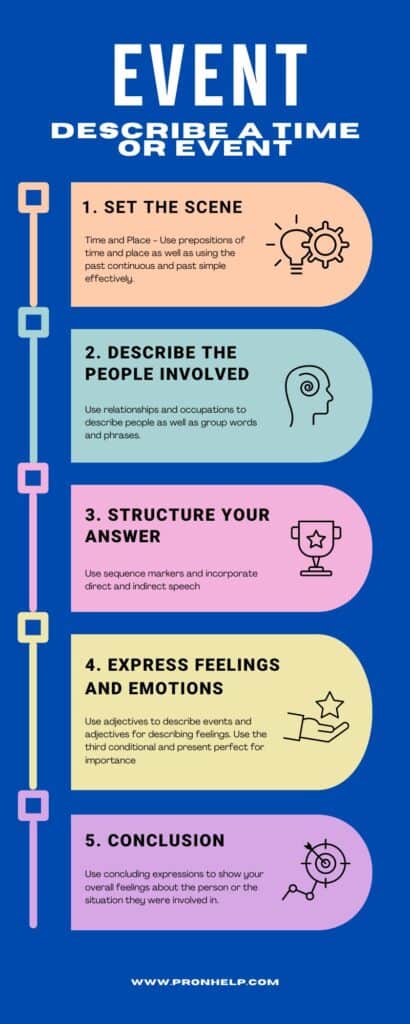
Setting the Scene: It was last year when I was at the train station. I was waiting for my train, and suddenly my phone rang. I didn’t recognise the number, but I picked up the call anyway.
Describing the People Involved: The person on the other end was a woman. I didn’t know her, but she sounded kind of worried. She asked if I was someone named Alex, and I told her that I wasn’t. She explained that she was looking for her friend and dialled the wrong number.
Structuring Your Answer: First, she asked if I could help her find the right number, but I said I didn’t know. After that, she apologised, and I told her not to worry. I hung up and continued waiting for my train.
Expressing Feelings and Emotions: At first, I was confused because I didn’t know why a stranger was calling me, but after the call, I felt okay. It wasn’t anything serious, so I didn’t mind.
Concluding Your Monologue: In the end, it was just a small mistake, and it didn’t really affect my day.
Explanation:
- Grammar: Simple past tense is used effectively, but more complex tenses like past continuous are not used.
- Vocabulary: The adjectives and vocabulary are basic, like “worried” and “confused.”
- Fluency: Some hesitations, but the answer is clear.
- Coherence: The answer is simple but lacks depth and detail.
IELTS Band 7 Answer:
Setting the Scene: This happened about six months ago when I was sitting in a café, waiting for my friend. I was having a coffee and checking my messages when suddenly, my phone started ringing. I didn’t recognise the number, but I decided to answer it.
Describing the People Involved: The caller was a man, and he sounded a bit frustrated. He asked, “Is this John?” I told him that he had the wrong number. He apologised and explained that he was trying to reach someone to discuss a business deal.
Structuring Your Answer: First, he asked me if I could confirm if the number he dialled was correct, and I checked but told him it wasn’t. After a short pause, he thanked me for my time, and I wished him luck in finding the right person. We both ended the call on a polite note.
Expressing Feelings and Emotions: I felt a bit surprised when the call first came in because I don’t usually answer calls from unknown numbers. However, by the end of the conversation, I felt fine because it wasn’t anything serious, and the man was polite.
Concluding Your Monologue: In conclusion, while the call was unexpected, it didn’t cause any trouble, and I even felt like I helped someone in a small way.
Explanation:
- Grammar: A wider range of tenses is used, including the past continuous. The sentence structure is more varied, and there’s better use of sequence markers.
- Vocabulary: The vocabulary is more descriptive, with adjectives like “frustrated” and “surprised.”
- Fluency: The answer flows more naturally, with fewer pauses.
- Coherence: The story is better developed and more structured.
IELTS Band 8 Answer:
Setting the Scene: A few months ago, while I was waiting for a friend at a busy café in the city centre, I received an unexpected phone call. I was in the middle of checking my emails when my phone rang, and the number wasn’t familiar to me, but out of curiosity, I answered it.
Describing the People Involved: On the other end of the line was a man who sounded quite stressed. He immediately asked, “Is this Andrew? We were supposed to meet at the office!” I could hear the frustration in his voice, so I calmly explained that he had dialled the wrong number. He quickly apologised and told me that he was late for an important business meeting.
Structuring Your Answer: At first, he was quite insistent, asking if I knew Andrew or if I had his contact details. I politely told him I didn’t and suggested he double-check the number. He thanked me for my time, and I wished him luck with his meeting. It was a brief but interesting exchange.
Expressing Feelings and Emotions: At the start of the call, I felt a bit confused and curious because it’s not every day that I receive a call like that. But as the conversation went on, I felt more relaxed, and by the end, I was actually amused by the situation. It was quite an unusual experience, but nothing too stressful.
Concluding Your Monologue: To sum up, while the call was unexpected, it was handled politely, and I think the man appreciated the brief help I offered. It’s one of those small, random moments that make the day a little more interesting.
Explanation:
- Grammar: Complex tenses, such as the past continuous and third conditional, are used accurately. Indirect speech is incorporated smoothly.
- Vocabulary: The vocabulary is rich and precise, with phrases like “stressed” and “insistent,” along with expressions for emotions like “curious” and “amused.”
- Fluency: The speech is fluent, with a natural flow and minimal pauses.
- Coherence: The answer is cohesive and well-structured, with detailed development of the situation.
Key Differences:
- Band 6: The answer is simple, with basic grammar and vocabulary. The structure is clear but lacks depth and detail.
- Band 7: The grammar is more varied, and there’s a wider range of vocabulary. The answer is more structured, with better use of sequence markers.
- Band 8: The answer uses complex grammar accurately, with precise and varied vocabulary. The story is well-organized, detailed, and flows smoothly.
IELTS Speaking Part 3 Quiz: Do You Know it All?

IELTS Speaking Part 3 AI Answers
1. Do most people mind others talking on the phone in public places?
Band 6 Answer: “Yes, I think most people do mind when others talk on the phone in public places. It can be annoying, especially when someone is talking loudly. People want peace and quiet, like on buses or in restaurants, so hearing phone conversations can disturb them.”
- Explanation: The Band 6 answer provides a basic response with simple sentence structures and limited vocabulary. The ideas are clear but not very developed. There is some repetition, like “can disturb them,” without deeper explanation or variation.
Band 7 Answer: “I believe most people do get annoyed when others talk on the phone in public places, especially if the conversation is loud. For instance, on public transport, people are often trying to relax or read, and loud phone calls can be very distracting. However, if someone speaks quietly, I think it’s less of a problem.”
- Explanation: The Band 7 answer introduces more complexity in sentence structures and uses examples to explain the idea better. The vocabulary is more varied, with words like “distracting” and “relax,” and the speaker provides additional detail by mentioning different scenarios like “public transport.”
Band 8 Answer: “In general, I’d say most people do mind when others speak on the phone in public, particularly in quieter environments like libraries or on public transport. The loudness of the conversation tends to amplify the annoyance, as it can interrupt people’s activities, whether they’re trying to concentrate or simply enjoy some peace. That said, if someone is speaking at a reasonable volume or in a designated space, such as a café, it’s usually more acceptable.”
- Explanation: The Band 8 response uses advanced vocabulary (“amplify the annoyance,” “designated space”) and more complex sentence structures. The answer includes more nuanced points, such as recognizing situations where phone conversations might be more acceptable. It also links ideas smoothly, showing greater fluency and coherence.
2. What are the differences between sitting beside a person who keeps talking on the phone and a person who keeps talking to you?
Band 6 Answer: “Sitting next to someone talking on the phone is annoying because you hear only one side of the conversation. But if someone is talking to you, at least you’re part of the conversation. It can still be annoying if they talk too much, but it’s a bit better than just listening to someone on the phone.”
- Explanation: The Band 6 answer is basic and direct. The vocabulary is simple, and the grammar is mostly straightforward. The ideas are clear but not deeply developed, and the speaker repeats the word “annoying” without providing much variation or elaboration.
Band 7 Answer: “When you sit next to someone talking on the phone, it can be frustrating because you only hear one side of the conversation, which feels more intrusive. In contrast, if someone is speaking directly to you, it’s a shared interaction, which makes it easier to tolerate, though it can still be tiring if they talk too much. The difference is that a phone call feels more like you’re being excluded, while direct conversation is more engaging.”
- Explanation: The Band 7 response introduces more complexity with vocabulary (“intrusive,” “shared interaction”) and compares the two situations more clearly. The answer includes more variety in sentence structures and offers a deeper explanation of the differences.
Band 8 Answer: “Sitting beside someone on the phone can be particularly irritating because you’re only hearing one side of the dialogue, which feels much more intrusive and disruptive. In contrast, when someone is speaking directly to you, it’s a two-way interaction, allowing you to engage in the conversation, even if it might occasionally become tiresome. The key difference is that a phone conversation makes you feel like an involuntary eavesdropper, whereas a direct conversation allows for active participation, making it more tolerable.”
- Explanation: The Band 8 response uses more sophisticated vocabulary (“involuntary eavesdropper,” “active participation”) and provides a deeper exploration of the differences. The sentence structures are more complex, and the ideas are connected more fluently, giving a well-rounded and nuanced answer.
3. Why do some people not care what they do in public places?
Band 6 Answer: “Some people don’t care because they just don’t think about others. They do what they want, and maybe they don’t care if they are disturbing others. Sometimes, they just don’t realize that their behavior is annoying or bothering other people.”
- Explanation: The Band 6 answer is simple and repetitive, with limited vocabulary. The ideas are clear but not deeply developed, and the speaker doesn’t provide many details or examples. The sentence structures are basic, and there’s little variety.
Band 7 Answer: “Some people don’t care about their behavior in public because they might be too focused on themselves. They’re more concerned with what they’re doing than how it affects others. For example, someone talking loudly on the phone may not realize how disruptive it is. It could also be that some people simply don’t think it’s a big deal and assume others won’t mind.”
- Explanation: The Band 7 answer adds more complexity to the ideas and introduces examples to support the explanation. The vocabulary is more varied (“disruptive,” “focused on themselves”), and the sentence structures are more advanced. The ideas are developed in more depth.
Band 8 Answer: “Some individuals seem indifferent to their actions in public spaces because they’re often too absorbed in their own activities or personal concerns to consider the impact on those around them. For instance, someone engrossed in a loud phone conversation might not be aware of how their behavior is disturbing others. Additionally, in some cases, people may feel a sense of entitlement, believing that their right to act as they please outweighs the need for consideration of others, or they may assume that public spaces are inherently chaotic, and their behavior won’t be noticed.”
- Explanation: The Band 8 response uses advanced vocabulary (“indifferent,” “entitlement,” “inherently chaotic”) and more complex sentence structures. The ideas are developed with depth and detail, offering a more nuanced and insightful answer. The response is also more fluent, with smooth transitions between points.
4. Do you think parents should teach their children not to behave badly in public places?
Band 6 Answer: “Yes, I think parents should teach their kids how to behave properly in public. When children behave badly, it can annoy other people. Parents should explain why it’s important to be polite and quiet, especially in places like restaurants or libraries.”
- Explanation: The Band 6 answer is simple and clear, but lacks detail. The vocabulary is basic, using words like “behave properly” and “annoy,” and the structure is mostly straightforward without much complexity.
Band 7 Answer: “Yes, I believe it’s really important for parents to teach their children proper behavior in public places. Bad behavior, like shouting or running around, can disturb others. Parents need to explain the reasons for good manners and make sure their children understand the impact their actions can have, especially in places like restaurants or public transport.”
- Explanation: The Band 7 answer provides more developed ideas and examples, using phrases like “proper behavior” and “good manners.” The sentence structures are more varied, and the speaker gives more context by describing specific types of bad behavior and places where good behavior is expected.
Band 8 Answer: “Absolutely, I think it’s essential for parents to teach their children how to behave in public spaces. Not only does misbehavior, such as shouting or being disruptive, affect the experience of others around them, but it also reflects on the child’s future interactions in society. Parents should instill values like respect and consideration, especially in environments like libraries, restaurants, or even on public transportation, where quietness and decorum are important.”
- Explanation: The Band 8 answer uses more sophisticated vocabulary (“misbehavior,” “instill values,” “decorum”) and offers a deeper analysis. The ideas are well-organized, and the speaker makes connections to larger societal values. The sentence structures are complex, with clear reasoning and fluency.
5. Is it acceptable to talk on the phone in public?
Band 6 Answer: “Sometimes it’s okay to talk on the phone in public, but it depends on the place. In busy places like a park, I think it’s fine. But in quiet places, like a library, it’s not polite because it can disturb people.”
- Explanation: The Band 6 response is direct and simple, with basic vocabulary and sentence structure. The ideas are clear but not deeply developed, and the reasoning is straightforward without much elaboration.
Band 7 Answer: “In general, I think it’s acceptable to talk on the phone in public, but it really depends on the setting. For example, if you’re in a crowded park or walking down the street, no one will probably mind. However, in quieter places, such as a café or on public transport, it’s better to keep phone conversations short and quiet, out of respect for others.”
- Explanation: The Band 7 answer provides more detail, with examples and explanations about different scenarios. The vocabulary is more advanced, with phrases like “out of respect for others” and “keep phone conversations short.” The ideas are more developed and connected logically.
Band 8 Answer: “While it’s generally acceptable to talk on the phone in public, I believe it’s important to be mindful of the environment. In open, noisy spaces, such as parks or busy streets, a phone conversation is unlikely to bother anyone. However, in more intimate or quiet settings, like cafés or on public transport, it’s essential to speak quietly or move to a less disruptive area. Being considerate of those around you is key in maintaining a balance between personal convenience and public decorum.”
- Explanation: The Band 8 answer uses sophisticated vocabulary (“intimate settings,” “disruptive area,” “public decorum”) and provides a well-balanced argument with more nuanced ideas. The sentence structure is complex, and the ideas are presented fluently and coherently.
6. Should people be banned from talking loudly in public places?
Band 6 Answer: “Yes, I think people should not talk loudly in public places because it’s annoying for others. For example, in a restaurant or on a bus, if someone talks loudly, it disturbs people around them. Maybe banning them from talking loudly is a good idea.”
- Explanation: The Band 6 answer is basic and clear, with limited vocabulary and simple sentence structures. The ideas are repetitive, and the speaker doesn’t explore the topic in much depth.
Band 7 Answer: “I think there should be rules against people talking loudly in certain public places. For example, in places where people go to relax, like restaurants or libraries, loud conversations can be really disruptive. However, in open spaces, like parks or streets, a ban might not be necessary, as noise is part of the environment. Overall, it’s about finding a balance.”
- Explanation: The Band 7 response introduces more complexity with balanced reasoning. The speaker distinguishes between different types of public spaces and provides more detailed examples. The sentence structures are more varied, and the vocabulary is more advanced, with terms like “disruptive” and “finding a balance.”
Band 8 Answer: “I don’t believe an outright ban on loud conversations in all public spaces is necessary, but there should definitely be restrictions in specific environments. In places like libraries, museums, or restaurants, where people seek a peaceful atmosphere, excessive noise can significantly detract from the experience. However, in more open or casual settings, like parks or busy streets, enforcing such a rule could be impractical and unnecessary. Ultimately, it’s about promoting respect for others without imposing overly strict regulations.”
- Explanation: The Band 8 answer provides a nuanced response, with sophisticated vocabulary (“outright ban,” “excessive noise,” “imposing overly strict regulations”) and more developed ideas. The speaker offers a clear, well-organized argument and discusses both sides of the issue with a balanced perspective. The sentence structures are more complex and varied.
Key Differences Between the Band Scores:
- Vocabulary: Band 6 answers rely on basic, repetitive vocabulary, while Band 7 introduces more precise language and Band 8 uses advanced vocabulary, idiomatic expressions, and a wider range of words.
- Grammar: Band 6 answers use simple sentences, whereas Band 7 introduces compound and complex sentences. Band 8 demonstrates even more advanced grammar, with complex structures and better flow.
- Fluency and Coherence: Band 6 answers are clear but lack depth, Band 7 responses are more logically organized with detailed examples, and Band 8 answers are fluent, well-structured, and show greater depth of thought.
- Idea Development: Band 6 answers are basic and straightforward, Band 7 responses offer more explanation and examples, and Band 8 answers provide deeper analysis and balanced reasoning with a wider range of perspectives.
Related Content
21 Simple Steps to the IELTS Speaking Score You Want

Achieving a high score in the IELTS Speaking test requires both practice and strategy. While there are many methods to help you improve, these 21 tips will make a significant…
How to Answer If You Know Nothing in IELTS Speaking

Taking tests such as IELTS Speaking are extremely challenging for many reasons, with one of the main ones being that a certain amount of life experience is needed to be…
How to Avoid Making Sweeping Statements

Sweeping statements are statements which cover a broad topic in a concise or even terse manner. They make it seem as if everybody does something. This is really common in…
How to Best Use the Latest IELTS Speaking Questions

There are several pages on this site that are dedicated to the ‘latest’ IELTS speaking questions. These questions are released for three periods of four months each year. January to…
How to Describe A Person: The Ultimate Guide

In IELTS Speaking Part 2, it is really common to be asked to describe a person. Whether it they are an old person, someone who is patient, a relative you…
How to Describe a Place: The Ultimate Guide

In the IELTS Speaking test, especially in Part 2, candidates are often asked to describe a place. Whether it’s a flat you would like to own, a favorite spot in…
How to Describe a Time or Event: The Ultimate Guide

In the IELTS Speaking test, especially in IELTS Speaking Part 2, candidates are often asked to describe a time when they did something memorable or significant. This guide will walk…
How to Easily Boost Your IELTS Vocabulary Score

If your job or course involves technical language in English, integrating it into your IELTS vocabulary in your speaking responses can significantly enhance your performance. By steering your answers toward…
How to Eliminate Hesitation in IELTS Speaking Part 2

In IELTS Speaking Part 2, the examiner will give you a cue card. You have one minute to make some notes to help you speak on that topic/question for between…
How to Speak for Longer in IELTS Speaking Part 2

This is a great way to extend your answer for IELTS Speaking Part 2. You use a strategy to suit the question, you do well, but there is still too…
How to Use Chunking in IELTS Speaking Part 2

Don’t memorise your answers in IELTS Speaking Part 2, that’s one of the worst things you can do. It’s really easy for an examiner to know when IELTS Speaking test…
How to Use Natural English Expressions for Better Precision

Improve Your Skills! Master that feeling that you MUST answer correctly by using these natural expressions to show what you know or don’t know about a topic. There is no…
How to Zoom In: The Most Useful Technique for IELTS Speaking

Imagine you are just starting to watch your favourite TV series. The theme music is playing, you see a view of a city, then a neighbourhood, then a street, then a…
IELTS Speaking
Latest questions, sample answers as well as many resources that will boost your journey to IELTS speaking success, Strategies for each part of the test! IELTS Speaking General IELTS Speaking…
IELTS Speaking Format, Preparation and 8 Great Hacks for Success

It’s madness to go into any English-speaking test expecting to do well. The IELTS Speaking test is demanding, so you should use any knowledge you can glean to your advantage….
IELTS Speaking Part 1 Format and 6 Simple Little Tricks To Help You

Many students think IELTS Speaking Part 1 is easy. It is an ideal time to add more challenging English, but knowing little tricks helps too. Know the format, how to…
IELTS Speaking Part 1 Questions

Many students think that the IELTS Speaking Part 1 questions are the easiest and simplest of the three parts, but it is a great time to show off what you…
IELTS Speaking Part 1 Quiz: Is It as Easy as You Think?

Test your IELTS Speaking Part 1 knowledge by taking this quick quiz. How much do you really know about this part of the speaking test? Try it and find out!…
IELTS Speaking Part 1 Sample Answers
This is a list of sample answers for IELTS Speaking Part 1 questions. All have transcripts of the answers. Some of them have video, some audio. Home > IELTS >…
IELTS Speaking Part 1: 16 Great Ways Start Your Test!

Many students think that the IELTS Speaking Part 1 Questions are the easiest and simplest of the three parts, but it is a great time to show off what you…
IELTS Speaking Part 2 – Phrases and Vocabulary

Here are some sentences and phrases to help you with IELTS Speaking Part 2. These are particularly useful for students who are using one of my strategies. This is a…
IELTS Speaking Part 2 Quiz: It Doesn’t Need To Be Hell!

Most students fear Part 2 of the IELTS Speaking test, but using strategies common to every topic, it can really boost your speaking score. How much do you know about…
IELTS Speaking Part 2 Sample Answers
This is a list of sample answers for IELTS Speaking Part 2 questions. All have transcripts of the answers. Some have video, some audio. Home > IELTS > Speaking > Part 2
IELTS Speaking Part 2: Format, Tips, and 5 Powerful Hacks

Are you worried about your IELTS Speaking test? Many students feel overwhelmed, especially when it comes to Part 2 of the exam. But fear not! This guide will help you…
IELTS Speaking Part 3 – Quantities and Types of People

In IELTS Speaking Part 3, when many questions ask about ‘people’ or ‘children’ or ‘businesses’, it is much easier to answer if you use expressions for quantities of people and…