
These are high-scoring sample answers for the following Cambridge B2 First Speaking Parts 3 and 4. Read them and the analysis to understand what you need to talk about and the kind of answers you need to give for a good B2 First speaking score.
Home > B2 First > Speaking > Part 3 / Part 4
B2 First Speaking Part 3 Quiz: Pass or Fail?


B2 First Part 3
Question
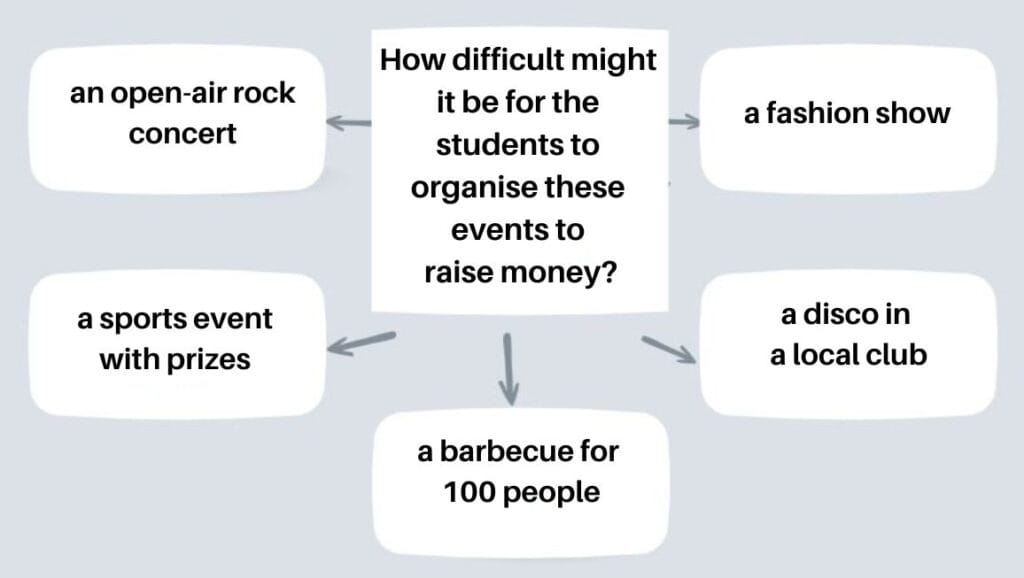
Sample Answer – Discussion
There is two minutes to discuss how each part influences the central question.
Candidate A:
Should we start with the open-air rock concert? I think that would probably be quite difficult. They’d need a big space, permission from the local council, sound equipment… and they might have to deal with noise complaints too. What do you think?
Candidate A:
Yeah, and the weather could be a big problem. If it rains, the whole thing might be cancelled. What about a fashion show? It might be easier in my opinion.
Candidate B:
Sure. They could use a school hall and ask students to model. But don’t you think they’d still need to organise lighting, music, and maybe ask someone to help with clothes or styling.
Candidate A:
Yeah. A disco in a local club might be even easier, though. Clubs already have music and lights, so students might just need to book the space and sell tickets. What do you think?
Candidate B:
Good point. And people usually enjoy going to discos, so it could attract a lot of students. What do you think about the barbecue for 100 people?
Candidate A:
Hmm… cooking for that many sounds stressful. They’d need lots of food, barbecues, and people to cook and serve. Plus, they’d have to be careful with health and safety.
Candidate B:
Exactly. And a sports event with prizes could be fun but might take time to organise. They’d need space, equipment, and maybe even referees or judges wouldn’t you say?
Candidate A:
Yes, and some students might be more interested in watching than joining in.
Sample Answer – Reaching a Decision
There is one minute for the candidates to reach a decision about which activity would be the most difficult to organise.
Candidate B:
I think we can agree the open-air rock concert would be the hardest to organise. It’s just so complicated with all the equipment, permissions, and possible issues.
Candidate A:
Yes, and there’s also the risk of bad weather. It’s probably the most expensive and risky option too.
Candidate B:
The disco seems much easier by comparison. Most of the things they’d need are already there.
Candidate A:
Exactly. So we agree that the rock concert would be the most difficult event to organise.
🎯 Targeted Tips
🔗 1. Use More Linking Expressions
To organise ideas naturally and fluently.
- Giving opinions: “I’d say…”, “From my point of view…”
- Adding: “Another thing is…”, “On top of that…”
- Contrasting: “On the other hand…”, “That could be easier…”
- Clarifying: “What I mean is…”
Example Improvement:
Instead of: “It’s difficult.”
Say: “It could be difficult because it involves a lot of preparation and planning.”
👂 2. Ask Each Other Questions Naturally
To show interaction and teamwork.
- “Do you think that would be harder than…?”
- “Which one sounds easier to you?”
- “What do you think about the fashion show?”
Why it helps: It avoids two monologues and shows you’re listening.
💡 3. Build on Each Other’s Ideas
Show active listening with small responses.
- “Exactly, and especially if…”
- “Yes, and they’d probably need help from teachers too.”
- “I hadn’t thought of that — good point.”
⏱️ 4. Keep Time in Mind
- 30 seconds per option is a good guide.
- Don’t let one option take 1 minute or more.
- Use phrases to move forward:
“Let’s move on to…” or “What about the next one?”
🗣️ 5. Paraphrase and Vary Vocabulary
Use synonyms to sound more fluent.
- Instead of always saying “difficult,” try:
“complicated,” “challenging,” “requires a lot of planning,” “involves more effort” - Instead of repeating “students need to,” try:
“they’d have to,” “it would involve,” “they might be expected to…”
B2 First Speaking Part 4 Quiz: Try Now!

B2 First Speaking Part 4
One candidate is asked a Part 4 question, then the other one is asked to give a shorter opinion on it too.
Questions
- What would you do if you wanted to raise money for a good cause?
- Do you think teenagers are responsible enough to organise events like these?
- Many young people do volunteer work in their free time. Do you think it is a good idea?
- How important do you think it is to raise money for good causes?
- When organising a big event, how important is it to plan ahead?
- How can parents encourage their children to be generous and help other people?
Sample Answers
1. What would you do if you wanted to raise money for a good cause?
If I wanted to raise money for a good cause, I would probably organise a charity event like a sponsored walk, a bake sale, or even an online fundraiser. Social media is also a powerful tool—you can reach more people and explain why the cause matters. I think the key is to do something that gets people’s attention and makes them want to support the project.
2. Do you think teenagers are responsible enough to organise events like these?
Yes, I think many teenagers are quite responsible and creative. If they are passionate about something, they can be very committed and full of energy. Of course, they might need some guidance from adults at times, especially with things like budgeting or permissions, but in general, I believe they are capable of organising successful events.
3. Many young people do volunteer work in their free time. Do you think it is a good idea?
Yes, I think it’s a great idea. Volunteer work helps young people develop useful skills, like communication and teamwork, and it also teaches them to think about others. It’s a way to gain experience, build confidence, and make a real difference in the community. I believe it can be just as valuable as schoolwork in many ways.
4. How important do you think it is to raise money for good causes?
I think it’s very important. There are always people and organisations that need help, and sometimes the only way to support them is through fundraising. Even small amounts of money can make a big difference when people work together. It also raises awareness about important issues, which is just as valuable as the money itself.
5. When organising a big event, how important is it to plan ahead?
Planning ahead is absolutely essential. Without good organisation, things can easily go wrong, and that can lead to stress or failure. When you plan in advance, you have time to think about the details, solve problems, and make sure everything runs smoothly. It also helps everyone involved know what to expect and what they need to do.
6. How can parents encourage their children to be generous and help other people?
Parents can set a good example by helping others themselves. Children often learn by watching what adults do. They can also talk to their children about the importance of kindness and involve them in activities like donating clothes, helping neighbours, or taking part in community events. I think it’s about showing that even small actions can make a big difference.
Less Common Vocabulary
- council – a body of people elected to manage the affairs of a city or county
- styling – the way in which something is made, designed, or performed
- health and safety – regulations and procedures intended to prevent accident or injury in workplaces or public environments
- referees – an official who watches a game or match closely to ensure that the rules are adhered to
- judges – a person who decides the results of a competition
- sponsored walk – a fundraising event where individuals walk a predetermined distance, and participants collect pledges from sponsors who agree to donate money for each mile or for completing the walk
- bake sale – a sale of home-baked items held in order to raise money for a charity or a special event
- fundraiser – an event held to generate financial support for a charity
- budgeting – allow or provide a particular amount of money in a budget
- raising awareness – increasing the general population’s knowledge or understanding of a particular issue, cause, or topic
- to run smoothly – to operate effectively, efficiently, and without any problems or interruptions
- donating – give (money or goods) for a good cause, for example to a charity
Related Content
How to Avoid Making Sweeping Statements

Sweeping statements are statements which cover a broad topic in a concise or even terse manner. They make it seem as if everybody does something. This is really common in…
Cambridge B2 First Speaking: 17 of the Best Ways to Improve

Improve Your Skills! Discover 17 effective strategies to ace the Cambridge B2 First Speaking test, from understanding the test format to mastering vocabulary and body language. Some readers have been…
B2 First Speaking: Your Guide to Success

The B2 First Speaking test is designed to assess your ability to communicate effectively in English across a variety of situations. You’ll be tested on everything from interacting with a…
B2 First Speaking Rubric: How To Score Well

Get the Facts! Discover what the B2 First Speaking rubric really means and how to prepare for each part of the test to maximize your score. Try it Now! How…
B2 First Speaking Parts 3 & 4 Sample Answers: Easy Learning!
Sample Answers: High scoring B2 First Speaking Part 3 and Par 4 sample answers to guide to a better score. Practice your skills. All have answer transcripts. Home > B2…
B2 First Speaking Part 4: Powerful Quantities and Types of People

Improve Your Skills! Accurately talk about people in B2 First Speaking Part 4 using these expressions for quantities and types of people and types of people. In B2 First Speaking…
B2 First Speaking Part 4: How to Talk About Unfamiliar Topics

Improve Your Skills! B2 First Speaking Part 4 is an English test, not a general knowledge one. Even if you don’t know the answer, you still have to speak. Taking…
B2 First Speaking Part 4: 2 Simple Ways to Improve

Improve Your Skills! Don’t make the two most common B2 First Speaking Part 4 errors. Follow this guide for a solid foundation to any part 4 question. Some seem to…
B2 First Speaking Part 4 Quiz: Try Now!

Quiz: How much do you know about what makes a good answer in B2 First Speaking Part 4? If you think you know everything, give this quiz a try and…
B2 First Speaking Part 4 Information and Advice

Get the Facts! Master B2 First Speaking Part 4 by learning the format, preparation, essential advice and sample questions. Know what to do, to have a calm exam. There is…