
These are high-scoring sample answers for the following Cambridge B2 First Speaking Parts 3 and 4. Read them and the analysis to understand what you need to talk about and the kind of answers you need to give for a good B2 First speaking score.
Home > B2 First > Speaking > Part 3 / Part 4
B2 First Speaking Part 3 Quiz: Pass or Fail?


B2 First Part 3
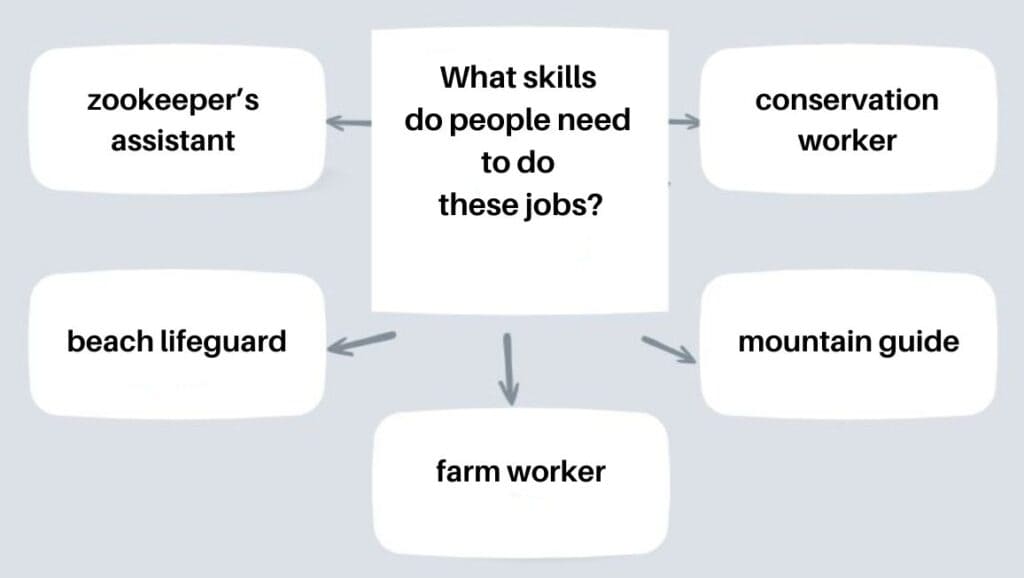
Question
Sample Answer – Discussion
There is two minutes to discuss how each part influences the central question.
Student A: OK, shall I start?
Student B: Sure, go ahead.
Student A: I think a beach lifeguard needs to have really strong swimming skills and also be very alert. They have to react quickly in emergencies and stay calm under pressure, wouldn’t you agree?
Student B: Yes, I agree. They also need to be good at working with people because they might have to give instructions or help someone who’s panicking.
Student A: Exactly. What about a zookeeper’s assistant? I think they need to be patient and careful, especially when working with animals. They probably also need to be physically fit because it’s quite a demanding job.
Student B: That’s true. And a mountain guide definitely needs to be very physically fit too. And they need good leadership skills to guide people safely, especially in bad weather or difficult terrain. Do you agree?
Student B: Yes, and also good knowledge of nature and first aid in case something goes wrong. As for a conservation worker. I suppose they need to be dedicated and really care about the environment. They probably need teamwork skills too, don’t you think?
Student B: Yes, and maybe scientific knowledge, especially if they’re collecting data or working on projects. And farm workers – that’s another job that needs physical strength. Also, I think they need to be reliable and willing to work long hours especially during busy seasons like harvest time.
Sample Answer – Reaching a Decision
There is one minute for the candidates to reach a decision about which activity needs the most skills?
Student A: So, which job do you think needs the most skills?
Student B: Hmm, maybe the mountain guide? It seems to require both physical and mental strength, plus responsibility for others.
Student A: That’s a good point. But I think a beach lifeguard also needs a lot of skills, especially when it comes to safety and saving lives.
Student B: True. Both jobs are about protecting people. Maybe we can agree on those two?
Student A: Yes, let’s say mountain guide and beach lifeguard need the most skills.
Targeted Tips for This Part 3 Question
🔄 1. Use More Linking Expressions
Why? They help students sound more natural and organized.
Examples to use:
- Giving opinions: “I’d say that…”, “In my opinion…”, “I believe…”
- Agreeing: “That’s true”, “I see what you mean”, “I agree with you there”
- Adding ideas: “Also”, “Another thing is that”, “What’s more…”
- Contrasting: “On the other hand”, “However”, “But at the same time…”
Student improvement:
Instead of saying “Yes, and…” every time, they could say: “That’s a good point. Also, they probably need to…”
👂 2. Ask Each Other Questions Naturally
Why? The examiners want to see interaction, not two separate monologues.
Useful phrases:
- “What do you think?”
- “Would you agree?”
- “Do you think that’s more important than…?”
Student improvement:
After describing the zookeeper’s job, a student could ask: “Do you think it’s harder than being a farm worker?”
🔁 3. Clarify or Build on Each Other’s Ideas
Why? Showing active listening earns points for interactive communication.
Examples:
- “Yes, and to add to that…”
- “I hadn’t thought of that, but it makes sense.”
- “Exactly, and that’s especially true when…”
Student improvement:
Instead of just saying “Yes,” add something like: “Yes, and if they panic, it could make the situation worse.”
📏 4. Manage Time and Keep the Focus
Why? You only have 2 minutes for discussion and 1 minute for a decision.
Strategy:
- Spend about 20–30 seconds on each option.
- Don’t go into too much detail on just one.
- Start the decision part clearly with:
“So, which one do you think is the most important?”
🗣️ 5. Practice Paraphrasing and Avoid Repetition
Why? It shows a good range of vocabulary and flexibility.
Examples:
- Instead of repeating “needs to be strong,” try:
- “has to be physically fit,” “requires stamina,” “should be in good shape”
B2 First Speaking Part 4 Quiz: Try Now!

B2 First Speaking Part 4
One candidate is asked a Part 4 question, then the other one is asked to give a shorter opinion on it too.
Questions
- Tell us about animals you like or dislike.
- Do you think animals should be kept in zoos? (Why/Why not?
- How important do you think it is to protect wildlife?
- Which do you prefer, working outdoors or working in an office? (Why?)
- Do you think it is a good idea to do volunteer work? (Why/Why not?)
- Do you think it is important to finish your studies before you get a job? (Why/Why not?)
Sample Answers
1. Tell us about animals you like or dislike.
I’ve always liked dogs because they’re friendly, loyal, and fun to be around. I especially like large breeds like Labradors or Golden Retrievers. They seem to understand people really well and make great companions. On the other hand, I’m not very keen on snakes or insects. I know they play a role in nature, but I feel quite uncomfortable around them.
2. Do you think animals should be kept in zoos? (Why/Why not?)
That’s a difficult question because I think it depends on the zoo. Some zoos do a good job of protecting endangered species and helping people learn about animals. But in general, I don’t like the idea of animals being kept in small spaces, especially if they don’t have enough room to move or behave naturally. Ideally, animals should live in the wild, but if a zoo can provide a safe and natural environment, it might be acceptable in some cases.
3. How important do you think it is to protect wildlife?
I believe it’s extremely important to protect wildlife. Every species has a role in the environment, and if we lose too many, it can affect the whole ecosystem. Also, many animals are in danger because of human activity, like pollution or deforestation, so I think we have a responsibility to protect them. It’s also about the future—if we don’t act now, future generations won’t be able to enjoy the beauty of nature.
4. Which do you prefer, working outdoors or working in an office? (Why?)
Personally, I prefer working outdoors. I feel more relaxed and energetic when I’m outside, especially in natural surroundings. Being in fresh air helps me concentrate and stay positive. Working in an office can be comfortable and organized, but it often feels a bit repetitive. Of course, it depends on the job, but I think I would enjoy something more active and varied.
5. Do you think it is a good idea to do volunteer work? (Why/Why not?)
Yes, I definitely think volunteer work is a good idea. It’s a great way to help others and also learn new skills. It can also give you a better understanding of different people and situations. Even though it’s unpaid, it can be very rewarding and can even help you find a job later because it shows that you are responsible and care about your community.
6. Do you think it is important to finish your studies before you get a job? (Why/Why not?)
In my opinion, it depends on the situation, but in most cases, it’s better to finish your studies first. Having a qualification usually gives you more job opportunities and better chances for the future. However, some people need to work earlier to support their families, and that’s understandable. Still, if possible, I think completing your education gives you a stronger foundation to build your career.
Less Common Vocabulary
- alert – quick to notice any unusual and potentially dangerous or difficult circumstances
- panicking – to act irrationally due to fear and doubt
- physically fit – possessing the ability to perform daily activities with ease and energy, along with the capacity to engage in physical exertion without excessive fatigue
- terrain- a piece of land
- first-aid – help given to a sick or injured person until full medical treatment is available
- dedicated – devoted to a task or purpose
- willing – ready, eager, or prepared to do something.
- loyal – giving or showing firm and constant support or allegiance to a person or institution
- breeds – a stock of animals or plants within a species having a distinctive appearance
- endangered – seriously at risk of extinction.
- ecosystem – a biological community of interacting organisms and their physical environment
- deforestation – the action of clearing a wide area of trees
- unpaid – work undertaken without payment
Related Content
How to Avoid Making Sweeping Statements

Sweeping statements are statements which cover a broad topic in a concise or even terse manner. They make it seem as if everybody does something. This is really common in…
Cambridge B2 First Speaking: 17 of the Best Ways to Improve

Improve Your Skills! Discover 17 effective strategies to ace the Cambridge B2 First Speaking test, from understanding the test format to mastering vocabulary and body language. Some readers have been…
B2 First Speaking: Your Guide to Success
The B2 First Speaking test is designed to assess your ability to communicate effectively in English across a variety of situations. You’ll be tested on everything from interacting with a…
B2 First Speaking Rubric: How To Score Well

Get the Facts! Discover what the B2 First Speaking rubric really means and how to prepare for each part of the test to maximize your score. Try it Now! How…
B2 First Speaking Parts 3 & 4 Sample Answers: Easy Learning!
Sample Answers: High scoring B2 First Speaking Part 3 and Par 4 sample answers to guide to a better score. Practice your skills. All have answer transcripts. Home > B2…
B2 First Speaking Part 4: Powerful Quantities and Types of People

Improve Your Skills! Accurately talk about people in B2 First Speaking Part 4 using these expressions for quantities and types of people and types of people. In B2 First Speaking…
B2 First Speaking Part 4: How to Talk About Unfamiliar Topics

Improve Your Skills! B2 First Speaking Part 4 is an English test, not a general knowledge one. Even if you don’t know the answer, you still have to speak. Taking…
B2 First Speaking Part 4: 2 Simple Ways to Improve

Improve Your Skills! Don’t make the two most common B2 First Speaking Part 4 errors. Follow this guide for a solid foundation to any part 4 question. Some seem to…
B2 First Speaking Part 4 Quiz: Try Now!

Quiz: How much do you know about what makes a good answer in B2 First Speaking Part 4? If you think you know everything, give this quiz a try and…
B2 First Speaking Part 4 Information and Advice

Get the Facts! Master B2 First Speaking Part 4 by learning the format, preparation, essential advice and sample questions. Know what to do, to have a calm exam. There is…