
These are high-scoring sample answers for the following Cambridge C1 Advanced Speaking Parts 3 and 4. Read them to understand what you need to talk about and the kind of answers you need to give for a good C1 Advanced speaking score.
Home > C1 Advanced > Speaking > Part 3 & 4 Sample Answers
C1 Advanced Speaking Part 3 Quiz: Do You Know?


C1 Advanced Speaking Part 3
Question
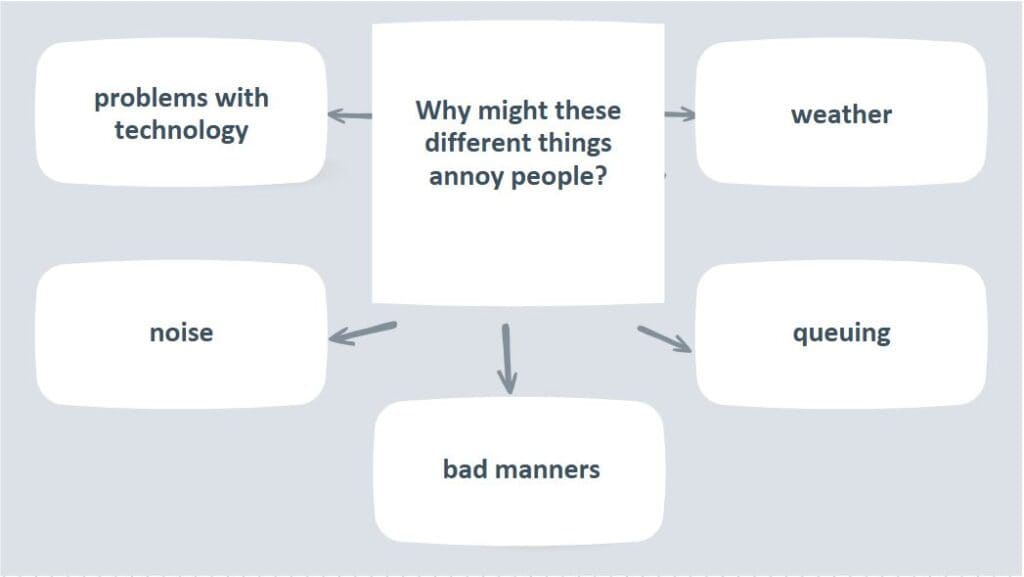
Sample Answer – Discussion
There is two minutes to discuss how each part influences the central question.
A: Would you like to start this one?
B: Sure. I think technology can be extremely frustrating, especially when you rely on it for work or communication. If your phone crashes or the internet goes down during an important meeting, don’t you think it can really ruin your day?
A: I couldn’t agree more. It’s particularly annoying when you’re in a rush and something just doesn’t work. Noise is the same – whether it’s traffic, loud neighbours, or even construction, it can be really disruptive and stressful. Does that get to you too?
B: Yes, constant noise can really affect your concentration and even your sleep. Speaking of stress, queuing is another one. People get really annoyed when they have to wait in line, especially if it feels unfair or if someone pushes in. What do you think about that?
A: I completely agree And bad manners can really get under people’s skin – things like not saying thank you, interrupting, or being rude in public. It creates a negative atmosphere and makes daily interactions unpleasant. What’s your take?
B: That’s true. Even small things like someone not holding a door open can feel quite irritating. What about the weather? That seems to be a big one, especially in countries where it’s often grey or rainy. Have you experienced that?
A: Yes, it’s terrible, especially if you had outdoor plans or if bad weather affects your commute. It’s something we can’t control, but it still has a big impact on our mood.
Sample Answer – Reaching a Decision
There is one minute for the candidates to reach a decision about which option annoys people most.
A: So, which of these do you think annoys people the most?
B: I’d say bad manners, because it directly affects how people relate to each other. It feels personal, unlike something like the weather.
A: I agree. And maybe problems with technology would come second, because so much of our lives depends on it now.
B: Exactly. When it fails, it can cause real inconvenience. So shall we say bad manners and technology problems are the most annoying?
A: Yes, let’s go with that.
CAE Speaking Part 4 Quiz: Are You The Best?

C1 Advanced Speaking Part 4
One candidate is asked a Part 4 question, then the other one is asked to give a shorter opinion on it too.
Questions
- Why do you think some people lose their temper more often than others?
- Do you think the pace of life today makes it more likely for people to lose their temper? …….. (Why?/Why not?)
- People say that getting angry can sometimes have a positive outcome. What’s your opinion?
- Do you think ‘anger management’ courses can be a good idea? …(Why? / Why not?)
- Is it always better to show your feelings rather than hide them? …….. (Why?/Why not?)
- Do you think we become less tolerant of other people’s behaviour as we get older?…(Why? / Why not?)
Sample Answers
1. Why do you think some people lose their temper more often than others?
I think it often depends on personality and how people were raised. Some people are naturally more emotional or impulsive, while others are better at controlling their reactions. Stress levels also play a big role—if someone is under constant pressure, they’re more likely to react quickly. It can also be a learned behaviour from family or their environment.
2. Do you think the pace of life today makes it more likely for people to lose their temper? Why / Why not?
Yes, I think so. Life has become very fast-paced and competitive, which increases stress and frustration. People often feel they don’t have enough time, and this can make them more impatient or irritable. When you’re constantly rushing or dealing with pressure, it’s much harder to stay calm.
3. People say that getting angry can sometimes have a positive outcome. What’s your opinion?
I agree to some extent. If anger is expressed in a controlled way, it can help people stand up for themselves or bring attention to something unfair. It can be a sign that something needs to change. However, if it’s uncontrolled or aggressive, it usually makes things worse rather than better.
4. Do you think ‘anger management’ courses can be a good idea? Why / Why not?
Yes, definitely. Not everyone learns how to deal with emotions in a healthy way, so these courses can teach useful techniques. They help people understand their triggers and learn how to respond more calmly. In the long run, that can improve both personal relationships and mental health.
5. Is it always better to show your feelings rather than hide them? Why / Why not?
Not always—it depends on the situation. In general, being open about your feelings is healthy because it helps build trust and prevents misunderstandings. But there are times when it’s more appropriate to wait or express emotions privately, especially if you’re very upset. It’s about finding the right balance.
6. Do you think we become less tolerant of other people’s behaviour as we get older? Why / Why not?
It varies, but many people do become less tolerant with age. They often become more set in their ways and less patient with things they don’t understand. On the other hand, some people become more understanding as they gain life experience. It really depends on the individual and their mindset.
Related Content
18 Terrific Ways to Improve Your C1 Advanced Speaking

One of the most effective ways to prepare for your C1 Advanced Speaking test is to watch this official test video. Such videos provide a realistic view of the test,…
Better C1 Advanced Speaking Part 2: Answer Structure

C1 Advanced Speaking Part 2 is a critical section of the exam where you need to deliver a well-structured, fluent, and engaging talk, should only take one minute. Whether you’re…
Better Discussions for C1 Advanced Speaking Part 3

In C1 Advanced Speaking Part 3, you and the other student need to discuss the different options of the central theme, described in the mind map or picture. You need…
C1 Advanced Speaking Information and Advice

Many students seem to miss basic facts about the C1 Advanced Speaking test, so this page is to fill in some of that missing information. There are also separate pages…
C1 Advanced Speaking Part 1 Information and Advice

Many students seem to miss basic facts about the C1 Advanced Speaking Part 1, so this page is to fill in some of that missing information about Part 1. There…
C1 Advanced Speaking Part 1 Questions

Introduction Many students think that the Speaking Part 1 questions in C1 Advanced are the easiest and simplest of the four parts, but it is a great time to show…
C1 Advanced Speaking Part 1 Quiz: Do You Know Enough?

Many think of C1 Advanced Speaking Part 1 as the easiest part, but you should be aware that every part of the speaking test is considered just as important as…
C1 Advanced Speaking Part 1 Sample Answers
This is a list of sample answers for C1 Advanced Speaking Part 1 questions. There are three different methods for answering each question. All have transcripts of the answers. Some…
C1 Advanced Speaking Part 1: 4 Great Tips

Many students think that the C1 Advanced Speaking Part 1 questions are the easiest and simplest of the four parts, but it is a great time to show off what…
C1 Advanced Speaking Part 1: How to Vary Your Answers

Introduction Many students think that the questions in C1 Speaking Part 1 in the C1 Advanced English test are the easiest and simplest of the four parts, but it is…
C1 Advanced Speaking Part 2 Information and Advice

Many students seem to miss basic facts about the C1 Advanced Speaking Part 2, so this page is to fill in some of that missing information about Part 2. There…
C1 Advanced Speaking Part 2 Quiz: Enough Time for You?

Do you know as much about C1 Advanced Speaking Part 2 as you think do? Take this quiz to test your knowledge. There’s nothing worse than being unprepared, especially when…
C1 Advanced Speaking Part 2 Sample Answers
This is a list of sample answers for C1 Advanced Speaking Part 2 questions. All have transcripts of the answers. Some have video, some audio. Home > C1 Advanced >…
C1 Advanced Speaking Part 2: Compare and Contrast

C1 Advanced Speaking Part 2 is a tricky part of the speaking test. It seems easy because you are given photos to contrast and compare, but you only have a…
C1 Advanced Speaking Part 2: People Vocabulary

In C1 Advanced Speaking Part 2, you need to choose two pictures from a set of three, then compare and contrast them while answering the two questions. You need to do…
C1 Advanced Speaking Part 2: Planning

C1 Advanced Speaking Part 2 is a tricky part of the test which really worries many candidates. A reliable route to a confident Part 2, is to use dedicated practice,…
C1 Advanced Speaking Part 2: Speculating

In C1 Advanced Speaking Part 2, you need to choose two pictures from a set of three, then compare and contrast them while answering the two questions. You need to do…
C1 Advanced Speaking Part 3 Information and Advice

Many students seem to miss basic facts about C1 Advanced Speaking Part 3, so this page is to fill in some of that missing information about Part 3. There is…
C1 Advanced Speaking Part 3 Quiz: Do You Know?

Although you have other test takers to speak to in Part 3, it’s easy to let them influence you too much. Take this quiz to test what you know about…
C1 Advanced Speaking Part 3: Asking for, and Giving Opinions

In C1 Advanced Speaking Part 3, test takers need to discuss the topics in the given diagram. To do this, they need to ask for and give opinions as well…