
What You Will Get!
Latest questions, Sample Answers and GREAT Tips on this page
The latest questions for IELTS Speaking tests between September and December 2024 including sample answers and great tips for:
Need Help with IELTS Speaking Part 2?
Click here to find friendly, experienced teachers who can help you prepare at a time that suits you!
Are you looking for the latest IELTS Speaking topics to fine-tune your practice? Our list covers real IELTS Speaking questions from September to December 2024, shared by candidates who’ve recently taken the test.
Home > IELTS > Speaking > Questions Archive
General Tips for IELTS Speaking
- IELTS Speaking is a difficult, stressful speaking test, so it is much more effective if you prepare for the test as well as trying to improve your English. If you know exactly what is expected from you and how you will feel, then you can prepare and manage your expectations. Doing this will reduce your stress and help to keep you calm while you speak.
- You should NEVER remember or recite answers, but it is completely natural to remember phrases, words and sentences that you can fit into many answers.
- If you read all the tips on this page and prepare, you will be able to mix and match what you have, so you can answer any IELTS speaking question.
- In Part 2, always add your own points in your notes because sometimes the bullet points on the cue card could be talked about in 30 seconds. Add your own at the beginning, between the cue card points and at the end, then you will always have something to speak about. As long as you look at your notes 😉
- If you sound happy when you talk about positive things and angry, sad or disappointed when you talk about negativity, you will really help your pronunciation score and also emphasise your meaning.
Latest IELTS Speaking Questions Parts 2 & 3
The majority of IELTS Speaking Part 2 topics are split into sections such as ‘Describe a person’, ‘Describe a place’ and ‘Describe a time or event’. The latest questions for these three main categories are outlined below. Other categories are further below, with ‘Describe an object’ and ‘Describe an activity’ to follow soon.
Describe a Person
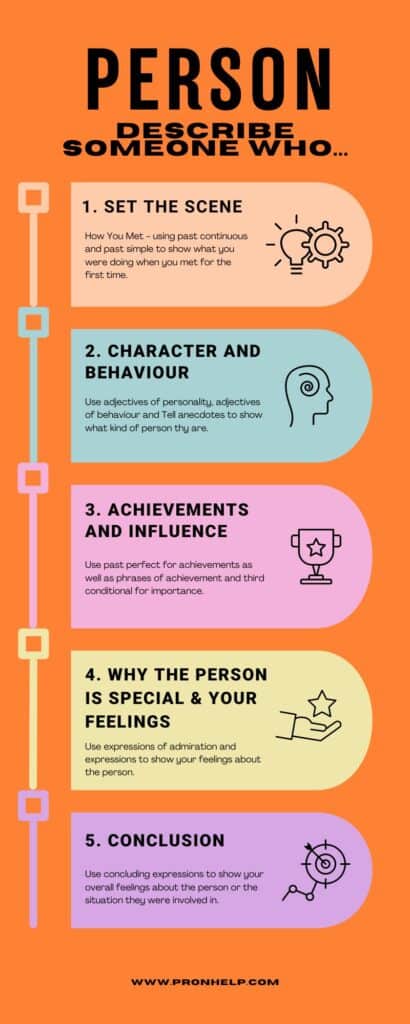
Latest Person Questions September to December 2024
Tips for Describing a Person
- Talk about someone you know who you can be adapted to many situations, such as your mum, your sister, …. Then they can become these different people, and you know what they look like, what they are like and how they would react.
- Add a brief physical and character description so the examiner has someone to imagine, which makes it much your talk come to life. More than one sentence is too much, though. All you need is a taste.
- Talk about what you do together and give an example if you have time. It’s important to answer the question and stay on topic, so an example should make the rest clear. It shouldn’t be the whole story.
Part 2
Describe a person who likes to make things by hand (e.g. toys, furniture)
You should say:
Who this person is
What he/she makes
Why he/she likes to make things by hand
And explain how you feel about the person
Part 3
- Are traditional handicrafts important to tourism?
- What are the benefits for students to learn to make things by hand?
- Why do many children like to make things by hand?
- How important are traditional handicrafts to a country’s industry?
- ls it reasonable to charge a high price for handmade things?
- How does modern technology change the handicraft industry?
Band 7 Sample Answer using these steps – Describe a person who likes to make things by hand (e.g. toys, furniture)
Setting the Scene: I first met Sarah when I was working part-time at a café, and she was my colleague. At the time, she was in the middle of working on a handmade wooden toy, and I was curious to know more about her hobby.
Describing Character and Behaviour: Sarah is incredibly patient and creative. She enjoys spending hours designing and making these beautiful wooden toys. I remember once she told me how she stayed up until 3 a.m. to finish a toy for a charity event. She’s always been hardworking and determined to perfect her craft, which is a trait I really admire.
Expressing Achievements and Influence: By the time I met her, she had already created several amazing pieces. If she hadn’t put so much effort into learning and practicing, she wouldn’t have been able to produce such intricate designs. Her skills have improved so much, and she often talks about how this hobby has taught her patience and attention to detail.
Discussing Why the Person is Special and Your Feelings: What makes Sarah special is not just her skill but her passion for making things by hand. She puts love and care into each project, and I really admire that about her. Seeing how dedicated she is makes me feel inspired to take on my own creative hobbies.
Concluding Your Monologue: Overall, I believe Sarah’s dedication to her craft is truly inspiring, and I’m lucky to know such a talented and kind person.
Explanation:
- Grammar: The candidate uses a wider range of tenses, including past perfect and conditional, though there are occasional minor errors.
- Vocabulary: The vocabulary is more varied, with adjectives like “incredibly patient” and “hardworking,” and there is better use of specific phrases.
- Fluency: The speech is more fluid, with fewer pauses.
- Coherence: The ideas are more developed and clearly connected, providing a clearer narrative.
Check out our ultimate guide for describing a person!
Part 2
Describe a person who has chosen a career in the medical field (e.g. a doctor, a nurse) – Band 6, 7 & 8 Sample Answers
You should say:
Who he/she is
What he/she does
Why he/she chose this career
And explain how you feel about him/her
Band 6 Sample Answer for this Part 2 Question
I’d like to talk about my cousin, Sarah. She’s a nurse at a hospital in my city. We met when I was, um, around 8 years old, and we’ve always been quite close. Sarah is a very kind person. She always helps others and takes care of her family too. One time, I remember, she, um, stayed up all night to help my grandmother when she was sick.
Sarah decided to become a nurse because she likes helping people. She thought it was a good job for her since she loves being around people and wants to do something useful for the community. I think, um, being a nurse is not easy, but she’s really good at it.
I really admire Sarah. She works hard, and even though her job is difficult, she always stays positive. I feel proud of her because she’s helping people every day, and I hope one day I can be as hardworking as her.
Note: This answer is a little short but has no hesitation and the grammar is correct. Can you do that?
Check out our ultimate guide for describing a person!
Part 3
- Do you think doctors and nurses are very important?
- Who plays a more important role, doctors or nurses?
- Do you think that doctors and nurses are not paid enough?
- Do you think it is necessary to learn first aid skills?
- What are the differences between the work of a doctor and a nurse?
- Can a hospital function effectively without nurses?
Band 6 Sample Answers for these Part 3 questions
1. Do you think doctors and nurses are very important?
Yes, I think doctors and nurses are very important. They help people who are sick or injured. Doctors give medicine, and nurses take care of the patients. Without them, many people would not get better. They do a good job.
2. Who plays a more important role, doctors or nurses?
I think both are important, but maybe doctors are more important because they decide the treatment. Nurses help the patients, but doctors make the big decisions, so I think doctors are more important.
3. Do you think that doctors and nurses are not paid enough?
I don’t think they are paid enough. Their jobs are very hard, and they have to work long hours. I think they should be paid more because they do a lot for people.
4. Do you think it is necessary to learn first aid skills?
Yes, I think it’s necessary. If you know first aid, you can help people in an emergency before the doctor comes. It’s good to know how to help others in dangerous situations.
5. What are the differences between the work of a doctor and a nurse?
Doctors and nurses have different jobs. Doctors check the patients and give medicine. Nurses take care of the patients, like giving them food and checking their health. Doctors make the big decisions, and nurses help with smaller things.
6. Can a hospital function effectively without nurses?
No, I don’t think so. Nurses do a lot of work, like helping the patients and doing things the doctors don’t have time for. A hospital needs nurses to work well.
If you think these Band 6 Sample Answers are useful, compare them to Band 7 and Band 8 sample answers for the same Part 2 and Part 3 questions.

Part 2
Describe a person who likes to read a lot
You should say:
Who this person is
How you knew him/her
What he/she likes to read
And explain why you think he/she likes to read a lot
Check out our ultimate guide for describing a person!
Part 3
- Why are many people so keen on reading?
- Do you think parents should help their children develop the reading habit from an early age?
- ls reading for fun or for work?
- What reading topics are popular in your country?
- What are the differences between paper books and movies?
- Do you think people of all ages need to read?
Part 3 tip for these questions
Questions 1, 2, 4 & 5 are suitable for sequencing. There are many reasons ….., There are many topics, There are many differences …. Firstly …. secondly …… and finally …… If you like you could also add an example. HOWEVER, try not to answer all of them in the same way, or the first answer will sound great, but the others will sound boring when you use the same structure.
Part 2
Describe an old person you know
You should say:
Who this person is
Where he/she lives in
What he/she has done in his/her life
And explain how you feel about this person
Check out our ultimate guide for describing a person!
Part 3
- What do you think people like to do when they are old?
- Do you think grandparents can always have a good relationship with their grandchildren?
- What can grandparents and grandchildren learn from each other?
- Do you think children’s parents enjoy living with the grandparents in the family? Why?
Part 3 tip for these questions
There is a strong possibility that you may never have known your grandparents. If that is the case, then you should speculate about what people do, what relationships they have and so on. This will help you to speak, stop you worrying and so improve your score.
Part 2
Describe a person who has strong opinions
You should say:
Who this person is
How you knew him/her
Why you think he/she is a person who has strong opinions
What kinds of strong opinions this person has
And explain how you feel about his/her opinions
Check out our ultimate guide for describing a person!
Part 3
- What do young people have strong opinions about?
- What do old people have strong opinions about?
- Are there many young people who have strong opinions in our lives?
- Which is more important, listening to others or persuading others?
- Do you think we should only say something after thinking it through?
- Do you think it is good to have strong opinions?
Part 3 tip for these questions
The first three questions in particular almost push you to answer about young people or old people. They are huge groups and so are really difficult to talk about accurately. However, if you split them into smaller groups related to the question, it makes it much easier to speak and your answer sounds great!
Part 2
Describe an old friend you had lost touch with and got in contact with again
You should say :
Who he/she is
How you knew each other
Why you lost contact
How you got in contact again
And explain how you felt after getting in contact again
Check out our ultimate guide for describing a person!
Part 3
ls it better to have a lot of friends than just a few friends?
Would having just a few friends limit your horizons?
Do you think you are good at maintaining good relationships with others?
Why do old friends lose touch with each other?
Why do people need to make new friends?
Why do we have to give up some old friends?
Part 3 tip for these questions
It is simple to start your answers to each of these questions with ‘Well, it depends, ……’ This is a speaking test, so varying your responses is crucial. Using ‘It depends’ is fine, but in the first three questions, you could just say ‘Yes, it is, ……’, ‘Yes it would, …….’, or Yes, I do, ……’. Of course, you could always say ‘No it isn’t’, ‘No it wouldn’t’ or ‘No I don’t’ instead.
Part 2
Describe a person from whom others like to ask for advice
You should say:
Who this person was
Why you asked for the advice
What the advice was
And explain how you felt about the advice
Check out our ultimate guide for describing a person!
Part 3
- Who should people ask for advice on big issues, family members or friends?
- Do you follow the advice of family members?
- Do people often ask advice from professional people, like a lawyer?
- Why do some people like to ask others for advice on almost everything?
- Do you think the advice parents give their children is always good?
- Are professional consultancy services expensive in your country?
Part 3 tip for these questions
Conditional sentences are great with questions like these. In question 1, for example, you could say something like ‘If I asked my brother, then he would say ……, but if I asked my sister, she would say something completely different. Comparing like this is great and using conditionals to so it makes it much easier to structure your answers.
Describe a Place
Following the structure in the infographic makes describing any place more straightforward and much less stressful. Of course you can add what you want to that suits your personality.
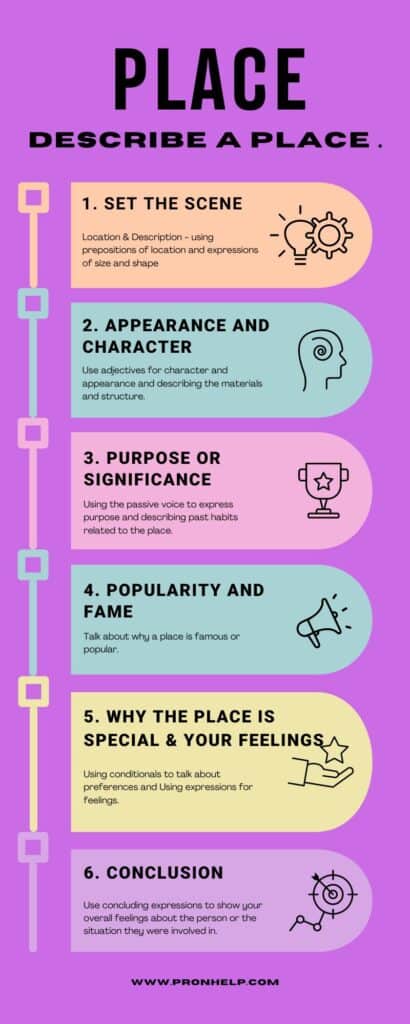
Tips for Describing a Place
- Think of an inside place and outside place you know where people go, such as a cafe and a park. They can both be used in various situations and you could even go for a walk with your person in the park before going to the cafe for a cup of coffee or something to eat. Prepare.
- Prepare places where there are people so you can mention them too, such as children playing, old men fishing or lovers walking their dogs in the park. Paint a picture.
- If you talk about a place where something happened, then you should still set the scene about where the place is in the city for example.
- A park could also be a large garden of a house or a hotel, it could be beside the sea or in the mountains, or it could just be an ordinary park.
- A cafe could also be someone’s living room, somewhere at work, an art gallery and so on. How is it decorated, what pictures are on the walls, what music is playing, what kind of people go there, when is it busy, when is it quiet? You don’t need to talk about all of these things, but if you have them ready, it’s much easier.
Latest Place Questions September to December 2024
Part 2
Describe a place in your city you have been to where you can see wildlife (eg. animals, birds, insects, plants) – Band 6, 7 & 8 Sample Answers
You should say
Where it is
When you went there
What animals you saw there
How you feel about the place
Band 8 Sample Answer using these steps – Describe a place in your city you have been to where you can see wildlife (e.g. animals, birds, insects, plants)
The place I’d like to talk about is Green Park, a large public park not far from my home, where I’ve had the chance to see a surprising amount of wildlife. I first visited the park years ago, but most recently, I went there last weekend with my family. We were strolling through the park when we noticed various birds flying overhead and squirrels darting from one tree to another. At one point, a large bird, possibly a hawk, swooped down right in front of us, which was quite a thrilling moment. Given that we live in a busy urban environment, encountering such wildlife felt almost surreal.
Green Park is beautifully landscaped, with a wide variety of trees and flowers, and it’s clear that a lot of effort goes into keeping the park well-maintained. I felt completely at peace there. The greenery and the presence of wildlife created a sense of calm that you rarely find in the city. If Green Park didn’t exist, I think the city would lose an important space for both relaxation and wildlife conservation.
To conclude, I have a deep appreciation for Green Park, not only because it allows me to reconnect with nature but also because it offers a sanctuary for local wildlife, something I believe every city should strive for.
Explanation of Band 8:
- Grammar: Demonstrates full control of a range of tenses (e.g., past continuous, past perfect, and third conditional), with complex structures.
- Vocabulary: Advanced vocabulary, including “landscaped,” “surreal,” “thrilling,” and “sanctuary.”
- Fluency and Coherence: Very smooth with no noticeable hesitation, using a variety of sentence types and linking devices.
- Pronunciation: Excellent intonation and stress patterns, making the answer sound engaging and expressive.
Check out our ultimate guide for describing places
Part 3
- Why are most children interested in wild animals?
- Should parents take their children to the zoo to see wild animals?
- Are wild animals easy to spot in your country?
- Are there many documentaries about wildlife in your country?
- What impact does only seeing wild animals in zoos have on children’s understanding of these animals?
- Which is the better way to see wildlife, watching documentaries or going into the wild?
Band 8 Sample Answers for these Part 3 questions
1. Why are most children interested in wild animals?
Children are inherently fascinated by the unknown, and wild animals represent a world they don’t typically encounter. The size, power, and mystery of animals like tigers, elephants, and whales spark their imagination. Media, like documentaries and animated films, also play a huge role in sustaining this interest by making these creatures seem both accessible and magical.
2. Should parents take their children to the zoo to see wild animals?
Yes, I believe taking children to the zoo can be an educational experience if done responsibly. However, I think it’s essential for parents to explain the difference between animals in captivity and those in the wild. Zoos offer children a rare opportunity to see animals up close, which can inspire interest in conservation efforts, but it’s crucial that the welfare of the animals is a priority.
3. Are wild animals easy to spot in your country?
Not really. Most wild animals in my country are confined to remote national parks and conservation areas. You’d have to travel quite far to see animals like leopards or elephants. In urban areas, the closest you’ll get to wildlife are birds and small mammals, but larger, more exotic species are rarely spotted outside their natural habitats.
4. Are there many documentaries about wildlife in your country?
Yes, there are plenty of wildlife documentaries available, especially on popular streaming platforms and national TV channels. These documentaries range from global series to those focusing on the local ecosystem, which help raise awareness about endangered species and the importance of conservation.
5. What impact does only seeing wild animals in zoos have on children’s understanding of these animals?
When children only see animals in zoos, their understanding may become somewhat skewed. They may not grasp the complexity of the animal’s natural behavior or environment because a zoo, no matter how well-designed, is an artificial setting. This limited view could prevent them from appreciating the real challenges these animals face in the wild.
6. Which is the better way to see wildlife, watching documentaries or going into the wild?
While documentaries offer an in-depth, safe, and informative way to observe animals, there’s nothing quite like seeing wildlife in its natural habitat. It provides a more authentic and emotional experience, as you witness animals interacting in their own environment. That said, for many people, documentaries are the only practical way to see certain species, and they offer a wealth of information.
Explanation of Band 8:
- Grammar: Mastery of complex structures, such as conditional clauses, passive voice, and relative clauses.
- Vocabulary: Sophisticated and precise vocabulary, including terms like “artificial setting,” “ecosystem,” and “conservation efforts.”
- Fluency and Coherence: Speech is highly fluent and coherent, with smooth transitions between ideas. No hesitations, and responses are well-developed and thoughtful.
- Pronunciation: Clear with excellent use of stress, rhythm, and intonation, making the speech dynamic and engaging.
If you think this Band 8 Sample Answer is useful, compare it to Band 6 and Band 7 sample answers for the same Part 2 and Part 3 questions.
Part 2
Describe someone else’s room you enjoy spending time in
You should say:
Where it is
What it is like
What you can do in it
And explain why you really like it
Check out our ultimate guide for describing places
Part 3
- Do you like to invite your friends to your home?
- Do most people visit other people’s houses during the most important holiday in your country?
- Why do people often take gifts with them when they visit others’ homes?
- What are the most enjoyable parts of having a meal together with your family?
- Who likes to stay at home more, young people or old people?
- Do you think old people will be able to keep up with the pace of technology in 50 years?
Part 3 tips for these questions
Remember to give general answers. If you want to talk about how you feel or what your family does, then say it generally. For example, ‘Some people do ……..’ (for talking about yourself. ‘In some families, they ……’ for talking about your family. In this way, you are using your family as an example of a group of families that do certain things, not specifically your own family.
Part 2
Describe a public park or garden
You should say:
Where it is
What it is like
How often you go there
What you often do there
And explain how you feel about it
Check out our ultimate guide for describing places
Part 3
ls it necessary to have public parks in cities?
What facilities are needed in a park?
What are the differences between a garden and a natural area?
Why do people like to visit tourist attractions?
What tourist attractions are popular in your country?
How can we encourage young people to go to parks more often?
Part 3 tips for these questions
It is useful to think of a Part 3 answer like an IELTS Writing Task 2 paragraph. Topic sentence, supporting sentence 1, example, supporting sentence 2, conclusion.
Part 2
Describe a place in your hometown/city that is different from other places and you would like to visit with your parents/friends
You should say:
Where it is
Why you think it is different
Who you would like to go there with
And explain whether you have been there
Check out our ultimate guide for describing places
Part 3
- What are the differences between big cities and small cities?
- Where do people in your hometown like to go?
- What are the differences between the places young people like to go and the places old people like to go?
- What do young people like to do in their leisure time?
- Do you think it is necessary to visit the same place many times?
- What factors attract people to go to visit other places other than their hometown?
Part 3 tips for these questions
These questions ask you about cities or people, so rather than answering about them, split them up. You could talk about industrial cities, financial centres or capital cities. Or you could talk about huge megalopolises, ports or ancient cities. As for ‘young people’, you could talk about those who prefer to lead a traditional life, those you are sporty or those who are desperate to explore. Doing this makes it easier to give a longer more detailed answer with better structure and vocabulary. Keep comparing!
Part 2
Describe an ideal and perfect place where you would like to stay (e.g. a house, an apartment)
You should say:
Where it would be
What it would look like
What special features it would have
Whether it would be big or small
And explain why it would be an ideal place for you
Check out our ultimate guide for describing places
Part 3
- What are apartments like in your country?
- Why are apartments popular in some places while not in other places?
- What would people normally consider when they rent or buy a house or an apartment?
- Do different people have different preferences for houses or apartments?
- Why do some people choose to live in the city center?
- What do you think buildings will be like in the future?
Part 3 tips for these questions
In questions like these, you can talk about what you are used to (generally) compared to what you have seen on TV or read about in books. Remember it’s an English test, not a general knowledge test, so if you have never rented an apartment, or have no idea why people choose to live in the city centre say what you THINK happens. As long as you use good English, that’s the most important thing.
Part 2
Describe a crowded place you went to
You should say:
Where it was
When you went there
Who you went there with
What you did there
And how you felt about it
Check out our ultimate guide for describing places
Part 3
- Which cities are overcrowded in your country?
Will there be more or less green space in cities in the future?
Will people use bikes more or less in cities in the future? - Why do people go to crowded places?
- Do you think there are some people who enjoy crowded places?
- Do you think it is a good trend to have more big cities?
Part 3 tips for these questions
Compare what some people do to what others do and give your opinion. That may sound easy to do, but can be tricky to do well. If you find it tricky, use natural phrases and expressions that will set the context quickly and easily.
Part 2
Describe a cultural place that you would like to learn the culture there (e.g. a library, museum, theatre)
You should say:
Where it is
How you knew this place
What it is like
And explain how the place is related to culture
Check out our ultimate guide for describing places
Part 3
- How does the internet affect culture?
- How is a culture formed?
- What kind of culture is popular among young people?
- How do young people learn different cultures?
- Which is more important in terms of culture, literature or music?
- Does the culture of the past have an impact on today’s culture?
Part 3 tips for these questions
Culture is a vague topic, so go into more detail in these answers and talk about related topics such as tradition, fashion, music, literature, food, dance and so on). It is also important to show that everyone in a culture is not the same.
Describe a Time or Event
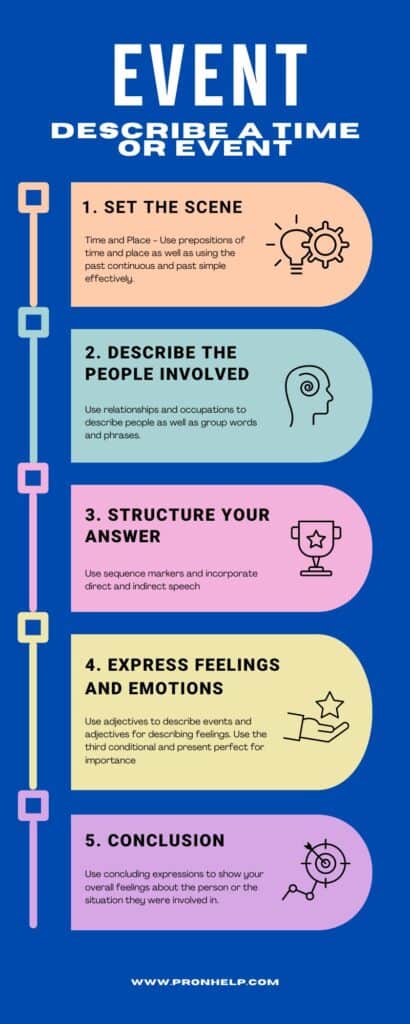
Tips for describing a time or event
- Describing a time or event usually means you need to talk about where something took place, who was there and what happened. As a result, describing a person/people and describing a place as above come in very useful. You can also choose an event to use as a template for any question, but in that template, you can also talk about your person and your places. This means you won’t need to think of everything in these questions as something new. Remember, do not recite whole answers, only remember chunks.
Latest Time / Event Questions September to December 2024
Part 2
Describe a time when you answered a phone call from someone you didn’t know in a public place
You should say:
When and where it happened
What he/she said
How you corresponded
And explain how you felt about the experience
Band 6 Sample Answer using these steps – Describe a time when you answered a phone call from someone you didn’t know in a public place
Setting the Scene: It was last year when I was at the train station. I was waiting for my train, and suddenly my phone rang. I didn’t recognise the number, but I picked up the call anyway.
Describing the People Involved: The person on the other end was a woman. I didn’t know her, but she sounded kind of worried. She asked if I was someone named Alex, and I told her that I wasn’t. She explained that she was looking for her friend and dialled the wrong number.
Structuring Your Answer: First, she asked if I could help her find the right number, but I said I didn’t know. After that, she apologised, and I told her not to worry. I hung up and continued waiting for my train.
Expressing Feelings and Emotions: At first, I was confused because I didn’t know why a stranger was calling me, but after the call, I felt okay. It wasn’t anything serious, so I didn’t mind.
Concluding Your Monologue: In the end, it was just a small mistake, and it didn’t really affect my day.
Explanation:
- Grammar: Simple past tense is used effectively, but more complex tenses like past continuous are not used.
- Vocabulary: The adjectives and vocabulary are basic, like “worried” and “confused.”
- Fluency: Some hesitations, but the answer is clear.
- Coherence: The answer is simple but lacks depth and detail.
Check out our ultimate guide for describing a time or event!
Part 3
- Do most people mind others talking on the phone in public places?
- What are the differences between sitting beside a person who keeps talking on the phone and a person who keeps talking to you?
- Why do some people not care what they do in public places?
- Do you think parents should teach their children not to behave badly in public places?
- Is it acceptable to talk on the phone in public?
Should people be banned from talking loudly in public places?
Part 2
Describe a prize you have received recently (e.g. money, something valuable, a medal) – Band 6, 7 & 8 Sample Answers
You should say:
What it was
When you received it
What you did to receive it
And explain how you felt about it
Band 8 Sample Answer for Describe a prize you have received recently (e.g. money, something valuable, a medal)
A few weeks ago, I received a prize that meant a lot to me: a gold medal for winning a regional basketball tournament. The competition took place on a Saturday afternoon at my local sports center, and it was an event I had been looking forward to for a long time. In the weeks leading up to the tournament, my team and I trained intensively, practicing every evening to fine-tune our strategies and improve our skills. On the day of the competition, we were all feeling a mix of excitement and nervousness because we knew the other teams would be tough opponents. We played several matches throughout the day, and each one was a challenge. However, after a hard-fought final game, we managed to win the championship, and it was an incredible feeling.
During the award ceremony, I was handed the gold medal, and I can still remember the overwhelming sense of pride and excitement that washed over me. The medal wasn’t just a piece of metal; it symbolized all the dedication, hard work, and perseverance that my team and I had put into preparing for the event. It felt like the perfect reward for all those hours of practice and the moments when we felt like giving up but kept pushing forward. I think the prize was significant not only because of the victory but also because of the sense of teamwork it represented. If we hadn’t worked so well together, I’m sure we wouldn’t have been able to achieve such success.
The medal is now hanging in a special place in my room, where I can see it every day. Whenever I look at it, it reminds me that with determination and effort, anything is possible. It also motivates me to keep striving for success in all aspects of my life, whether it’s sports, academics, or personal goals.
Explanation of Band 8:
- Grammar: Very complex sentence structures, including conditional forms (“If we hadn’t worked so well together”), passive voice (“was handed the gold medal”), and perfect tenses.
- Vocabulary: Advanced and precise vocabulary, such as “overwhelming,” “perseverance,” and “striving for success.”
- Fluency and Coherence: The response flows smoothly, with sophisticated use of linking words and a clear, logical structure.
- Pronunciation: Excellent, with varied intonation, stress, and rhythm that make the speech dynamic and engaging.
Check out our ultimate guide for describing a time or event!
Part 3
- Do you think competition is all about the prize?
- Why should we set prizes for competitions?
- What prizes should schools set for students?
What criteria should be set for students to win a particular prize? - Why do many companies offer prizes to their customers?
- Why do some companies encourage employees to compete with each other?
Band 8 Part 3 Sample Answers for these questions
1. Do you think competition is all about the prize?
I don’t think competition is primarily about the prize. While the reward is certainly a motivating factor, I believe the main purpose of competition is self-improvement and personal growth. It’s about pushing boundaries and seeing how far you can go, even if you don’t end up winning the prize.
2. Why should we set prizes for competitions?
Prizes are a great way to incentivize participation and effort. They provide a clear goal that people can strive for, which helps to maintain interest and motivation. Prizes also add a sense of achievement and recognition for the winner, which makes the competition more exciting and rewarding.
3. What prizes should schools set for students?
Schools should offer prizes that encourage educational growth, such as scholarships, study materials, or even opportunities for further learning like workshops or field trips. These types of rewards not only acknowledge the students’ achievements but also help them continue to develop academically. Symbolic rewards like certificates and medals are also valuable for recognizing effort and perseverance.
4. What criteria should be set for students to win a particular prize?
The criteria for winning should be clear and specific. It should be based on merit, such as the quality of the student’s work, their creativity, and their level of effort. In some cases, teamwork, leadership, or problem-solving skills might also be considered. The key is to reward students who genuinely excel in the particular area being judged.
5. Why do many companies offer prizes to their customers?
Companies use prizes as a marketing strategy to attract and retain customers. Offering prizes creates excitement and engagement, which encourages people to interact more with the brand. It can help to boost sales, as customers are more likely to purchase products when there’s the added possibility of winning something. It’s also a great way to build long-term loyalty.
6. Why do some companies encourage employees to compete with each other?
Some companies foster competition among employees as a way to drive innovation and productivity. When employees are motivated to outperform each other, they often put in extra effort and come up with creative solutions. However, it’s essential that the competition remains healthy and doesn’t create tension or resentment, as that could negatively impact teamwork.
Explanation of Band 8:
- Grammar: Wide range of complex structures, including passive voice, relative clauses, and conditionals, used naturally.
- Vocabulary: Highly specific and advanced vocabulary, including terms like “self-improvement,” “incentivize,” and “foster competition.”
- Fluency and Coherence: Extremely fluent and coherent, with ideas logically developed and connected smoothly. No hesitations, and responses are comprehensive.
- Pronunciation: Excellent control over intonation, stress, and rhythm, making the speech engaging and dynamic.
If you think this Band 8 Sample Answer is useful, compare it to Band 6 and Band 7 sample answers for the same Part 2 and Part 3 questions.
Part 2
Describe a time when you lost an important valuable item
You should say:
When and where it happened
What it was
How valuable it was
How you lost it
And explain how you felt about the experience
Check out our ultimate guide for describing a time or event!
Part 3
- What are some common items that people tend to lose easily?
- What are the reasons why people often misplace or lose things?
- What do people often do after losing things?
- What should parents do to teach their children not to lose things?
- Are there any good ways to remind us not to forget or lose things?
- ls it important for students to be organized?
Part 3 tips for these questions
Compare what different people do. Young women do …., middle aged women do ……, while elderly women do ……. Children might ….. Teenagers might ….., but young adults might …… Same with parents – Busy parents might not ….. conscientious parents will ….. while lazy ones can’t ……
Part 2
Describe a time when you received good service in a shop/store
You should say:
Where the shop is
When you received the good service
What service you received
And explain how you felt about the service
Check out our ultimate guide for describing a time or event!
Part 3
- Why are shopping malls so popular?
- What are the advantages and disadvantages of shopping in small shops?
- What are the differences between shopping online and in-store shopping?
- What are the advantages and disadvantages of shopping online?
Part 3 tips for these questions
In questions about advantages and disadvantages, use this structure. Introduce the topic, talk about the advantages, maybe give an example, talk about the disadvantages and finally talk about how you feel about them.
Part 2
Describe a time when you helped a family member/relative with something
You should say:
When it happened
Who you helped
How you helped
And explain how you felt about the experience
Check out our ultimate guide for describing a time or event!
Part 3
- How can children help their parents at home?
Should parents always help their children with everything? - What can children learn by helping others?
Do neighbours often help each other in your country?
How do people know that their neighbours might need help? - Should parents reward their children when they help others?
Part 3 tips for these questions
You will probably need to try really hard not to repeat yourself while answering these questions, so think about how you could avoid doing that.
Part 2
Describe a movie you like that you watched recently
You should say:
When and where you watched it
Who you watched it with
What it was about
And explain why you like this movie
Check out our ultimate guide for describing a time or event!
Part 3
- What kinds of movies do you think are successful in your country?
- What are the factors that make a successful movie?
- Do Chinese people prefer to watch domestic movies or foreign movies?
- Do you think only well-known directors can create the best movies?
- Do you think successful movies should have well-known actors or actresses in leading roles?
- Why do people prefer to watch movies in the cinema?
Part 3 tips for these questions
Many people love questions about movies, music or books, but you really need to prepare some better vocabulary to answer them well. You could talk about different genres, authors, how they make people feel, what was written about them in the media and so on. Learn the words and practice using them!
Part 2
Describe something you did in your study/work that has made you feel confident
You should say:
When and where it happened
What you did
Why it made you feel confident
And explain how you felt about it
Check out our ultimate guide for describing a time or event!
Part 3
- How can a person become more confident?
What can teachers do to help their students become more confident? - How can teachers help their students become more confident by rewarding them for studying?
- What can teachers do to make studying more interesting?
- Do you think that children of confident parents are also confident?
- Why do so many people lack confidence these days?
Part 3 tips for these questions
If you are taking your IELTS Speaking test, then you are probably not a parent or a teacher, therefore these questions may be a little difficult. Guide the examiner through your thoughts and explain that you don’t really know. If you put yourself in their (the parents or teachers) place, what would you do.
Part 2
Describe a challenge you faced that you thought was rather difficult
You should say:
What it was
When and where you faced it
Why you thought it was a difficult challenge
And explain how you felt at the time
Check out our ultimate guide for describing a time or event!
Part 3
- What do children often do when they face a challenge?
- ls it easy for children to overcome a challenge?
- Do most people choose to face a challenge alone or with others?
- What activities do you think would make children feel challenged? Why?
- What challenges would people face when learning new sports?
- Why do some people enjoy doing extreme sports?
Part 3 tips for these questions
Some children / people will do ….., while others will …… After an introduction, talk about one side and why that works for these children / people, then talk about the other side. Finish with what you think most children or people would do.
Other Questions September to December 2024
Part 2
Describe a photo that is special to you
You should say:
When and where it was taken
Who are in the photo
Why it is special to you
And explain whether you will keep it for a long time
Part 2 tips for this questions
Be careful about describing photos, drawings and paintings because you need to talk about the photo now, but the subject of the photo is in the past.
Part 3
- Who would take photos more often, young people or older people?
- What do young people and old people like to take photos of?
- Why do some people pay a ton of money to hire professional photographers to take photos at some special occasions, such as weddings?
Part 2
Describe your favourite food at a traditional festival or a special event in your country
You should say:
What it is
At which festival/event you eat it
How it is made
And explain why you like it
Part 3
- Do people in your country grow plants at home?
- What plants can people grow in cities?
- Are there any difficulties when people grow plants in cities?
- Do most people prefer vegetables bought from the supermarket or grown at home?
- Why do people like to have a big meal at traditional festivals or big events?
- Is it bad behaviour for people to look at their phones during a meal?
Part 3 tips for these questions
Don’t just give a list of different kinds of plants but also talk about why people grow them. To eat, for seasoning, because they’re pretty etc. What makes them easy to grow, what makes it difficult? Weather, surroundings, birds …..
Part 2
Describe an online video in which you learned something new
You should say:
When and where you watched it
What it was
Why you watched it
And explain what you have learned from it
Part 3
Do you think online learning will replace face-to-face learning?
What kinds of videos are most popular in your country?
Are there many people who watch online videos a lot?
Do you think people spend too much time watching short videos? why?
Why are so many young people obsessed with short videos?
What are the advantages of online learning?
Part 3 tips for these questions
Don’t talk about everything at once with these Part 3 questions. If Part 2 is about videos, then most of the Part 3 questions will be about that topic too. So don’t give a great first answer, then repeat yourself for the others. Mention Tik-Tok, YouTube, Instagram and so on by name and remember the differences between short videos and videos.
Latest IELTS Speaking Part 1 Questions
Tips for Part 1 questions
- Answer the question and add one or two sentences. No more. The more you speak, the more unclear you become, so the more errors you make.
- Try to answer the questions in different ways.
- Try to be consistent. It’s ok not to tell the truth but remember what you say. It is really strange to listen to someone say they hate hamburgers in one question, then a few questions later talk about how they adore them.
- Part 1 is a chance to show a variety of grammar because you know the answers. this means it gives you the chance to think of your grammar more without worrying so much about the answer as in Part 2.
- If you think you haven’t given a full enough answer, don’t worry. the examiner can ask if they want to know.
Taking photos
Part 1
- Do you like taking photos?
- Where do you like to go to take photos?
Making friends/people
Part 1
- Do you like making friends?
- Did you make a lot of friends when you were a child?
- Have you made any new friends recently?
- What do you often talk about with your new friends?
Do you like meeting new people?
Where can you meet new people? - Do you enjoy talking to new people?
Teamwork
Part 1
- Do you like teamwork?
- Have you teamed up with someone else before?
What do you learn from working in a team? - What do you dislike about teamwork?
Place of work/study
Part 1
- Do you prefer to study at home or in a library?
- What is your favourite place to study?
- What part of your school do you like the most?
- Do you prefer to work at home or in the workplace?
- Do you prefer to work alone or in a group?
Good view
Part 1
- What is the view like around the place where you live?
- Have you seen an unforgettable view?
- Would you take photos when you see a good view?
What is your favourite place and why?
Perfume
Part 1
- Do you like perfume?
- Do you use perfume?
- Where do you spray perfume?
- Do you send perfume to others as a gift?
Do you spend a lot of money on buying perfume?
Teachers
Part 1
- Do you have a favourite teacher?
- In what way has your favourite teacher helped you?
- Do you have a teacher from your past that you still remember?
- Are you still in touch with your primary schoolteachers?
- Do you want to be a teacher in the future?
Fishing
Part 1
- ls fishing popular in your country?
- Do you like eating fish?
- Do you like fishing?
- Did you ever go fishing when you were a child?
Laughing
Part 1
- Do you enjoy watching interesting and funny movies?
- Do you think you are a funny person?
- Are you a person who often makes others laugh?
- Do you always laugh at funny things?
- When was the last time you laughed?
Roads and streets
Part 1
- Are the roads and streets in the area where you live busy?
- How do people cross the road in the city where you live?
- How is the condition of the roads in your city?
- Do you think the roads in your city need improvement?
Coins
Part 1
- Do you often carry coins with you?
- Have you ever collected coins?
ls it convenient to use coins? - Do you use coins in your daily life?
- Did you use coins as a child?
Bikes
Part 1
- Did you have a bike when you were young?
- Do you have a bike now?
- Do you often ride a bike now?
- Are bikes popular in your country?
Did you ride a bike when you were little?
Common Mistakes to Avoid in IELTS Speaking
Part 1
- Making your answers too long. Be calm, remain in control and answer the question, then add one or two sentences.
- Not answering the question. If you don’t know, say you don’t know. It’s an English test, not a general knowledge test. You’re not expected to know about everything, you are however, expected to be able to say what you mean.
- Using formal English when it isn’t needed.
Part 2
- Only using the points you are given on the cue card. Add your own in different places so you always have somewhere to go when you are speaking.
- Not looking at your notes. An incredible number of test takers make notes during the 1 minute then never look at them when they are speaking. They are REALLY useful, look at them!
- Spending too long thinking of the right word. You have to balance your vocabulary score with your fluency score. If you hesitate for too long trying to think of the right word, then your fluency will suffer. It’s better to just leave the word and move on with what you were saying. It’s a speaking test, so you need to speak!
- It’s really easy to tell a story about someone really close to you (maybe your mum) and not give any idea of what they are like. Especially if you struggle to think of things to talk about, get closer to the story and talk about more detail. If you do that, you can put the picture in your mind into the examiner’s mind, so they find it easy to follow you.
- Not having a structure to follow. If you practice, you find that structuring your answers a certain way will help you speak and make it easy for you to be understood. Zooming in at the beginning of an answer is a really good way to set the context, for example.
- Not knowing what to do if you still have time. You have followed the plan in your notes and said everything you can about the answer, but you still have time. What do you do? Have a plan, such as talking about how the topic reminds you of something else.
Part 3
- Thinking it’s OK to answer Part 3 questions in the same way as Part 1 questions. Part 1 questions are about you and your life, while part 3 questions are about topics in general. It’s important to know how to answer each type of question correctly.
- Giving circle answers, such as A=B, so B=A. This is just wasting everyone’s time. Structure your answer in another way if you find yourself wanting to do this.
- Trying to answer questions about people. rather than answering questions about a HUGE group of people, split them up into different sections by age, wealth, region or any way you like. Answering using three of these sections is much easier and sounds so much better.
- Not speculating or guessing. You can’t know the answer to every question, but you still need to speak. In some exams, this is called talking about an unfamiliar topic. It’s just a skill, but it takes practice. The more you practice it, the less you are afraid of not knowing the answer.
- Being disorganised. Prepare, know what is expected of you in each part of the speaking test. Know which kinds of questions you answer best and which you don’t like. Have a plan for each. The more you are prepared, the easier your speaking test will be.
- Trying to use vocabulary and grammar that is too advanced for you. Doing this will cause you to make much more errors and will decrease your score rather than improve it. You must find a balance between which vocabulary and grammar you use well and which you don’t.
Full List of Latest IELTS Speaking Questions for September to December 2024
Part 2
Describe a person who has chosen a career in the medical field (e.g. a doctor, a nurse) – Band 6, 7 & 8 Sample Answers
You should say:
Who he/she is
What he/she does
Why he/she chose this career
And explain how you feel about him/her
Check out our ultimate guide for describing a person!
Part 3
- Do you think doctors and nurses are very important?
- Who plays a more important role, doctors or nurses?
- Do you think that doctors and nurses are not paid enough?
- Do you think it is necessary to learn first aid skills?
- What are the differences between the work of a doctor and a nurse?
- Can a hospital function effectively without nurses?
Part 2
Describe a person who likes to make things by hand (e.g. toys, furniture)
You should say:
Who this person is
What he/she makes
Why he/she likes to make things by hand
And explain how you feel about the person
Check out our ultimate guide for describing a person!
Part 3
- Are traditional handicrafts important to tourism?
- What are the benefits for students to learn to make things by hand?
- Why do many children like to make things by hand?
- How important are traditional handicrafts to a country’s industry?
- ls it reasonable to charge a high price for handmade things?
- How does modern technology change the handicraft industry?
Part 2
Describe a person who likes to read a lot
You should say:
Who this person is
How you knew him/her
What he/she likes to read
And explain why you think he/she likes to read a lot
Check out our ultimate guide for describing a person!
Part 3
- Why are many people so keen on reading?
- Do you think parents should help their children develop the reading habit from an early age?
- ls reading for fun or for work?
- What reading topics are popular in your country?
- What are the differences between paper books and movies?
- Do you think people of all ages need to read?
Part 2
Describe an old person you know
You should say:
Who this person is
Where he/she lives in
What he/she has done in his/her life
And explain how you feel about this person
Check out our ultimate guide for describing a person!
Part 3
- What do you think people like to do when they are old?
- Do you think grandparents can always have a good relationship with their grandchildren?
- What can grandparents and grandchildren learn from each other?
- Do you think children’s parents enjoy living with the grandparents in the family? Why?
Part 2
Describe a person who has strong opinions
You should say:
Who this person is
How you knew him/her
Why you think he/she is a person who has strong opinions
What kinds of strong opinions this person has
And explain how you feel about his/her opinions
Check out our ultimate guide for describing a person!
Part 3
- What do young people have strong opinions about?
- What do old people have strong opinions about?
- Are there many young people who have strong opinions in our lives?
- Which is more important, listening to others or persuading others?
- Do you think we should only say something afterthinking it through?
- Do you think it is good to have strong opinions?
Part 2
Describe an old friend you had lost touch with and got in contact with again
You should say :
Who he/she is
How you knew each other
Why you lost contact
How you got in contact again
And explain how you felt after getting in contact again
Check out our ultimate guide for describing a person!
Part 3
ls it better to have a lot of friends than just a few friends?
Would having just a few friends limit your horizons?
Do you think you are good at maintaining good relationships with others?
Why do old friends lose touch with each other?
Why do people need to make new friends?
Why do we have to give up some old friends?
Part 2
Describe a person from whom others like to ask for advice
You should say:
Who this person was
Why you asked for the advice
What the advice was
And explain how you felt about the advice
Check out our ultimate guide for describing a person!
Part 3
- Who should people ask for advice on big issues, family members or friends?
- Do you follow the advice of family members?
- Do people often ask advice from professional people, like a lawyer?
- Why do some people like to ask others for advice on almost everything?
- Do you think the advice parents give their children is always good?
- Are professional consultancy services expensive in your country?
Describe a Place
Latest Place Questions September to December 2024
Part 2
Describe a place in your city you have been to where you can see wildlife (eg. animals, birds, insects, plants) – Band 6, 7 & 8 Sample Answers
You should say
Where it is
When you went there
What animals you saw there
How you feel about the place
Check out our ultimate guide for describing places
Part 3
- Why are most children interested in wild animals?
- Should parents take their children to the zoo to see wild animals?
- Are wild animals easy to spot in your country?
- Are there many documentaries about wildlife in your country?
- What impact does only seeing wild animals in zoos have on children’s understanding of these animals?
- Which is the better way to see wildlife, watching documentaries or going into the wild?
Part 2
Describe someone else’s room you enjoy spending time in
You should say:
Where it is
What it is like
What you can do in it
And explain why you really like it
Check out our ultimate guide for describing places
Part 3
- Do you like to invite your friends to your home?
- Do most people visit other people’s houses during the most important holiday in your country?
- Why do people often take gifts with them when they visit others’ homes?
- What are the most enjoyable parts of having a meal together with your family?
- Who likes to stay at home more, young people or old people?
- Do you think old people will be able to keep up with the pace of technology in 50 years?
Part 2
Describe a public park or garden
You should say:
Where it is
What it is like
How often you go there
What you often do there
And explain how you feel about it
Check out our ultimate guide for describing places
Part 3
ls it necessary to have public parks in cities?
What facilities are needed in a park?
What are the differences between a garden and a natural area?
Why do people like to visit tourist attractions?
What tourist attractions are popular in your country?
How can we encourage young people to go to parks more often?
Part 2
Describe a place in your hometown/city that is different from other places and you would like to visit with your parents/friends
You should say:
Where it is
Why you think it is different
Who you would like to go there with
And explain whether you have been there
Check out our ultimate guide for describing places
Part 3
- What are the differences between big cities and small cities?
- Where do people in your hometown like to go?
- What are the differences between the places young people like to go and the places old people like to go?
- What do young people like to do in their leisure time?
- Do you think it is necessary to visit the same place many times?
- What factors attract people to go to visit other places other than their hometown?
Part 2
Describe an ideal and perfect place where you would like to stay (e.g. a house, an apartment)
You should say:
Where it would be
What it would look like
What special features it would have
Whether it would be big or small
And explain why it would be an ideal place for you
Check out our ultimate guide for describing places
Part 3
- What are apartments like in your country?
- Why are apartments popular in some places while not in other places?
- What would people normally consider when they rent or buy a house or an apartment?
- Do different people have different preferences for houses or apartments?
- Why do some people choose to live in the city center?
- What do you think buildings will be like in the future?
Part 2
Describe a crowded place you went to
You should say:
Where it was
When you went there
Who you went there with
What you did there
And how you felt about it
Check out our ultimate guide for describing places
Part 3
- Which cities are overcrowded in your country?
Will there be more or less green space in cities in the future?
Will people use bikes more or less in cities in the future? - Why do people go to crowded places?
- Do you think there are some people who enjoy crowded places?
- Do you think it is a good trend to have more big cities?
Part 2
Describe a cultural place that you would like to learn the culture there (e.g. a library, museum, theatre)
You should say:
Where it is
How you knew this place
What it is like
And explain how the place is related to culture
Check out our ultimate guide for describing places
Part 3
- How does the internet affect culture?
- How is a culture formed?
- What kind of culture is popular among young people?
- How do young people learn different cultures?
- Which is more important in terms of culture, literature or music?
- Does the culture of the past have an impact on today’s culture?
Describe a Time or Event
Latest Time / Event Questions September to December 2024
Part 2
Describe a time when you lost an important valuable item
You should say:
When and where it happened
What it was
How valuable it was
How you lost it
And explain how you felt about the experience
Check out our ultimate guide for describing a time or event!
Part 3
- What are some common items that people tend to lose easily?
- What are the reasons why people often misplace or lose things?
- What do people often do after losing things?
- What should parents do to teach their children not to lose things?
- Are there any good ways to remind us not to forget or lose things?
- ls it important for students to be organized?
Part 2
Describe a time when you received good service in a shop/store
You should say:
Where the shop is
When you received the good service
What service you received
And explain how you felt about the service
Check out our ultimate guide for describing a time or event!
Part 3
- Why are shopping malls so popular?
- What are the advantages and disadvantages of shopping in small shops?
- What are the differences between shopping online and in-store shopping?
- What are the advantages and disadvantages of shopping online?
Part 2
Describe a prize you have received recently (e.g. money, something valuable, a medal) – Band 6, 7 & 8 Sample Answers
You should say:
What it was
When you received it
What you did to receive it
And explain how you felt about it
Check out our ultimate guide for describing a time or event!
Part 3
- Do you think competition is all about the prize?
- Why should we set prizes for competitions?
- What prizes should schools set for students?
What criteria should be set for students to win a particular prize? - Why do many companies offer prizes to their customers?
- Why do some companies encourage employees to compete with each other?
Part 2
Describe a time when you helped a family member/relative with something
You should say:
When it happened
Who you helped
How you helped
And explain how you felt about the experience
Check out our ultimate guide for describing a time or event!
Part 3
- How can children help their parents at home?
Should parents always help their children with everything? - What can children learn by helping others?
Do neighbours often help each other in your country?
How do people know that their neighbours might need help? - Should parents reward their children when they help others?
Part 2
Describe a movie you like that you watched recently
You should say:
When and where you watched it
Who you watched it with
What it was about
And explain why you like this movie
Check out our ultimate guide for describing a time or event!
Part 3
- What kinds of movies do you think are successful in your country?
- What are the factors that make a successful movie?
- Do Chinese people prefer to watch domestic movies or foreign movies?
- Do you think only well-known directors can create the best movies?
- Do you think successful movies should have well-known actors or actresses in leading roles?
- Why do people prefer to watch movies in the cinema?
Part 2
Describe a time when you answered a phone call from someone you didn’t know in a public place
You should say:
When and where it happened
What he/she said
How you corresponded
And explain how you felt about the experience
Check out our ultimate guide for describing a time or event!
Part 3
- Do most people mind others talking on the phone in public places?
- What are the differences between sitting beside a person who keeps talking on the phone and a person who keeps talking to you?
- Why do some people not care what they do in public places?
- Do you think parents should teach their children not to behave badly in public places?
- Is it acceptable to talk on the phone in public?
Should people be banned from talking loudly in public places?
Part 2
Describe something you did in your study/work that has made you feel confident
You should say:
When and where it happened
What you did
Why it made you feel confident
And explain how you felt about it
Check out our ultimate guide for describing a time or event!
Part 3
- How can a person become more confident?
What can teachers do to help their students become more confident? - How can teachers help their students become more confident by rewarding them for studying?
- What can teachers do to make studying more interesting?
- Do you think that children of confident parents are also confident?
- Why do so many people lack confidence these days?
Part 2
Describe a challenge you faced that you thought was rather difficult
You should say:
What it was
When and where you faced it
Why you thought it was a difficult challenge
And explain how you felt at the time
Check out our ultimate guide for describing a time or event!
Part 3
- What do children often do when they face a challenge?
- ls it easy for children to overcome a challenge?
- Do most people choose to face a challenge alone or with others?
- What activities do you think would make children feel challenged? Why?
- What challenges would people face when learning new sports?
- Why do some people enjoy doing extreme sports?
Other Questions September to December 2024
Part 2
Describe a photo that is special to you
You should say:
When and where it was taken
Who are in the photo
Why it is special to you
And explain whether you will keep it for a long time
Part 3
- Who would take photos more often, young people or older people?
- What do young people and old people like to take photos of?
- Why do some people pay a ton of money to hire professional photographers to take photos at some special occasions, such as weddings?
Part 2
Describe your favourite food at a traditional festival or a special event in your country
You should say:
What it is
At which festival/event you eat it
How it is made
And explain why you like it
Part 3
- Do people in your country grow plants at home?
- What plants can people grow in cities?
- Are there any difficulties when people grow plants in cities?
- Do most people prefer vegetables bought from the supermarket or grown at home?
- Why do people like to have a big meal at traditional festivals or big events?
- Is it bad behaviour for people to look at their phones during a meal?
Part 2
Describe an online video in which you learned something new
You should say:
When and where you watched it
What it was
Why you watched it
And explain what you have learned from it
Part 3
Do you think online learning will replace face-to-face learning?
What kinds of videos are most popular in your country?
Are there many people who watch online videos a lot?
Do you think people spend too much time watching short videos? why?
Why are so many young people obsessed with short videos?
What are the advantages of online learning?
Latest IELTS Speaking Part 1 Questions
Taking photos
Part 1
- Do you like taking photos?
- Where do you like to go to take photos?
Making friends/people
Part 1
- Do you like making friends?
- Did you make a lot of friends when you were a child?
- Have you made any new friends recently?
- What do you often talk about with your new friends?
Do you like meeting new people?
Where can you meet new people? - Do you enjoy talking to new people?
Teamwork
Part 1
- Do you like teamwork?
- Have you teamed up with someone else before?
What do you learn from working in a team? - What do you dislike about teamwork?
Place of work/study
Part 1
- Do you prefer to study at home or in a library?
- What is your favourite place to study?
- What part of your school do you like the most?
- Do you prefer to work at home or in the workplace?
- Do you prefer to work alone or in a group?
Good view
Part 1
- What is the view like around the place where you live?
- Have you seen an unforgettable view?
- Would you take photos when you see a good view?
What is your favourite place and why?
Perfume
Part 1
- Do you like perfume?
- Do you use perfume?
- Where do you spray perfume?
- Do you send perfume to others as a gift?
Do you spend a lot of money on buying perfume?
Teachers
Part 1
- Do you have a favourite teacher?
- In what way has your favourite teacher helped you?
- Do you have a teacher from your past that you still remember?
- Are you still in touch with your primary schoolteachers?
- Do you want to be a teacher in the future?
Fishing
Part 1
- ls fishing popular in your country?
- Do you like eating fish?
- Do you like fishing?
- Did you ever go fishing when you were a child?
Laughing
Part 1
- Do you enjoy watching interesting and funny movies?
- Do you think you are a funny person?
- Are you a person who often makes others laugh?
- Do you always laugh at funny things?
- When was the last time you laughed?
Roads and streets
Part 1
- Are the roads and streets in the area where you live busy?
- How do people cross the road in the city where you live?
- How is the condition of the roads in your city?
- Do you think the roads in your city need improvement?
Coins
Part 1
- Do you often carry coins with you?
- Have you ever collected coins?
ls it convenient to use coins? - Do you use coins in your daily life?
- Did you use coins as a child?
Bikes
Part 1
Are bikes popular in your country?
Did you ride a bike when you were little?
Did you have a bike when you were young?
Do you have a bike now?
Do you often ride a bike now?